
A custody evaluation in Texas is a court-ordered forensic investigation by a neutral expert, and under Texas Family Code practice the basic interviews include each parent and each child who is 4 years old or older. A written report is typically filed with the court in about 90 days after assignment, so this process moves on a real timeline even when your family feels stuck in limbo.
When a judge orders one, it usually means the court wants a clearer picture before deciding conservatorship, possession, and access. That can feel unsettling in the moment, especially if you're already worried about time with your child, but understanding the process gives you something solid to hold onto.
Your Guide to Navigating a Texas Custody Evaluation
A parent usually hears the words “custody evaluation” at one of the hardest moments in a case. Maybe the other side is accusing you of not being involved enough, or maybe you're the one asking the court to look more closely at the home your child spends time in.
That fear makes sense. A custody evaluation is personal, and it can feel like someone is opening every drawer in your family life to see what's inside.
The better response is preparation, not panic. Texas courts use these evaluations when they need a deeper look at the family, and the process is meant to help the judge decide what arrangement fits the child's needs. For a plain-English overview of how Texas courts think about the child's welfare, the best-interest and Holley factors guide is a helpful companion piece.
Practical rule: treat the evaluation like a formal fact-gathering process, not a casual conversation. The evaluator is looking for patterns, consistency, and child-centered decision-making.
If you're trying to understand what is a custody evaluation in Texas, think of it as a structured investigation that helps the court compare parenting environments, not a test of who can sound more polished for one afternoon. Parents who stay calm, organized, and focused on their child's routines usually give the evaluator a clearer picture.
For families who need legal representation in conservatorship, possession, and access matters under Chapter 153, Texas Child Custody Lawyer is one resource that fits naturally into that conversation. A custody evaluation doesn't decide your case by itself, but it often shapes the rest of it.
The Legal Purpose of a Custody Evaluation in Texas
Texas family courts use custody evaluations to gather impartial information when the evidence is disputed or the conflict is high. The legal idea underneath it is simple, even if the process isn't. The judge is supposed to make orders that serve the best interests of the child, not reward the louder parent or punish the more emotional one.
What the court is trying to learn
In plain English, the court wants to know whether each home can support the child's safety, stability, and developmental needs. That matters whether the order is for joint managing conservatorship, where parents share decision-making authority, or for a more limited setup focused on where the child lives and when each parent has possession.
A possession schedule is the calendar that tells each parent when the child is with them. If parents can't agree on that schedule, or if there are concerns about safety, substance use, mental health, or repeated conflict, the court may want a custody evaluation before making final decisions.
Texas law ties the evaluation process to specific child-custody rules in Chapter 107, and under Section 107.109 the basic mandatory interviews include each party and each child who is 4 years old or older; additional home visits, interviews with household members, and parent-child observations can be ordered, but they are not automatic in every case. That age-based rule is one reason the process feels so personal. It's designed to gather direct information, not just courtroom arguments.
The evaluator is not there to pick a “winner.” The job is to give the judge enough grounded information to make a custody order that fits the child.
A custody evaluation is usually not ordered because a parent failed at something specific. More often, it's used because the court needs facts that the parents can't agree on. If your case involves a modification, the same logic often applies. The judge wants to know whether the current order still fits the child's life, or whether the child's circumstances now call for a different arrangement.
Who Conducts the Evaluation and What They Look For
The evaluator is usually a trained neutral professional, often a psychologist, social worker, or therapist who works as a third-party investigator for the court. Their role is not to take sides. It's to gather enough reliable information to help the judge understand the family system.
What the evaluator actually examines
Tarrant County describes the process as an intensive forensic investigation that's used only in severe or complex cases as a “last resort” because it is invasive and time-consuming. That description is accurate. The evaluator may interview both parents, the children, and household members, then review home conditions and background information before reaching any conclusion.
The review often includes criminal history, CPS history, medical information, and psychological history. Harris County also describes the evaluation as a forensic assessment that can include interviews with parents, children, significant others, collateral witnesses, school and medical records, home visits, criminal and CPS history, and other sources.
What matters in that process is not whether your house looks perfect for a day. What matters is whether the evaluator can see that your home and routines support the child's daily life.
What parents should understand about the evaluator's lens
Evaluators usually look at a few broad questions:
- Can this parent meet the child's emotional needs?
- Can this parent meet the child's physical needs?
- Does the child feel bonded and secure here?
- Is the home safe and stable?
- Does this parent support the child's relationship with the other parent when it's healthy and appropriate?
Those questions matter because the evaluator is testing real-life parenting, not courtroom image. A parent who stays organized, calm, and child-focused often makes a stronger impression than a parent who talks mostly about the other side's faults.
That doesn't mean concerns about the other parent should be ignored. It means those concerns work best when they're tied to the child's needs, not adult frustration. Evaluators see the difference quickly.
The Custody Evaluation Process Step by Step
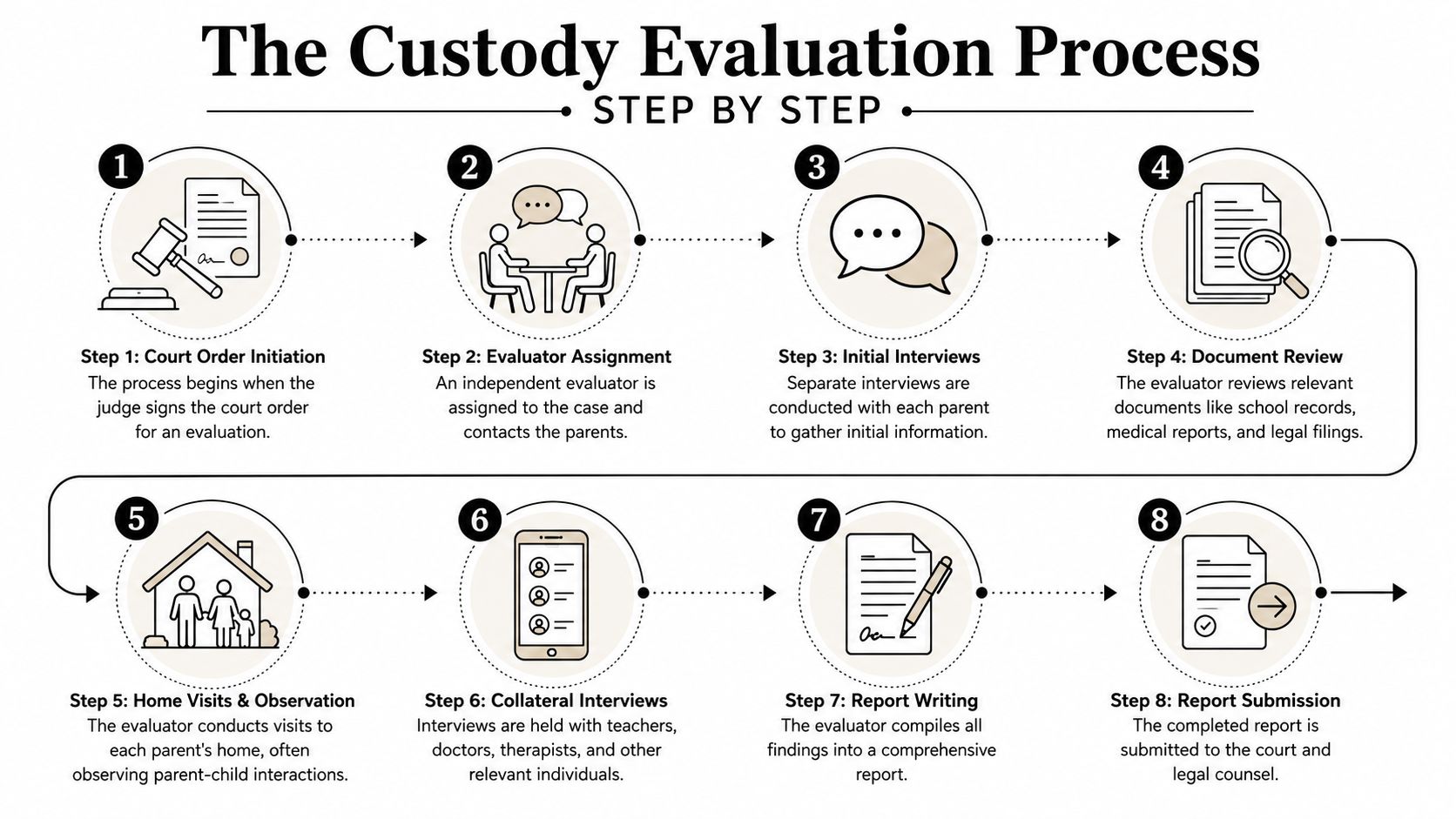
The evaluation starts when the court enters the order and assigns the evaluator. From there, the process usually unfolds in stages, and knowing the sequence can keep the experience from feeling chaotic.
The usual flow
- Court order and assignment. The judge signs the order, and the evaluator is officially assigned.
- Initial contact. The evaluator reaches out to the parents and schedules interviews.
- Parent interviews. Each parent meets separately with the evaluator and gives background, concerns, and parenting history.
- Child interviews. The child is interviewed in a developmentally appropriate way and outside the presence of the parties.
- Document review. Records such as school, medical, and legal documents are reviewed.
- Home visits. The evaluator observes the living environment and, in some cases, parent-child interaction.
- Collateral contacts. Teachers, doctors, therapists, and other relevant people may be interviewed.
- Report preparation and filing. The evaluator writes the report and submits it to the court.
A written report is typically filed with the court in about 90 days after assignment, according to the cited Texas authority on Section 107.109. That timing matters because parents sometimes assume the process will be over in a few weeks. It usually isn't.
If you need a place to keep school records, therapy notes, and other sensitive materials secure while you're preparing, File Studio for secure files is a practical option for organizing documents without leaving them scattered across your phone or email.
Helpful mindset: don't try to perform. Try to be consistent. Evaluators notice when a parent is trying to show the child's real routine instead of staging a perfect scene.
Texas courts rely on the written report, but they also know the report is one part of the bigger case. That's why document quality, calm communication, and honest answers matter at every step.
How to Prepare for Your Custody Evaluation
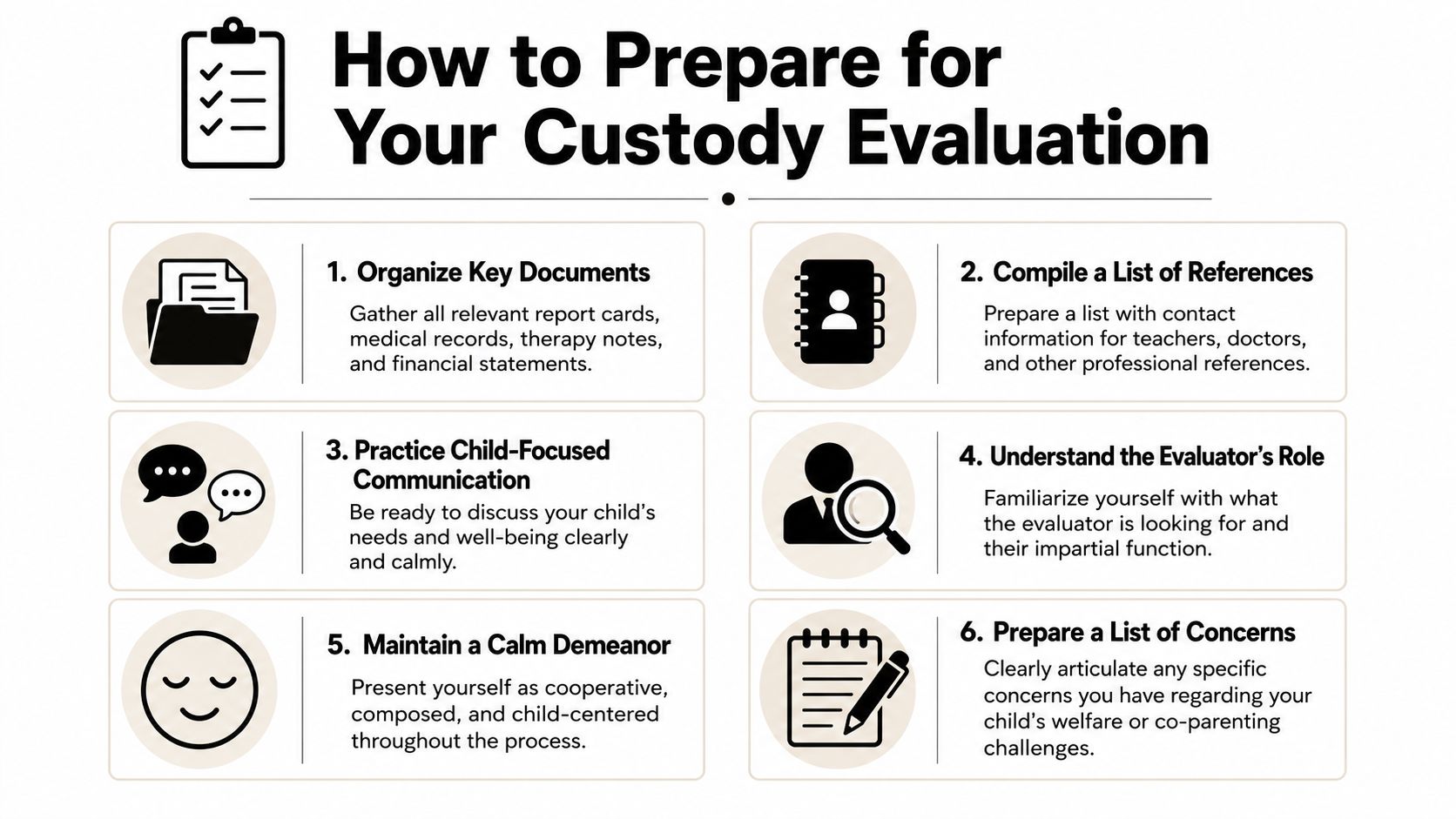
Preparation works best when it's practical. You don't need a script, and you don't need to over-explain every decision you've ever made. You do need to be ready to show how you parent on a normal day.
Start with your documents
Begin by gathering the records that show your child's life over time. That usually means report cards, medical records, therapy notes, school attendance information, and communication logs with the other parent. The more organized the records are, the easier it is for the evaluator to see patterns instead of isolated arguments.
A separate set of notes can help, too. Keep track of appointments, school events, and any changes in routines that affect your child. If your records are scattered, you'll spend interview time searching instead of explaining.
For a deeper look at how courts and evaluators think about evidence, the resource on what evidence matters most in a custody case can help you narrow your focus.
Prepare for the interview the right way
The evaluator will likely ask about your child's routines, your parenting history, discipline, school involvement, and how you handle conflict. Answer directly. If a question touches on the other parent, keep your response centered on the child's needs, not personal resentment.
A good rule is simple. If your answer sounds like a complaint you'd make to a friend, it probably needs to be rephrased. If it sounds like a decision you made to protect your child's stability, you're on the right track.
Keep the home calm and normal
Your home doesn't need to look like a magazine spread. It does need to be safe, clean enough for a child, and set up in a way that matches the child's age and routine. Think about sleeping space, daily routines, and basic organization.
Practical rule: the evaluator is looking for a stable home, not a staged one. Authentic order matters more than forced perfection.
Stay child-centered in every conversation
Your strongest message is that you know your child's needs and you're focused on meeting them. That includes recognizing the child's relationship with the other parent where it's healthy and safe to do so. Evaluators often pay attention to whether a parent can encourage that bond instead of turning the child into a messenger or referee.
If your case needs additional legal support while you prepare, The Law Office of Bryan Fagan, PLLC is one option for parents working through custody, visitation, and modification disputes. Whatever counsel you use, the main goal stays the same, present a clear picture of your parenting without trying to manufacture one.
The Evaluator's Report Costs and Your Legal Options
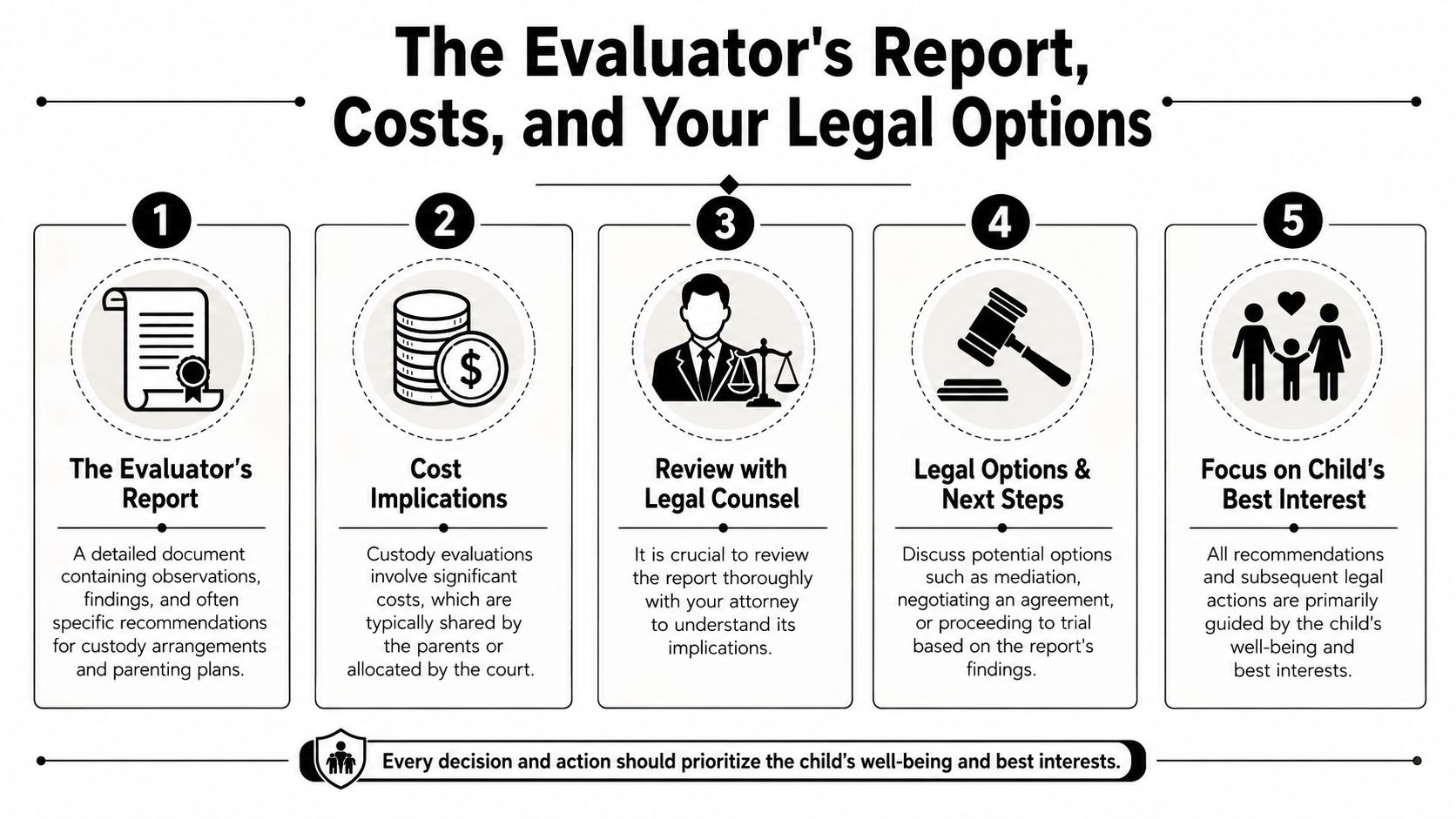
Once the interviews and review are complete, the evaluator submits a report to the court. That report usually summarizes the observations, the information gathered, and sometimes recommendations about conservatorship and possession. Judges often pay close attention to it because it packages a lot of information into one document.
What the report means, and what it doesn't
The report is influential, but it's not binding on the judge. That distinction matters. A judge can consider the report alongside live testimony, documents, and other evidence before entering orders.
The cost side matters too. Texas family-law sources commonly report fee estimates starting around $2,000 for disputed cases, and in especially complex matters they can rise to $10,000–$15,000. Harris County describes the process as resource-intensive, and Tarrant County's “last resort” language reflects that reality.
What to do if you disagree with the findings
Disagreement with the report doesn't mean you're out of options. You can work with your attorney to challenge weak conclusions, present contrary evidence, or use the hearing process to test the evaluator's opinions. The right response depends on what the report says and how it was built.
A careful review with counsel is important because some reports have gaps, rely on incomplete records, or miss context that matters to the child. In those situations, the answer is rarely anger. It's usually better evidence.
How legal strategy fits after the report
Sometimes the report opens the door to settlement because both sides can see the risks more clearly. Other times, it confirms that trial is the only path forward. If the findings suggest the current order no longer fits the child's needs, a custody modification may be worth discussing.
For parents trying to budget for that next stage, the information in child custody attorney fees can help frame the larger legal cost picture. Keep in mind that costs vary with the conflict level, the amount of evidence, and how much work the case requires.
A report can strongly influence the case, but it doesn't end the case. Your next move still matters.
Key Takeaways and Next Steps for Your Case
A custody evaluation in Texas is a serious, court-ordered investigation, not a casual interview and not a punishment. The evaluator is trying to help the court see the child's real world, including the stability of each home, each parent's role, and the practical details that affect daily life.
The best preparation is steady, child-focused, and honest. Organize your documents, keep your home calm and functional, and answer questions in a way that shows how you meet your child's needs. That approach works for mothers, fathers, grandparents, and other caregivers because the evaluator is looking for parenting patterns, not perfection.
If the report is unfavorable, you still have legal options. If it supports your position, you still need a plan for what comes next. Either way, a custody evaluation is only one part of the larger Texas family law process.
If you need help with a child custody or visitation case in Texas, our experienced attorneys can guide you every step of the way. Contact The Law Office of Bryan Fagan, PLLC today for a free consultation.
A CTA for Law Office of Bryan Fagan, PLLC.