
Supervised visitation is a court-ordered setting where a neutral third party watches parent-child contact. In Texas, courts order it under Family Code Chapter 153 when safety concerns, an abuse history, or a long gap in contact make unsupervised visits unsafe.
You may be reading this after a judge used unfamiliar words such as supervised possession, restricted visitation, or a supervised access order. You may be a mother trying to protect a child, a father fighting to preserve a relationship, or a grandparent hoping to rebuild contact. Whatever brought you here, feeling worried or embarrassed is understandable. Supervision can feel like a judgment about your parenting, but the order itself is designed to address safety while preserving family contact when possible.
Understanding Supervised Visitation in Plain English
A father has not seen his young child for a long time, while the other parent reports serious safety concerns. The judge may decide that ending contact would go too far, yet a private visit would pose too much risk. The court could order visits at a visitation center, with a neutral adult present for the entire interaction.
That is the practical meaning of what is supervised visitation. It is parent-child contact, usually involving a noncustodial parent and child, while a neutral third party monitors the visit. The arrangement creates a controlled setting when the court is concerned about abuse allegations, family violence, substance use, abduction, severe conflict, or a lengthy interruption in the relationship. A major review traces supervised visitation as a formal family-court service to 1982, followed by broader development through an international association of visitation providers according to the AFCC review.
The people involved
The noncustodial parent, sometimes called the possessory conservator, is the parent whose time with the child has been limited or conditioned. The custodial parent generally has the child in their care or exercises primary possession under the order. Texas law often uses conservatorship, possession, and access instead of the more familiar terms custody and visitation.
The supervisor is the neutral adult or professional who stays present, follows the written order, observes the interaction, and responds when a safety rule is violated. Professional standards describe supervision as maintaining visual and, when required, listening oversight throughout the visit, with authority to stop contact if necessary California Standards of Judicial Administration, Standard 5.20. In plain English, the supervisor should not leave the room or permit a private conversation that the order forbids.
What supervision is meant to accomplish
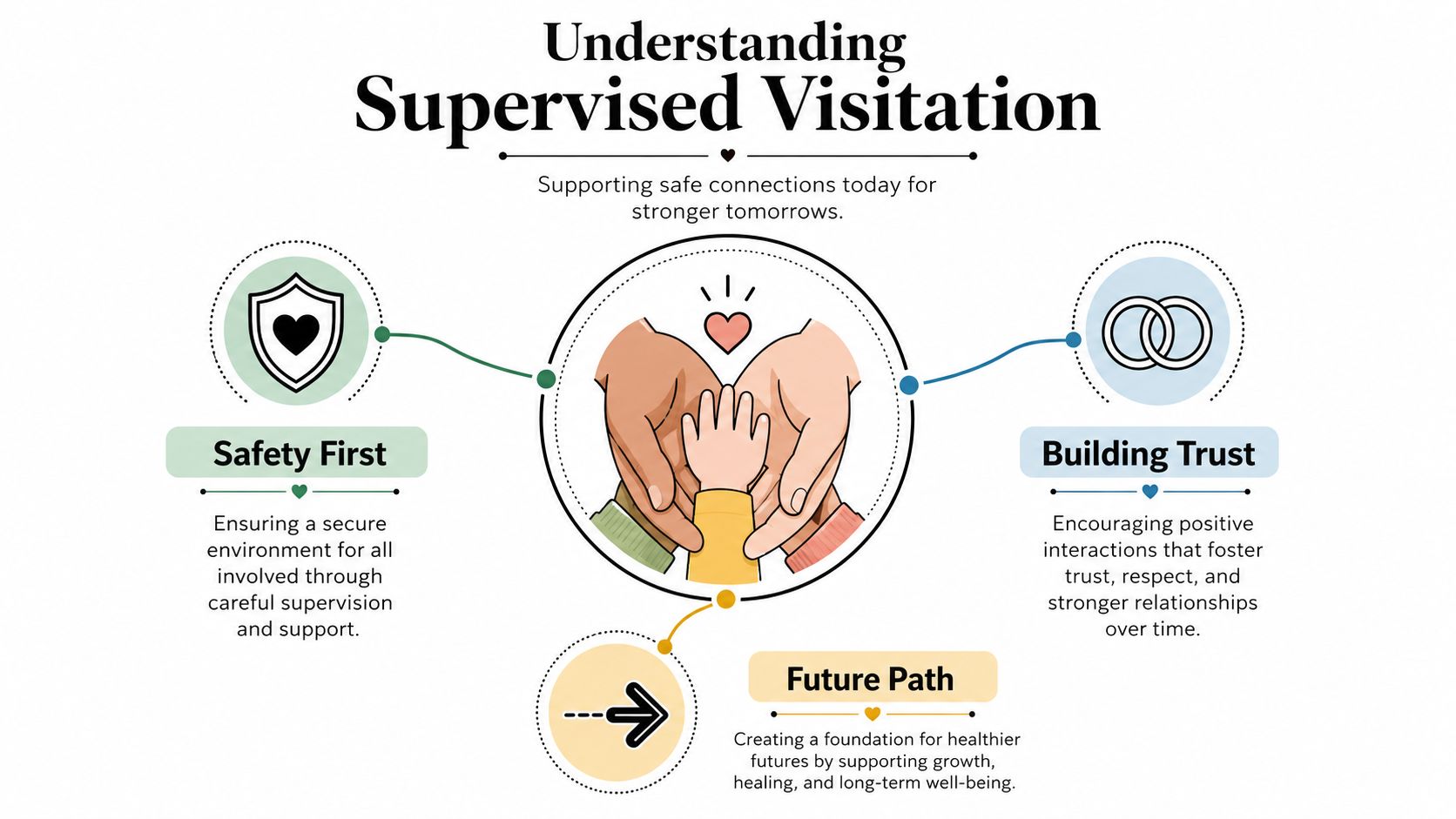
Supervised visitation does not automatically end a parent's parental rights. It means the court has selected a controlled form of contact because unsupervised possession isn't considered safe at that point. Each visit gives the parent an opportunity to follow the order, maintain a calm relationship, and address the concern that led to supervision.
Under Texas Family Code Chapter 153, conservatorship orders and possession schedules must center on the child's best interests. The judge considers safety, emotional needs, stability, and the child's relationship with each parent. A parent's preference matters, but it does not control the decision.
Supervision may be temporary, but the passage of time alone does not end it. The written order, proof that circumstances have changed, and the child's best interests determine whether the arrangement should continue, change, or end.
Types of Supervised Visitation in Texas
A court order may require a parent's contact with a child to occur under different forms of supervision. Read the wording carefully. Supervised visitation means someone observes the parent-child visit. Supervised exchanges usually monitor only the handoff, so the two arrangements do not provide the same protection.
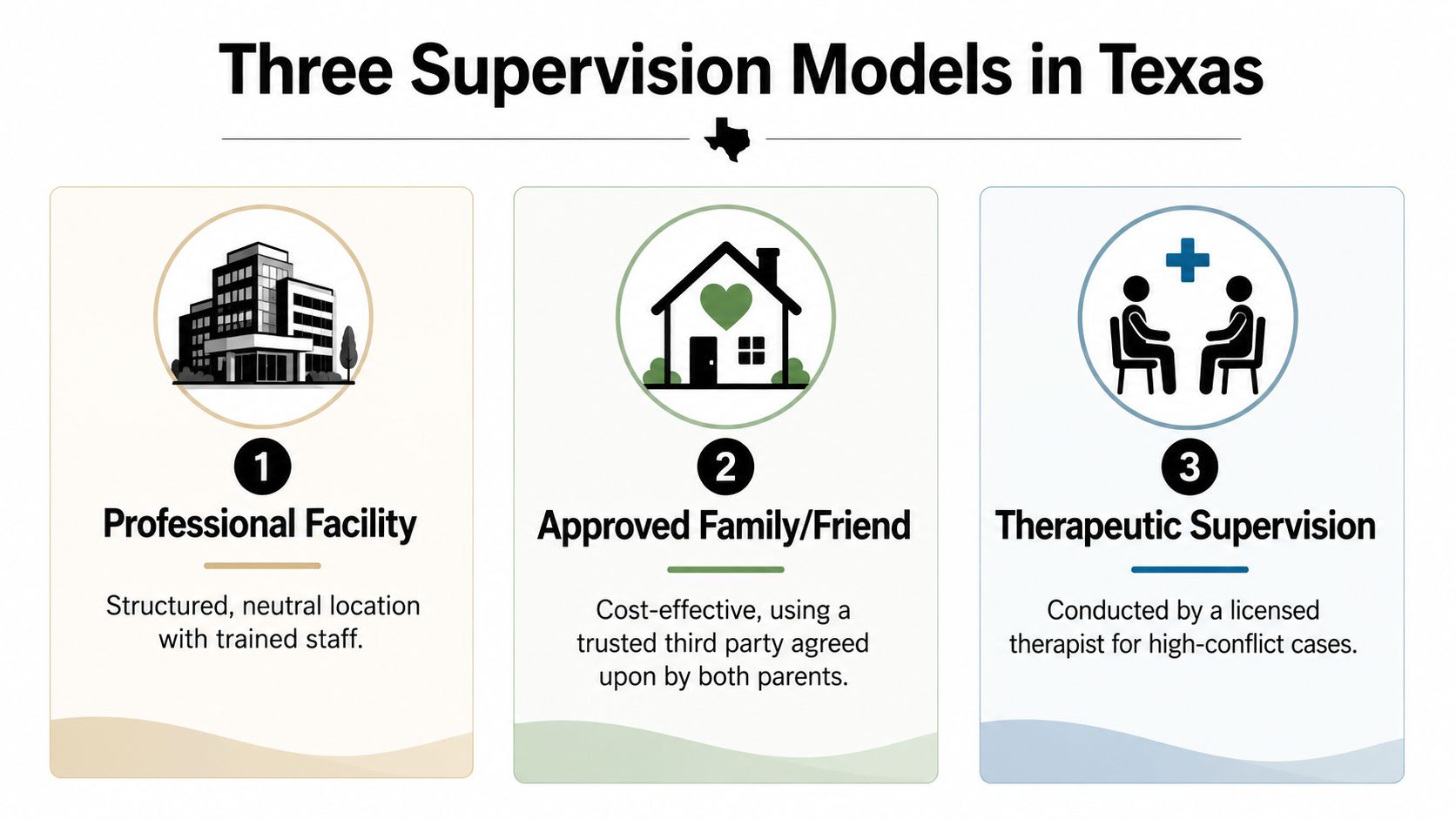
Professional visitation facilities
A professional facility offers a neutral setting and trained staff. The supervisor remains present throughout the visit, follows written safety procedures, and records factual observations. This model may suit a case involving serious allegations, threats, substance concerns, or intense conflict between the adults.
For example, a therapist or trained visitation provider might supervise a teenager's contact with a parent after abuse allegations. The facility separates the parents, gives staff authority to address violations, and reduces the chance that the child becomes part of an argument.
An approved relative or trusted adult
A supervisor may be an adult the parents agree on, someone familiar to the child, or a business that handles high-conflict parenting matters. A court-approved grandparent, aunt, family friend, or another trusted adult can work when that person remains neutral and intervenes when necessary, as described in Texas Access guidance through Texas Law Help.
A family supervisor may help a young child feel more comfortable. Familiarity alone is not enough. A relative who openly supports one parent may lack the neutrality the order requires. The supervisor must follow the written terms, report violations, and protect the child even when that creates tension within the family.
Supervised exchanges
A supervised exchange monitors the transfer from one parent to the other. It can keep the parents from meeting face-to-face, yet it does not necessarily place anyone in the room during parenting time. If the order requires continuous observation, an exchange monitor does not meet that requirement.
A standard possession schedule describes ordinary parenting time. A supervision order adds conditions specific to safety. For background on the default schedule, see The Texas Standard Possession Order Explained. Under Texas Family Code Chapter 153, including Sections 153.004 and 153.005, the court determines the supervision level based on the specific risk found and the child's best interests. A proposed order should use concrete language, such as requiring “continuous, in-person supervision by an approved provider during the entire visit,” rather than only stating that contact is supervised.
When Texas Courts Order Supervised Visitation
Texas courts use the best interests of the child standard when deciding possession and access. In practical terms, the judge weighs whether a proposed schedule protects the child while supporting a healthy relationship with each parent. Chapter 153 governs conservatorship, possession, and access, so a supervised arrangement usually appears as a specific condition within a temporary or final order.
Common safety concerns
A court may consider supervision when evidence points to:
- Family violence: A documented history of violence or credible threats can lead to restrictions designed to protect the child and the other parent.
- Abuse or neglect concerns: Allegations, findings, or other evidence involving physical, sexual, or emotional harm can make private visitation unsafe while the court evaluates the situation.
- Substance use: A parent's current alcohol or drug-related concerns may justify a sober adult's continuous presence.
- Abduction risk: Threats to take the child, refusal to return the child, or other facts may support tightly controlled contact.
- Long gaps in contact: A parent who has been absent may need a gradual process to reestablish a relationship.
- Severe conflict: When parents cannot exchange the child safely or repeatedly involve the child in disputes, the order may require a neutral provider.
The evidence should connect the concern to the child's safety or well-being. A parent asking for supervision should organize relevant records, messages, police reports, medical information, protective orders, witness testimony, or other admissible evidence. A parent opposing supervision should be prepared to answer the allegations and present evidence of safe parenting, treatment, compliance, or changed circumstances.
Temporary orders and final orders
Supervision can appear in temporary orders while a Suit Affecting the Parent-Child Relationship, commonly called a SAPCR, is pending. Temporary orders provide structure during the case and may change after a hearing or final trial.
A final order may also require supervision for a defined period, until a condition is met, or for as long as the court finds it necessary. Strong orders identify who supervises, where visits occur, whether the supervisor must maintain line-of-sight and hearing oversight, what conduct is prohibited, and what steps could support less restrictive possession.
Practical rule: Ask for clear wording. “Supervised visits” alone may not answer who supervises, where contact occurs, or what happens if the provider is unavailable.
Courts and providers rely on neutral, fact-based observations rather than conclusions about whether a parent is “good” or “bad.” That structure matters because research on supervised visitation remains inconsistent across jurisdictions, with differences in definitions, settings, and outcomes making broad effectiveness comparisons difficult 2023 review.
What Happens During a Supervised Visit
The first visit may feel tense. You may worry that every word and action will be judged. A clear routine helps: the court order sets the boundaries, and the provider's written rules explain how the visit will operate.
Before arrival
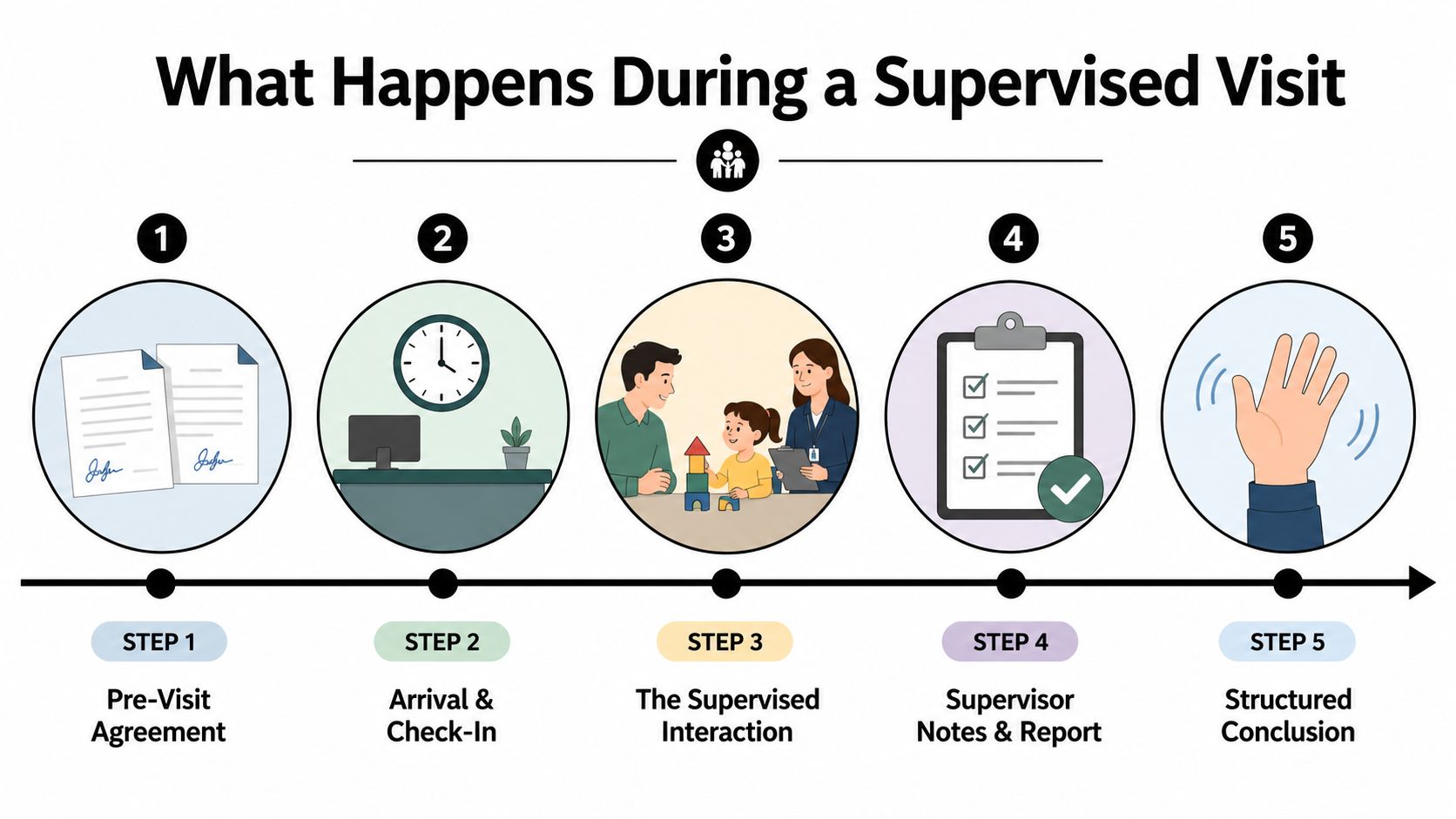
Read the order and complete the provider's intake process. Confirm the location, start time, identification requirements, approved adults, permitted activities, cancellation rules, and payment arrangements. Arrive early enough to check in without reducing the child's scheduled time.
Pack age-appropriate activities, permitted snacks, diapers, comfort items, medication, or other supplies the order allows. Leave weapons, alcohol, drugs, threatening messages, and prohibited items at home. Do not arrive impaired. Do not use the visit to discuss the lawsuit or ask the child to take sides.
During contact
The supervisor should stay close enough to see and hear the interaction if the order requires line-of-sight and hearing oversight. Ordinary activities are usually the focus: playing, reading, eating, helping with homework, or talking about daily life. The parent should not ask the child to carry messages, keep secrets, choose between parents, or report on the other household.
The supervisor can set ground rules, redirect conversation, document violations, stop unsafe conduct, and end the visit if immediate safety requires it. Supervisors typically operate under a risk-management protocol that gives them authority to redirect, document, and end visits for safety. Their role is separate from that of a mediator, therapist, or messenger.
After the visit
The provider may prepare a factual report covering attendance, start and end times, activities, statements, compliance with rules, and safety concerns. Those observations can later help the court assess whether the current arrangement remains appropriate. A report should describe what happened rather than argue that a parent is good or bad.
Keep the ending calm. Follow the approved transition process, and do not confront the other parent at the facility. If you believe the report contains an error, preserve messages, receipts, calendars, or other records and discuss the issue with counsel. Arguing with the child or supervisor can create another concern.
A custody evaluation or social study is a separate process and does not automatically decide the case. For an explanation of how that process differs, review this resource on Texas custody evaluations and social studies.
How to Request, Modify, or Enforce a Supervised Visitation Order
A parent may request supervised visitation in an initial SAPCR, during temporary orders, or in a later modification case. The request should identify the specific safety concern, explain how it affects the child, and propose terms a court and provider can follow. Clear motion language works like a safety plan. It tells everyone who may supervise, where visits may occur, and what conduct is prohibited.
Requesting supervision
A request may ask the court to name the supervisor, location, level of oversight, and prohibited conduct. For example:
Sample request language: “Petitioner requests that Respondent's periods of possession occur only in the continuous presence of a court-approved neutral supervisor who maintains line-of-sight and hearing oversight, at an approved visitation facility or another location ordered by the Court, until further order.”
The attorney should adjust this language to the facts and the evidence. A parent requesting supervision should organize records that support the stated concern. A parent opposing supervision should address credible safety issues directly, avoid minimizing them, and present evidence showing why a less restrictive schedule would protect the child.
Modifying supervision
Texas courts generally require proof that a change serves the child's best interest and that the circumstances of the child, a conservator, or another affected person have materially and substantially changed. The court will not usually end supervision just because a parent wants a regular possession schedule. For an overview of Texas modification standards, see Texas custody modification guidance.
Useful evidence may include provider reports, completed counseling or treatment, proof of compliance with the existing order, stable housing, safe prior visits, and testimony from qualified witnesses. Texas law also provides specific pathways involving a child who is at least 12 and communicates a preference to the judge in chambers, or a primary custodian who has allowed another person to provide primary care for at least 6 months. Texas Law Help explains these statutory considerations in its guidance on material and substantial changes for custody modification suits.
| Trigger | What the parent must show | Typical outcome |
|---|---|---|
| Safety concern has improved | Reliable evidence that the risk has changed and a new arrangement serves the child | The court may reduce supervision or change conditions |
| Child expresses a preference in chambers | The statutory requirements apply and the change remains in the child's best interest | The judge may consider a modified possession arrangement |
| Another person provided primary care | The applicable statutory pathway and best-interest standard are satisfied | The court may review conservatorship or possession |
| Order violation | The violation, the order's terms, and the effect on the child or parenting schedule | The court may enforce, clarify, or modify the order |
Enforcing the order
Do not rewrite the order yourself. If the other parent arrives intoxicated, seeks private contact, refuses provider rules, or takes the child outside the approved arrangement, preserve messages, reports, photographs, calendars, and other records. Report the conduct through the provider's process, your attorney, or the court, depending on the order and the immediate safety concern. A step-by-step guide to enforcing a custody order in Texas can help you identify the appropriate next action.
Costs, Providers, and Who Pays in Texas
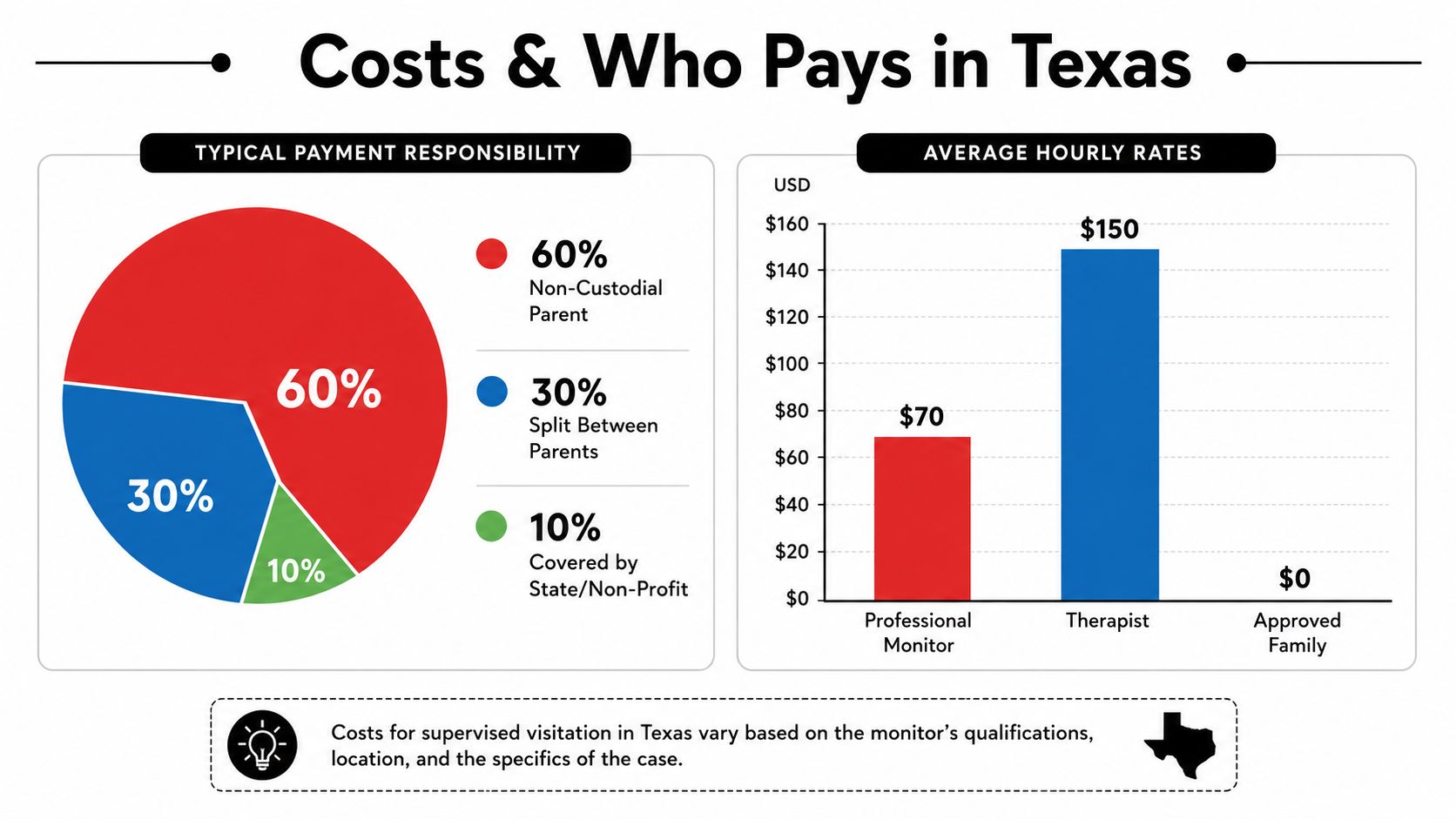
A parent may agree to supervised visitation, then discover that the provider's fees, travel time, and scheduling rules make visits difficult to maintain. In Texas, cost depends on the provider, supervision model, location, and wording of the order. A professional center may charge for each visit, while an approved relative may reduce or eliminate provider fees. Texas guidance explains that one or both parents may be assigned facility costs, so the order should state who pays and when, rather than leaving the issue to assumptions Texas Access through Texas Law Help.
Supervised visitation programs also serve more than the visiting parent and child. A Florida statewide report recorded 1,844 referred cases, 7,022 clients served, and 31,682 services provided from October 1, 2020, through September 30, 2021. The participants included 3,129 children, 1,998 visitors, and 1,895 custodians or others, showing why a provider's staffing, records, and administrative fees can affect the entire arrangement Florida statewide database report.
The same report cited an Ontario pilot study with an average cost per visit ranging from $15 to $309 and estimated that about 3 in 10,000 people used the service. Those figures do not establish Texas prices. They do show why parents should ask for a written fee schedule, cancellation policy, transportation requirements, and payment terms before accepting a proposed provider.
Compare the practical options
| Provider option | Main benefit | Main concern |
|---|---|---|
| Professional facility | Neutral setting, trained staff, structured records | Fees and scheduling may create barriers |
| Approved family member or friend | Familiar setting and potentially lower cost | The supervisor must stay neutral and enforce the order |
| Therapeutic provider | Clinical support for complicated parent-child needs | Availability and fees can vary |
| Court-approved alternative | May fit unusual family circumstances | The order must define authority and reporting duties |
If a facility is unaffordable, tell the court promptly. Ask for nonprofit or sliding-scale services, an approved adult supervisor, a different payment allocation, or a schedule that reduces unnecessary visits and travel. Request those terms in writing. Skipping visits because of cost can create a separate problem, while a specific request gives the judge a chance to set a workable arrangement.
Safety Considerations and Special Family Situations
A good supervision order responds to the family's actual safety problem. For a military parent returning from deployment, the plan may need a gradual reintroduction that respects the child's comfort and the parent's schedule. For a relocation dispute, neutral supervision can help maintain contact while the court evaluates travel, distance, and stability.
Grandparents also need a careful legal analysis. A grandparent may seek possession, access, or conservatorship under Texas law, but the standard and facts differ from a parent's request. A supervisor should keep the child out of adult conflict and should never use visits to pressure the child to reject a parent.
Children often understand more than adults realize. Use age-appropriate language, avoid blame, and explain that the supervising adult is there to help keep visits safe. Parents may find practical guidance in this resource on talking to kids about divorce.
Planning for emergencies and violence
If domestic violence is part of the case, the order should address safe arrival and departure, communication boundaries, exchange locations, and what happens if a threat occurs. A parent may need protective relief in addition to custody terms. For more context, review custody, family violence, and protective orders inside a SAPCR.
Keep copies of incident reports, provider communications, missed-visit records, and emergency documentation. If visits repeatedly create danger or emotional harm, seek legal advice promptly rather than changing the schedule on your own. The court can evaluate whether supervision should be strengthened, modified, or ended.
Frequently Asked Questions and Next Steps for Texas Parents
Can supervised visitation be lifted? Yes, but a parent generally must show a material and substantial change and that modification serves the child's best interest.
How long does it last? The order controls. It may be temporary, conditional, or continue while safety concerns remain.
Can a child be forced to attend? Follow the court order. A child's fear or refusal should be reported through appropriate legal channels, not handled by ignoring the order.
What if the supervisor reports concerns? Preserve your records and speak with an attorney before responding in court.
Key takeaway: Supervised visitation protects children while preserving contact when private visits aren't safe. Read every term, follow it carefully, address the concern behind the order, and seek a modification through the court when circumstances change.
If you need help with a child custody or visitation case in Texas, our experienced attorneys can guide you every step of the way. Contact Law Office of Bryan Fagan, PLLC for a free consultation about requesting, defending against, modifying, or enforcing supervised visitation.