
The Standard Possession Order is Texas's default visitation schedule when parents can't agree, and in its most common form it gives the non-primary parent the first, third, and fifth weekends of each month. For parents who live within 100 miles of each other, that usually also includes a Thursday evening from 6:00 p.m. to 8:00 p.m. during the school year and a 30-day summer period.
When you're living through a divorce, custody case, or post-separation dispute, that answer can feel both relieving and overwhelming. Relieving because there is a default rule. Overwhelming because legal words like “possession,” “conservatorship,” and “standard order” don't sound much like real family life.
Most parents aren't asking for legal jargon. They're asking, “When will I see my child?” “Who gets spring break?” “What if there are five weekends in a month?” “What happens if we live far apart?” Those are practical questions, and Texas law does give practical answers.
Navigating Your New Normal A Parent's Introduction
A lot of parents first look up what is the standard visitation schedule in Texas late at night, after a hard conversation, after being served papers, or after realizing they may not see their child as often as they assumed. The fear underneath that search is usually simple. You want to stay close to your child, and you don't want confusion to damage that relationship.
Texas family law tries to create a starting point for that uncertainty. A possession order is the court's roadmap for when each parent has time with the child. It operates as a shared family calendar, made legally enforceable. It doesn't fix every emotion in the room, but it can reduce guesswork and lower conflict.
Parents often tell me the schedule feels abstract until they picture real life. School pickup. Soccer practice. Thursday dinner. A July vacation. Once you place the order onto an actual calendar, it starts to feel less like a legal document and more like a routine your child can count on.
A clear schedule won't erase the pain of separation, but it can give your child a sense of stability and give you a path forward.
That emotional side matters. If you're trying to talk with your child about changes at home, this expert advice for difficult family changes can help you choose words that feel calm, age-appropriate, and reassuring.
Here's the good news. You don't need to memorize the entire Texas Family Code to understand your rights. You need to know the basic terms, know how to read the calendar, and know what steps to take if the default schedule doesn't fit your family.
Understanding Texas Custody and Visitation Basics
Texas custody terms can feel intimidating at first because the labels are formal, but the ideas underneath them are practical. Once you translate the vocabulary into daily life, your order starts to read less like a legal document and more like instructions for school nights, doctor visits, and who handles the big decisions.
Conservatorship means decision-making
In Texas, conservatorship is the legal term for custody. It defines who has the right to make important choices for a child, such as decisions about education, medical care, counseling, and other major parts of the child's life.
This is the part of a case that answers, "Who gets to decide?"
Sometimes parents share many of those rights. Sometimes one parent has the exclusive right to make certain decisions, especially the decision about the child's primary residence. That split can confuse parents because shared conservatorship sounds like a 50-50 schedule, but Texas law does not use those terms interchangeably.
Two labels show up in many orders:
- Joint Managing Conservator usually means both parents share many rights and duties, even if one parent has the exclusive right to determine where the child lives. The presumption favoring shared decision-making is explained in Joint Managing Conservatorship in Texas.
- Sole Managing Conservator means one parent holds more of the major legal authority. Courts use this arrangement in cases where shared decision-making would not protect the child's best interests.
A useful way to read this is simple. Conservatorship tells you who holds the steering wheel on major life choices. It does not tell you how many overnights each parent gets.
Possession means parenting time
Possession is the Texas word for the schedule itself. It answers a different question: "When is the child with each parent?"
That is why a parent can have meaningful time with a child without holding every major decision-making right, and why a parent with important legal rights may still follow a set possession schedule. The two ideas work together, but they do different jobs.
For parents trying to understand the non-primary parent's role in plain English, this guide on what a possessory conservator is in Texas helps connect the legal term to real parenting time.
This distinction matters in everyday life. One part of your order governs who signs off on major choices. Another part maps out Thursday evenings, weekends, holidays, and exchanges. Reading those parts separately often makes the whole order much easier to follow.
Best interests of the child means the child comes first
Texas courts decide conservatorship and possession based on the best interests of the child. In everyday terms, the judge is looking for the arrangement that best supports the child's safety, stability, emotional health, education, and routine.
Practical rule: Judges focus on what helps the child function and feel secure, not on keeping score between parents.
That standard shapes almost every custody decision. A parent asking for more weekday time, a parent asking for decision-making authority, and a parent asking for a schedule that fits the school calendar are all measured by the same question. Does this arrangement serve the child well in real life?
Understandably, many parents feel overwhelmed, and that reaction is normal. The legal phrases sound abstract until you place them on a family calendar and connect them to ordinary moments: homework, bedtime, pickup lines, medication, birthday plans. Once you do that, the order becomes easier to understand and easier to follow.
The Texas Standard Possession Order Explained
Your court order may call it the Standard Possession Order, or SPO. In daily life, it is the schedule that answers the questions parents ask every week: Who has this weekend? Is there a Thursday visit? What happens when the month has five Fridays?
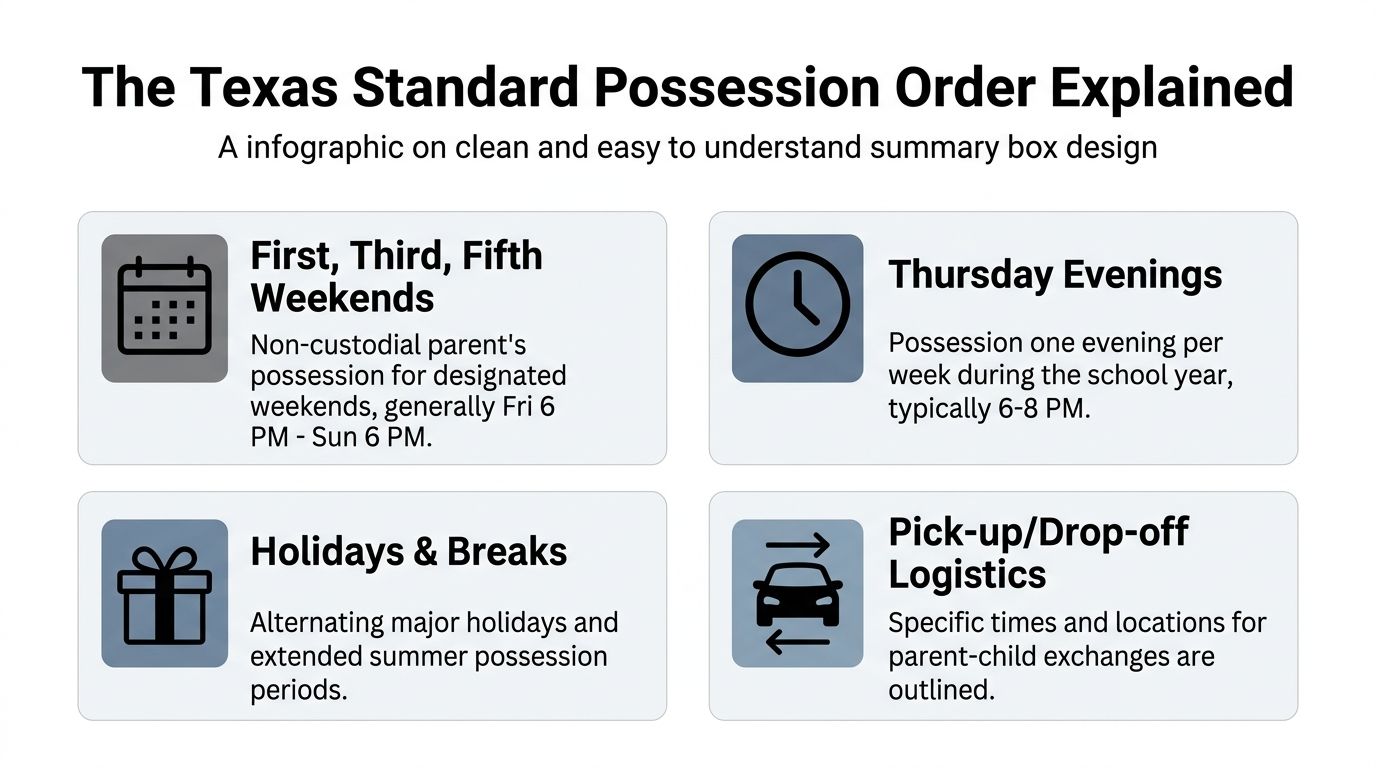
Under Texas law, the standard schedule usually gives the noncustodial parent possession on the first, third, and fifth weekends of each month from 6:00 p.m. Friday to 6:00 p.m. Sunday, plus a Thursday evening from 6:00 p.m. to 8:00 p.m. during the school year under Texas Family Code sections 153.312 through 153.317 as summarized here. Reading that in legal form can feel stiff. Put it on a calendar, though, and the pattern starts to make sense.
A visual summary can make the order easier to digest.
How to count first third and fifth weekends
This is one of the most common sticking points for parents. The weekends are not assigned by alternating back and forth forever. They are counted fresh each month.
The easiest way to read the calendar is to focus on Fridays:
- Find every Friday in the month.
- Count them in order as first, second, third, fourth, and fifth.
- Match possession to the first, third, and fifth Friday.
So if a month has five Fridays, the non-primary parent gets three weekends that month. That can lead to back-to-back weekends near the end of one month and the start of the next. Parents often assume that must be a mistake. Usually, it is just how the calendar falls.
What a normal school-year week looks like
For many families, the SPO works like a base calendar with a few repeating blocks. One block is the weekend pattern. Another is the short Thursday period during the school year. That Thursday time may seem small on paper, but in real life it can mean dinner, homework help, a school project, or just regular face time that keeps the child connected to both homes.
Summer adds another layer. For parents who live within 100 miles, the standard order typically gives the noncustodial parent 30 consecutive days of summer possession. If different dates are not chosen by April 1, the default period is July 1 through July 31.
A more detailed explanation of how the longer version works is available in this guide to the expanded standard possession order in Texas. If you want a more technical reading of the traditional schedule itself, The Texas Standard Possession Order explained walks through how lawyers and courts usually read these provisions.
A short video can also help if you learn better by hearing the schedule explained out loud.
Why this schedule exists
The standard order gives families a predictable rhythm. That matters because children usually do better when pickup times, school-night contact, and weekend routines are settled in advance rather than renegotiated every few days.
If the legal wording still feels intimidating, translate it into ordinary events. Friday pickup. Sunday return. Thursday dinner. Summer dates chosen by spring. Once those pieces are placed on a real calendar, the SPO stops feeling like courtroom language and starts looking like a plan you can follow.
Expanded Schedules and Long Distance Possession
A parent in Dallas and a parent in Fort Worth may follow one pattern. A parent in Houston and a parent in El Paso may follow another. The Texas schedule changes with distance because a child can only handle so many school-night drives, packing routines, and long car rides before the calendar starts working against the child instead of for the child.
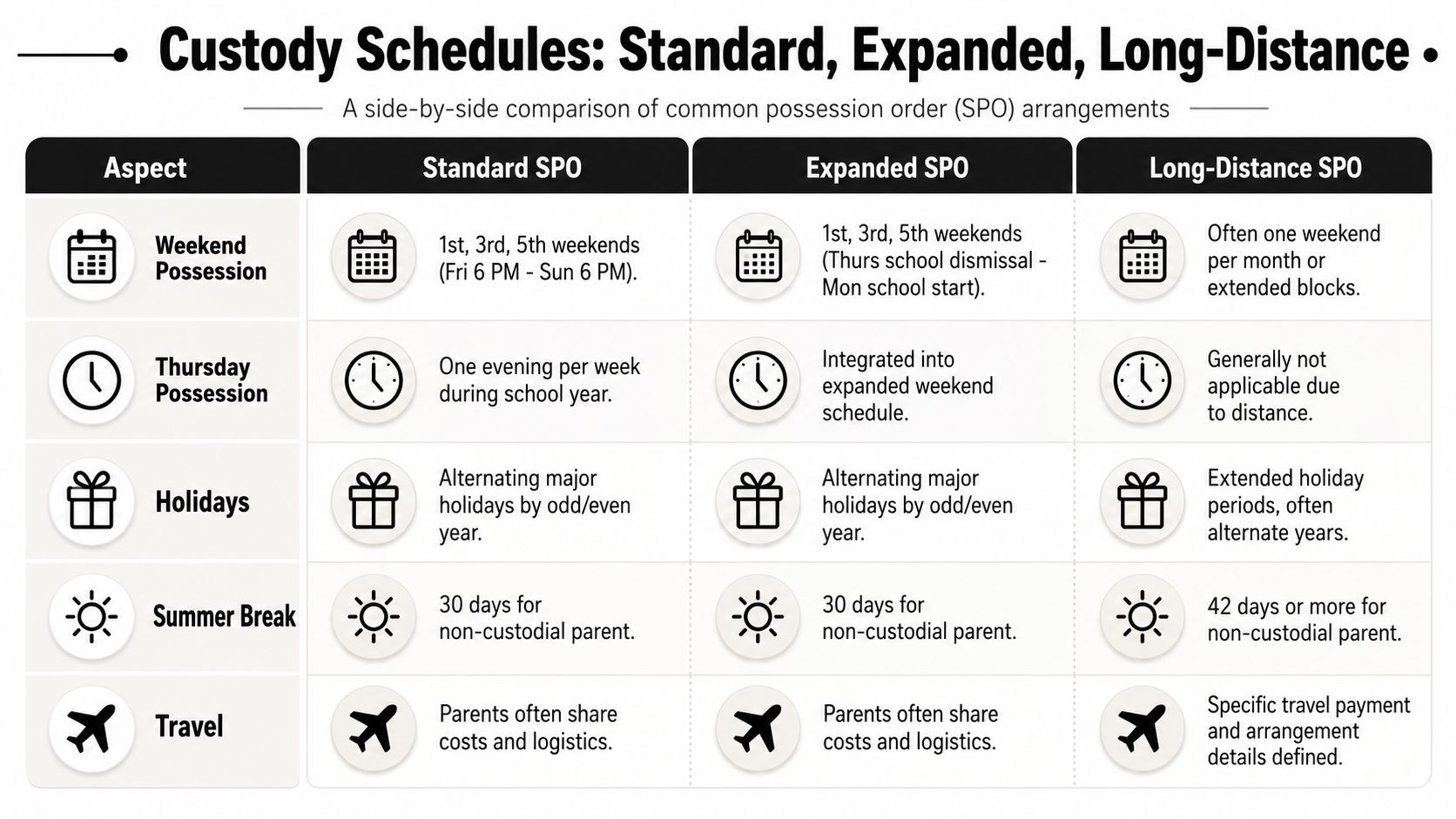
This side-by-side view helps.
Under 50 miles
For parents who live close to each other, the schedule often allows more frequent exchanges because school pickup, bedtime, and weekday routines are easier to manage. According to this Texas family law overview of the Expanded Standard Possession Order, a change scheduled for September 1, 2025 makes the Expanded Standard Possession Order the default for parents living within 50 miles of the child.
In practical terms, the expanded version usually means the non-primary parent gets more ordinary parenting time, not just “visit” time. Weekends typically stretch from Friday at school dismissal to Monday when school resumes, and the Thursday period becomes an overnight that lasts until school resumes Friday.
That detail matters more than it may seem at first. A Thursday overnight can mean homework at your house, getting school clothes ready in the morning, and taking your child back to school yourself. A longer weekend can mean one less rushed handoff and more time for regular family life.
This overview of the Expanded Standard Possession Order in Texas shows how that newer format reads on paper and how many parents translate it onto a real calendar.
Between 50 and 100 miles
This range causes confusion because parents are close enough for regular contact, but not always close enough for frequent school-night exchanges to be realistic. The court may still use the traditional standard structure unless the order says something different.
The safest approach is simple. Read the mileage language in your order, then read the pickup and return terms line by line. Two families can both say they have a “Texas standard schedule” and still have very different calendars once distance and special provisions are factored in.
Over 100 miles
Long-distance possession usually trades frequency for longer blocks of time. The same guide also states that when parents live more than 100 miles apart, the noncustodial parent may choose one weekend per month instead of three, with longer possession periods at other times of year.
It also states that long-distance orders can provide 42 consecutive days of summer possession. That approach works like batching errands into one trip instead of making the same drive over and over. Fewer exchanges can reduce travel strain on the child, while longer stretches give the parent meaningful time to settle into a real routine.
Here is the practical tradeoff:
- Closer-distance schedules usually allow more frequent contact and more school-week involvement.
- Long-distance schedules usually reduce exchanges and increase extended time during breaks.
- Your signed order controls even if a friend in a similar situation follows a different pattern.
Distance does not reduce the importance of the parent-child relationship. It changes the structure of possession so the schedule is more workable for the child.
For many parents, this is the point where legal wording starts to feel personal. That is normal. The better question is not just “How much time do I get?” but “How will this schedule work on a school calendar, with this drive, for this child?” Once you put the order on an actual calendar and map the exchanges, the logic behind the distance rules becomes much easier to see.
Holiday Schedules Summer Breaks and Special Cases
A lot of parents feel comfortable once they understand the first, third, and fifth weekend pattern. Then the first school break or major holiday arrives, and the whole schedule suddenly feels less predictable.
That reaction makes sense. The Texas Standard Possession Order works like a layered calendar. Your regular weekends are the base layer. Holidays, school breaks, and summer elections sit on top of it and can replace the usual pattern for those dates.
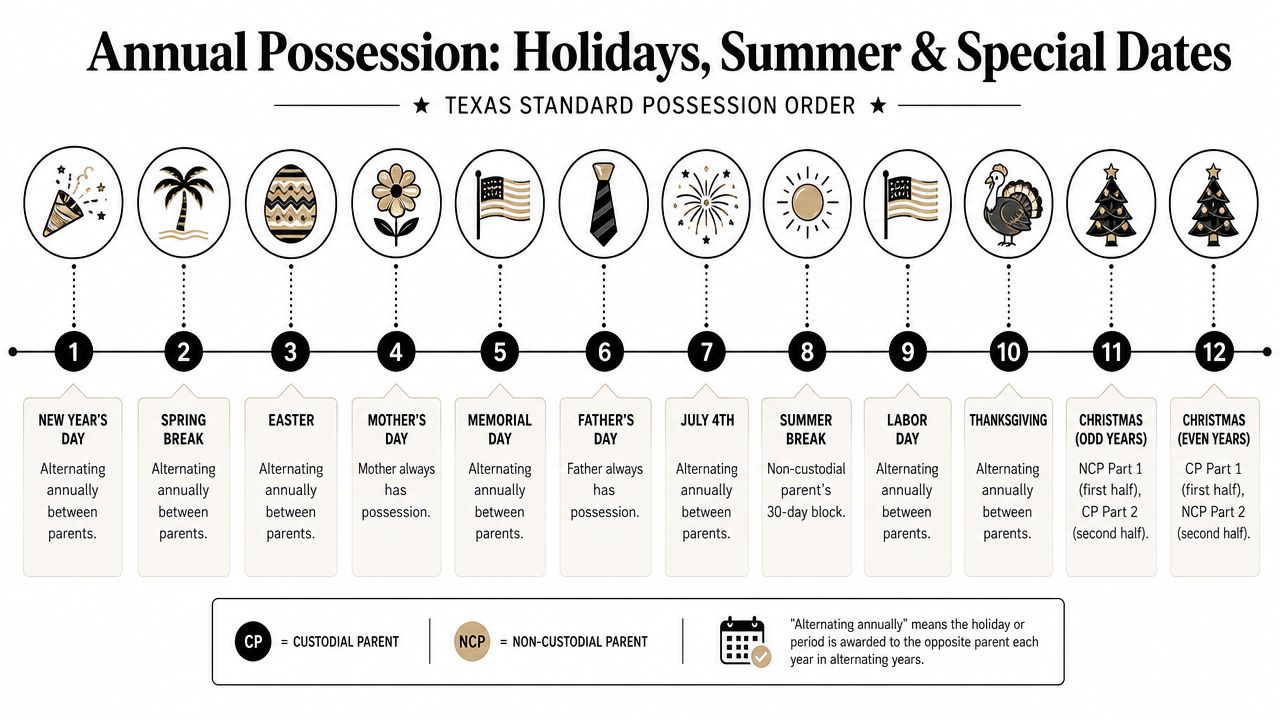
How holiday possession usually works
Texas uses an alternating holiday structure. According to Texas Law Help's explanation of possession orders, the Standard Possession Order rotates certain holidays by year, and spring break is commonly assigned to the noncustodial parent in even-numbered years.
The point that trips parents up is simple. A holiday period usually overrides the normal weekend schedule. So even if a weekend would ordinarily belong to one parent, the holiday schedule may give that time to the other parent instead.
Reading the order on a wall calendar often helps more than reading it as a block of legal text. Mark regular weekends first. Then add spring break, Thanksgiving, and the winter holiday periods in a different color. Once you do that, the schedule usually starts to look much more logical.
Common areas of confusion include:
- Spring break, which often rotates by year
- Thanksgiving and winter holidays, which typically alternate between parents
- Regular weekends that disappear or shift because a holiday period controls
- Exchange times tied to school dismissal or return dates, rather than a parent's work schedule
This practical guide to the Texas holiday possession schedule can help turn those legal rules into a real family calendar.
Summer choices and deadlines
Summer possession affects real-life planning more than almost any other part of the order. Vacations, camps, family reunions, and childcare arrangements often depend on getting these dates right.
Many orders let a parent choose summer dates by giving notice before a stated deadline. Missing that deadline can mean the default summer period applies instead. In other words, the calendar may make the decision for you if you do not make it on time.
A simple habit can prevent a lot of conflict. Put every notice deadline from your order into your phone calendar at the start of the year, with reminders set a few weeks early.
When the standard schedule may not fit
The Standard Possession Order is a common starting point, but it is not automatic for every child. Texas Law Help also notes that the presumption favoring the SPO does not apply to children under 3 years old.
That matters in daily life. Babies and toddlers often do better with shorter, more frequent contact, especially when sleep routines, feeding schedules, or bonding concerns are still developing. A custom schedule may also make more sense for a child with special needs, a parent in military service, or a parent whose work hours do not line up with the default exchange times.
Courts still come back to the same question in those cases. What schedule serves the child's best interest in this family, with this child, and under these circumstances? The Best-Interest Standard and the Holley Factors explains that legal framework in plain English.
The default order gives many families a workable structure. Your signed order may still need adjustments that fit your child's age, routine, health needs, and school calendar.
How to Read Your Order and Avoid Common Pitfalls
Many custody disputes don't start with bad intentions. They start with two parents reading the same sentence differently.
Words that often cause problems
Court orders use precise phrases. Those phrases matter. If your order says possession begins “at the time school is regularly dismissed,” that usually does not mean “whenever the parent is free after work.” It means the school-day dismissal point controls.
Likewise, if your order gives the first, third, and fifth weekends, don't convert that into an every-other-weekend system in your head. Those are not always the same thing.
A few trouble spots come up repeatedly:
- Miscounting weekends because a month has five Fridays.
- Ignoring holiday overrides and assuming the normal weekend still applies.
- Missing notice deadlines for summer choices or long-distance elections.
- Arguing over exchange details because the order names a place or time one parent hasn't read carefully.
Read it like a checklist
The easiest way to read a possession order is to break it into categories instead of trying to absorb it all at once.
| Part of the order | What to look for |
|---|---|
| Regular weekends | Which weekends apply and when they start and end |
| Weekday time | Whether there is a school-year evening or overnight period |
| Holiday provisions | Which holidays override the normal schedule |
| Summer possession | Election rights, deadline dates, and default dates |
| Exchange terms | Pickup time, drop-off time, and location |
Print a calendar and mark each category in a different color. That sounds simple, but it prevents a lot of conflict. Your child shouldn't have to feel the tension created by calendar confusion.
Keep communication practical
If you and the other parent disagree about the wording, go back to the order before you go back to old arguments. Focus on the text, the dates, and the child's schedule.
Good habits help:
- Confirm in writing when a holiday or summer period is approaching.
- Use the order's language instead of emotional shorthand.
- Save a marked calendar for your records.
- Ask for legal clarification early if the wording is unclear.
Small misunderstandings turn into larger conflicts when parents rely on assumptions instead of the signed order.
For some families, creating a written parenting plan helps reduce those avoidable clashes. A resource like Parenting Plans in Texas Custody Cases can be useful when parents need clearer structure around exchanges, routines, and decision-making.
If legal language still feels hard to decode, professional guidance can help. The Law Office of Bryan Fagan, PLLC handles custody, visitation, modification, and enforcement matters in Texas, which can be relevant when a parent needs help interpreting or applying a signed order.
Your Next Steps Modifying or Enforcing a Schedule
Sometimes the standard schedule works well at first and stops working later. A child starts school. A parent relocates. Work hours change. A young child grows into a different routine. In those situations, Texas law may allow a modification of the order if the facts support it and the change serves the child's best interests.
Other times, the problem isn't the wording. It's that one parent won't follow it. If a parent repeatedly denies possession, changes exchange times without agreement, or refuses to return the child as ordered, the issue may call for enforcement.
When modification may make sense
A modification request usually focuses on changed circumstances and on why a different arrangement would better fit the child's current needs. Parents often wait too long because they hope the problem will solve itself. Sometimes it does. Often it doesn't.
You may need to look at modification if:
- Distance has changed and the original exchange pattern no longer makes sense.
- The child's needs have changed because of age, school, health, or routine.
- A parent's work or military obligations now interfere with the schedule.
- The current order creates repeated conflict that harms stability.
When enforcement may be the better path
If the order is clear and the other parent isn't following it, changing the order may not be the first answer. Enforcing it may be. That can involve documenting missed exchanges, saving written communications, and getting legal advice about the proper next filing.
The key is this. You don't have to choose between doing nothing and starting a fight. There is a middle path. You can take calm, organized legal steps aimed at restoring consistency for your child.
Key Takeaway
The answer to what is the standard visitation schedule in Texas depends on the wording of your order, the distance between parents, and whether holiday or summer provisions override the normal pattern. For many families, the starting point is still the familiar first, third, and fifth weekends, but the primary task is learning how that legal rule translates into your child's actual calendar.
If you're a mother trying to protect routine, a father trying to stay meaningfully involved, a grandparent seeking clarity, or a caregiver helping a child through change, the most important next step is to read the signed order closely and get guidance before a misunderstanding turns into a larger dispute.
If you need help with a child custody or visitation case in Texas, our experienced attorneys can guide you every step of the way. Contact The Law Office of Bryan Fagan, PLLC today for a free consultation.