
When your child needs to be enrolled in school, taken to the doctor, or kept on a steady routine between two homes, legal labels suddenly feel very personal. Many parents come looking for one simple answer to one urgent question. What rights does a custodial parent have in Texas?
In Texas, the answer starts with a word that often confuses families: conservatorship. Texas courts usually use that term instead of “custody.” The language is different, but the actual issue is the same. Who has the authority to make decisions, provide stability, and protect the child's day-to-day life?
If you're trying to sort out an informal arrangement, dealing with a difficult co-parent, or wondering whether your current order protects you, you're not overreacting. These concerns are common, and they matter. A parent can feel “in charge” in everyday life and still have legal gaps that create real risk.
A good place to start is understanding how parental rights in Texas work in practice. Once you know which rights come from a court order, which rights are shared, and which rights are exclusive, you can make decisions with much more confidence.
When Your Child's Future Is on the Line
A lot of parents are living in the gray area when they first ask about custody. The child has been staying mostly with one parent. School pickup is routine. Medical appointments are handled. Family members may even describe that parent as the “custodial parent.” But if no judge has signed an order, that daily reality may not be legally protected.
That's why this topic matters so much. Rights involving children aren't just about labels. They affect where your child lives, who can receive child support, how parenting time works, and what happens when the other parent suddenly disagrees.
Texas also approaches these cases with a child-focused standard called the best interest of the child. In plain English, that means the court looks at what arrangement supports the child's safety, stability, and healthy development, not what feels most convenient or most fair to the adults. That standard runs through Texas Family Code Chapter 153 and shapes how judges make conservatorship and possession decisions.
Your role in your child's life may already be clear to you. The court still needs that role clearly written into an enforceable order.
Parents often feel intimidated by the legal terms. They shouldn't. Once those terms are translated into normal language, the system becomes easier to follow. You don't need to memorize statutes to protect your child. You need to understand which rights are automatic, which rights must be awarded, and which rights can disappear if they're never formalized.
Understanding the Language of Texas Custody
Texas family law uses precise language, and that language matters. If you hear “custody,” the court is usually talking about conservatorship. Conservatorship is the legal framework that defines each parent's rights and duties.
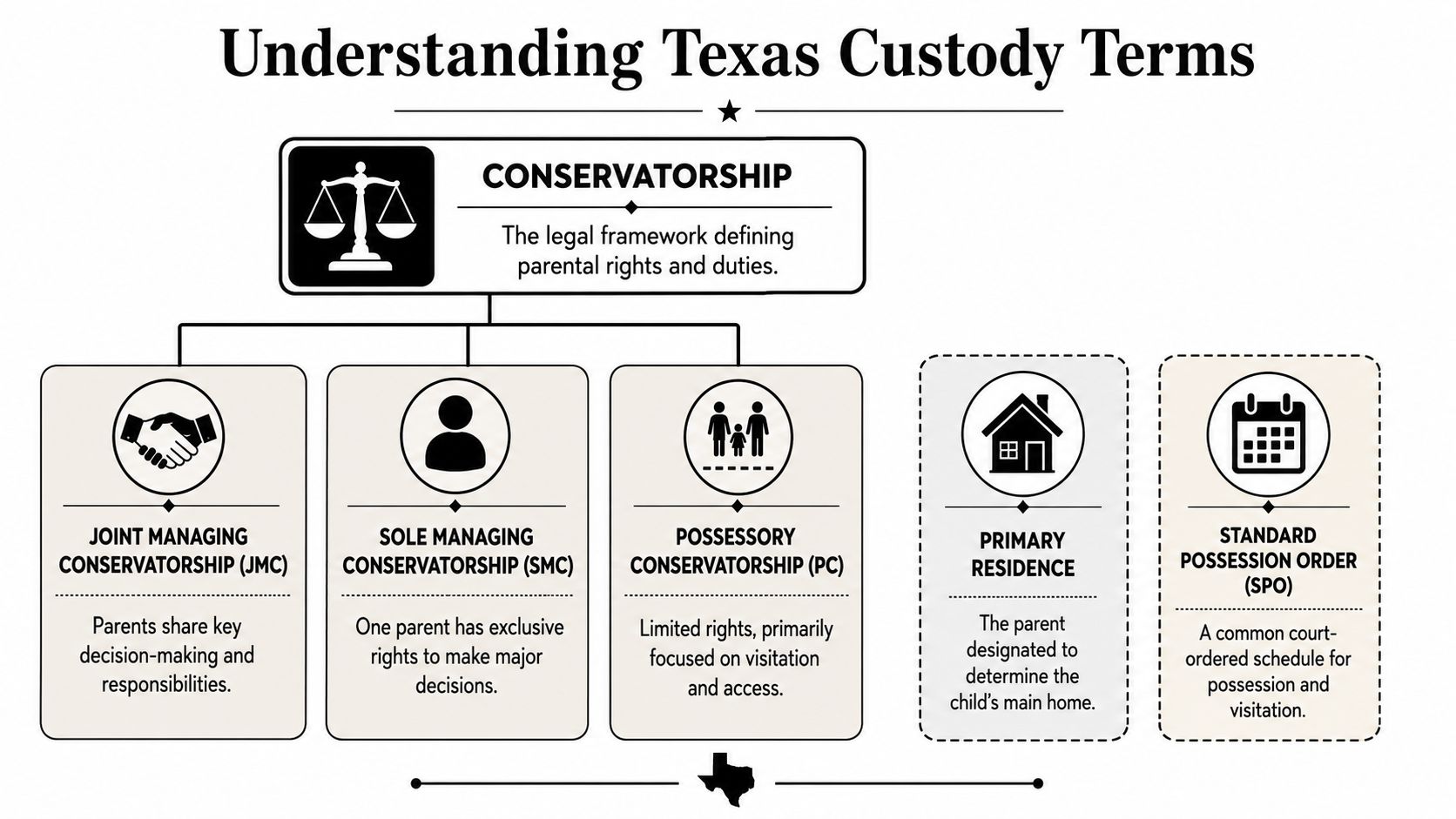
The core terms parents need to know
Think of a custody order like a company chart. More than one person may have an important role, but not everyone has the same authority.
- Conservatorship means the legal arrangement covering parental rights, duties, and decision-making.
- Joint Managing Conservatorship usually means both parents share major rights and responsibilities. Texas commonly favors this structure, and Joint Managing Conservatorship in Texas is often misunderstood because “joint” doesn't always mean equal time or equal authority on every issue.
- Possessory Conservator usually refers to the parent who has possession or visitation rights but does not hold the key exclusive rights assigned to the primary parent.
- Primary Joint Managing Conservator is often what people mean when they say “custodial parent.” This is the parent who is typically given the exclusive right to establish the child's primary residence.
For a fuller plain-English breakdown, it helps to review conservatorship in Texas.
Why the court order is everything
Many parents are often blindsided. They assume that because the child has mainly lived with them, they already have enforceable custodial rights. Without a court order, that assumption can break down fast.
According to Texas Law Help's explanation of parents' rights when no custody orders exist, when there is no court order, both parents generally have equal rights to physical possession of the child. That means a parent who has been acting as the day-to-day caregiver may have no legal mechanism to enforce exclusivity or prevent the other parent from taking the child until a court enters an order.
Practical rule: If your arrangement exists only through texts, family habit, or verbal agreement, it may feel stable but still be legally fragile.
That's why parents often file a SAPCR, which stands for Suit Affecting the Parent-Child Relationship. This is the court case used to establish conservatorship, possession, child support, and other enforceable terms involving a child.
The phrase that causes the most confusion
Parents often hear “joint managing conservators” and assume neither parent has a stronger claim to the child's home base. That isn't always true. A court can appoint both parents as joint managing conservators while still giving one parent the exclusive right to decide where the child primarily lives.
That distinction is the hinge point in many Texas custody cases.
The Right to Establish Your Child's Home Base
The most important right many custodial parents receive in Texas is the exclusive right to designate the child's primary residence. In practical terms, this means the parent can decide the child's main home.

That decision affects more than a street address. It usually shapes the child's school district, daily routines, community ties, and the logistics of co-parenting. In many families, this is the issue that carries the most weight during negotiations because it influences almost everything else.
What this right looks like in real life
A custody order may say that the child's residence must stay within a certain county, school district, or similar geographic area. According to Guest and Gray's discussion of child custody modification in Texas, a custodial parent in a joint managing conservatorship order typically holds the exclusive right to designate the child's primary residence, often restricted to a specific geographic area, while the other parent is a possessory conservator with visitation rights.
That geographic restriction is the court's way of balancing two important goals:
- Stability for the child
- Meaningful access for the other parent
If one parent lives in Houston and the other lives nearby, a local restriction may help preserve school continuity and a workable possession schedule. If the child could be moved across Texas without notice, the other parent's court-ordered time might become much harder to maintain.
Why relocation becomes a legal flashpoint
Parents often think, “I'm the custodial parent, so I can move wherever I want with my child.” That's not usually how it works. The right to choose the primary residence is powerful, but it's often bounded by the written order.
A move may also involve practical planning far beyond the courtroom. If a lawful move is on the table, families often need help with school transfers, housing timing, and transportation. In that context, resources like reliable TLC Moving & Storage solutions can help parents think through the logistics that come after the legal question is answered.
A short overview can help make this easier to picture:
| Issue | Why it matters |
|---|---|
| Primary residence | Determines the child's main home |
| Geographic restriction | Limits where that home can be located |
| School ties | Affects enrollment and continuity |
| Possession schedule | Works best when parents live within a practical distance |
For parents who want a visual explanation of how this right fits into a broader custody case, this video gives helpful background.
Your Financial Rights as a Custodial Parent
Child support is one of the clearest legal rights attached to custodial status in Texas. If you are the parent designated to receive support, that money is paid for the child's benefit. It is meant to help cover the child's daily needs, not to reward one parent or punish the other.
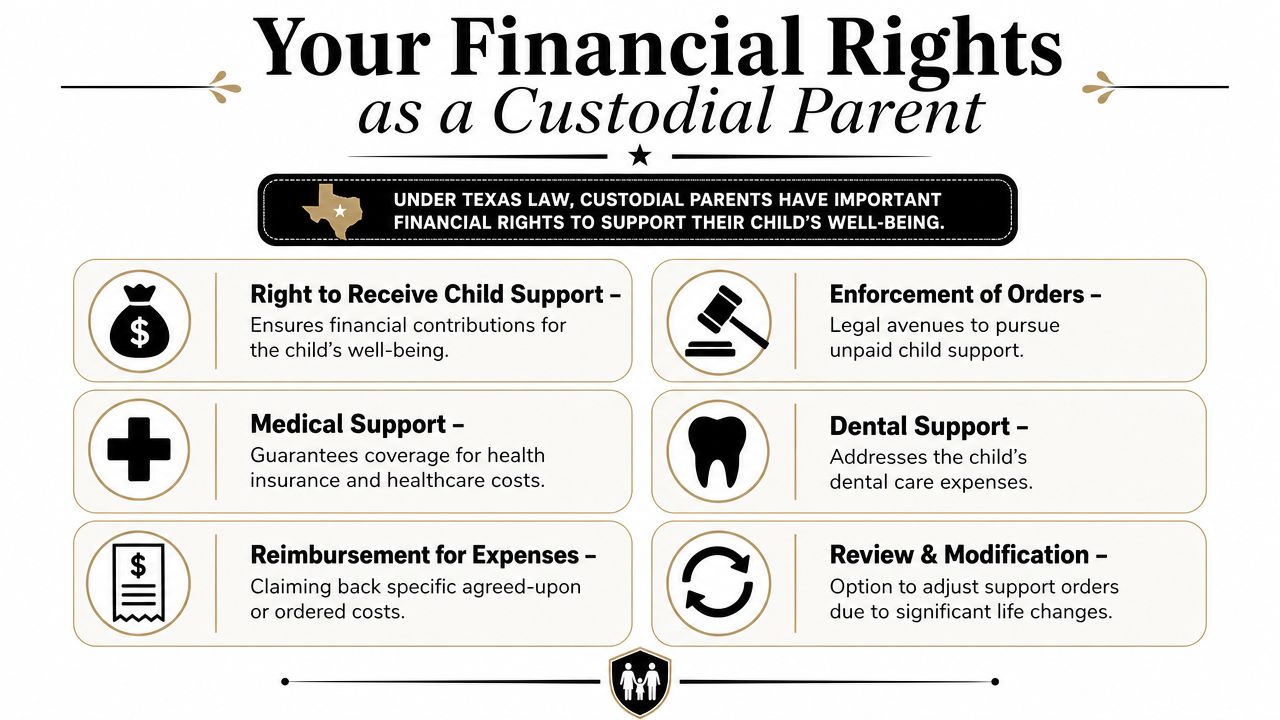
Who receives child support
Texas law recognizes the custodial parent as the designated recipient of child support on the child's behalf. That matters because the right to receive support is not automatically shared. It is tied to the role assigned in the court order.
According to the Texas Attorney General's noncustodial parent handbook, the noncustodial parent must pay 20% of net income for one child and 25% for two children, with higher percentages for additional children. Those guidelines create a framework that many parents can use to anticipate what support may look like in a standard case.
What parents often misunderstand about support
Support and visitation are separate obligations. A parent doesn't get to withhold possession because support hasn't been paid. A parent also doesn't get to stop paying support because possession time has become frustrating. Courts treat both duties seriously.
Child support is tied to the child's needs. Parenting time is tied to the child's relationship with each parent. One problem does not cancel out the other.
This is one reason documentation matters so much. If support is unpaid, enforcement may be available. If expenses like medical or dental costs are supposed to be shared under the order, records and receipts become important.
Practical ways to protect this right
Parents often reduce conflict when they stay organized from the beginning. Useful habits include:
- Keep payment records: Save statements, notices, and payment confirmations.
- Track extra child expenses: Preserve receipts for medical, dental, school, or agreed costs.
- Review the order carefully: Child support terms are only enforceable the way they are written.
- Learn how custody and support interact: A plain-English guide on how custody affects child support in Texas can help parents understand the connection.
Texas orders may also include medical and dental support obligations. The details depend on the written order, but the larger point stays the same. A custodial parent is not expected to carry the child's financial needs alone when support has been ordered.
Key Decision-Making Powers for Your Child
Custodial rights aren't limited to where your child sleeps most nights. They also include decision-making power. Some rights are shared. Some are independent. Some are exclusive. The exact mix depends on the court order.
Shared authority and exclusive authority
Texas often gives both parents access to important information about the child. That can include medical, educational, and psychological records. In many joint managing conservatorship cases, both parents may also consult with doctors, teachers, and counselors.
What changes from case to case is who gets to make the final call when the parents disagree.
A useful way to think about it is this:
- Shared rights let both parents stay informed and involved.
- Independent rights let either parent act without needing permission in certain situations.
- Exclusive rights place final authority in one parent's hands.
That distinction matters when there is tension over school choices, therapy, treatment plans, or religious upbringing.
Everyday examples that make this clearer
Suppose a child needs counseling. One order may let both parents consent independently. Another may require agreement. A third may give one parent the exclusive right to make that decision after consulting the other.
Suppose a school issue comes up. Both parents may have access to report cards and teacher communication, but only one parent may have authority over the child's main residence, which often determines school enrollment in the first place.
Under Texas Family Code Section 153.073 as published by Justia, a conservator may have the exclusive right to direct the child's moral and religious training during that parent's period of possession unless the court limits that right. That's a good example of how Texas law can separate one kind of authority from another.
Why the best-interest standard still controls
Even when a parent has a strong legal right, courts still measure custody issues against the best interest of the child. That phrase can sound abstract, but it usually comes down to familiar concerns:
| Question | Why a judge cares |
|---|---|
| Is the child stable? | Courts try to avoid unnecessary disruption |
| Can the parents cooperate? | Shared rights work better when communication is possible |
| Is the child safe and supported? | Safety is always central |
| Will the order reduce conflict? | A workable order often protects the child better |
If you're a mother, father, grandparent, or caregiver trying to understand your authority, the key is not guessing. Read the exact words of the order. Many disputes happen because parents rely on assumptions instead of the actual language.
Navigating Possession Orders and Visitation Schedules
Many custody disputes aren't really about legal theory. They're about calendars. Who has Thursday evening? What happens on Thanksgiving? When does summer possession start? Those are the questions that turn a court order into everyday life.
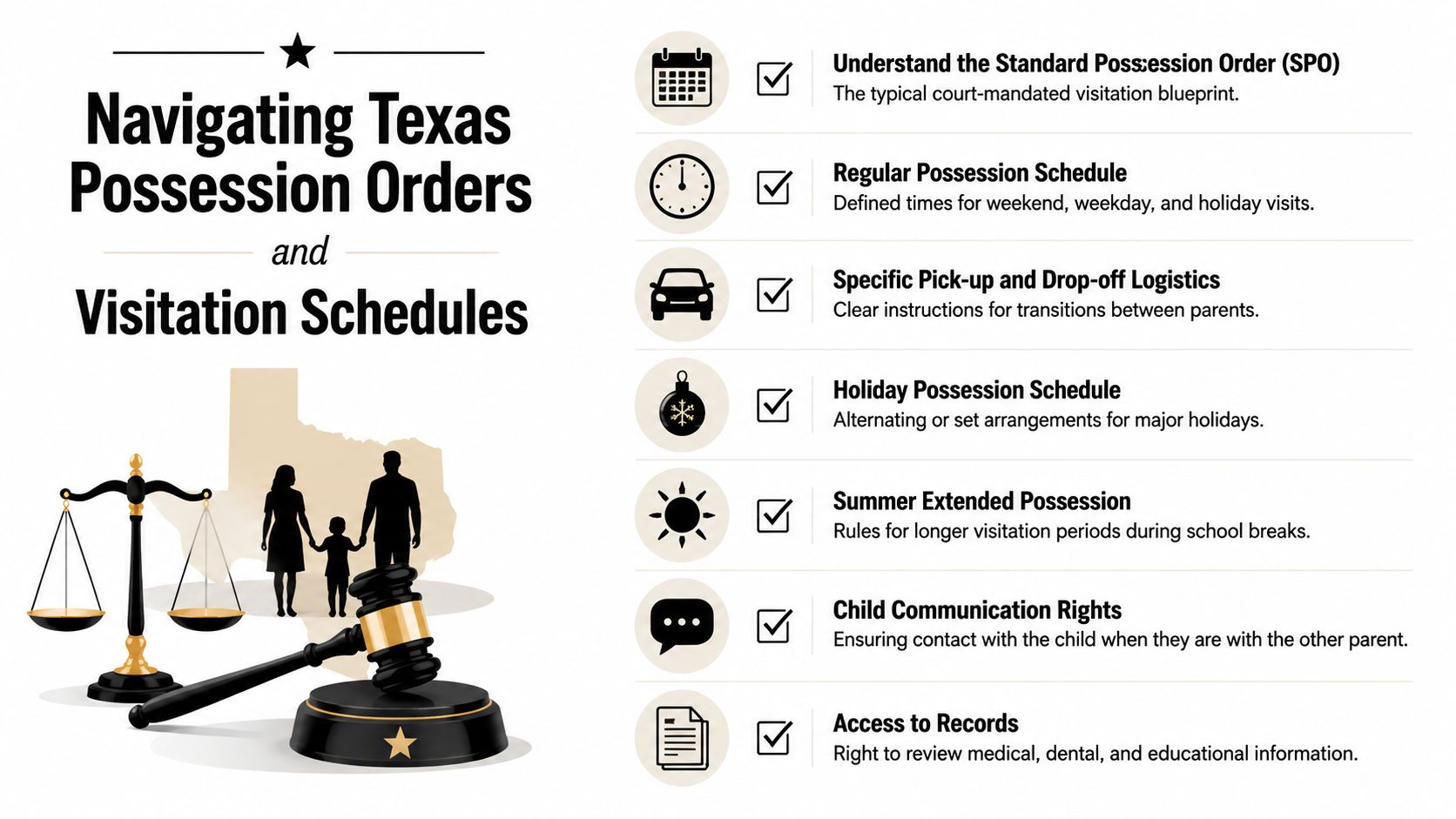
The standard schedule many Texas families use
Texas law presumes the Standard Possession Order, often called the SPO, is in the child's best interest for children age three and older. According to the Texas Attorney General's parenting time overview, that schedule gives the noncustodial parent possession on 1st, 3rd, and 5th weekends, Thursday evenings during school, alternating holidays, and a 30-day extended summer period.
In plain language, the SPO acts like a default blueprint. Parents can agree to something different, and courts can order something different when needed, but the SPO is the starting point many families see.
How to read the calendar without getting lost
The “1st, 3rd, and 5th weekends” part causes confusion because parents often focus on date numbers instead of weekend sequence. The first weekend of the month is not the weekend with the 1st on it. It's the first full weekend identified under the order's timing rules.
A few patterns matter most:
- Weekends: The noncustodial parent usually has the 1st, 3rd, and 5th weekends.
- Thursday periods during school: This creates regular contact during the school term.
- Alternating holidays: Parents usually trade major holidays under the order.
- Extended summer possession: One parent may have a longer uninterrupted summer block.
The more detailed your calendar system is, the fewer arguments you'll have about pickups, drop-offs, and holiday handoffs.
Why routines matter more than parents realize
Children usually handle two-home schedules better when transitions are predictable. Bedtime routines, homework expectations, and comfort items matter. For younger children especially, consistency across households can lower stress. Parents trying to coordinate sleep schedules may find practical help in guides about consistent baby naps, especially when both caregivers want the child to move smoothly between homes.
A simple checklist helps many co-parents avoid common mistakes:
- Mark school-year Thursdays early: Don't wait until the week of pickup.
- Confirm holiday exchanges in writing: A short message can prevent a long argument.
- Keep one shared calendar: Even a basic digital calendar can reduce confusion.
- Read the order, not your memory: The exact wording controls.
If your family's needs don't fit the standard schedule, that doesn't mean you're doing anything wrong. It may mean a custom order or later modification makes more sense.
How to Enforce or Modify Your Custody Order
Your co-parent is late again for the exchange. Then a weekend visit is skipped. Then school information stops reaching you. A court order can feel solid until the other parent starts treating it like a suggestion instead of a rule.
That is the moment many parents realize an important truth. Custodial rights are powerful, but they do not protect you by themselves. They have to be clearly written, officially signed, and used when problems start.
Texas parents usually have two legal tools here: enforcement and modification. They sound similar, but they solve different problems. Enforcement asks the court to make the other parent follow the current order. Modification asks the court to change the order because real life has changed enough that the old plan no longer works.
Enforcement when the other parent breaks the order
Enforcement fits cases where the order is still workable, but one parent is not following it. Common examples include:
- Possession violations: A parent does not return the child at the ordered time.
- Support violations: Court-ordered child support is not paid.
- Access interference: A parent blocks communication or withholds information the order requires them to share.
- Geographic violations: A parent moves or keeps the child outside the residence restriction in the order.
A custody order works a lot like a set of traffic rules. If one driver runs red lights, the answer is not for the other driver to do the same. In custody cases, parents usually protect themselves best by following the order, staying calm, and building a clear record of what happened.
Good records matter. Keep calendars, text messages, emails, school notices, payment histories, and notes made close to the event. Judges are often less interested in who sounds more upset and more interested in who can show dates, times, and exact violations.
Keep your notes factual. Write what happened, when it happened, and who was present. Skip labels, threats, and guesses about motive.
Some families also need outside help before or during court action. That can include mediation for disputes that are still workable, or legal counsel for repeated violations involving custody, visitation, support, or enforcement. The Law Office of Bryan Fagan, PLLC handles these family law matters as part of its practice.
Modification when life has changed
Modification is different. It applies when the current order no longer fits the child's needs or the family's reality. Parents often file for modification after a planned move, a major change in the child's schooling or health needs, or a parenting schedule that has stopped working in practice.
This issue comes up often when a parent wants to relocate. As explained by Versus Texas on custodial parent rights in Texas, a parent with the right to determine the child's primary residence may still need court approval if the move would go beyond a geographic restriction in the order. In that situation, the court may review whether the move is a material and substantial change in circumstances and whether a new arrangement would serve the child's best interest.
That legal phrase can sound intimidating. A simple way to read it is this: something important has changed, and the old order may no longer be a good fit for the child.
How to tell which path fits your problem
Parents often lose time because they choose the wrong tool. If the order still makes sense and the other parent is ignoring it, enforcement is usually the better fit. If the order itself has become outdated, modification is usually the better fit.
Ask these questions before filing:
- Is the main problem that the other parent is violating the current order?
- Has something important changed so the current order no longer works well?
- What proof do I have, such as messages, school records, or payment records?
- How would a judge view this from the child's point of view?
A quick comparison helps:
| Situation | Likely legal path |
|---|---|
| Parent will not return child on time | Enforcement |
| Support is not paid as ordered | Enforcement |
| Parent wants to move outside the geographic restriction | Modification |
| Child's medical, educational, or daily needs have changed significantly | Modification |
Why waiting can weaken your position
Parents sometimes hope a custody problem will correct itself. Sometimes it does. Often, it turns into a pattern. Missed exchanges become routine. Denied communication starts to look normal. The longer that goes on, the harder it can be to fix without court involvement.
The bigger danger is an informal arrangement. If there is no signed court order, there may be nothing to enforce at all. That is why many parents need to hear this clearly: doing most of the day-to-day parenting does not automatically give you legally enforceable protection. An unofficial schedule may feel stable right up until conflict starts.
Use your order like the instruction manual it is supposed to be. Read the exact language. Match the problem to the right legal tool. Keep careful records. Then act before a temporary problem becomes the new normal.
Your Next Steps to Secure Your Parental Rights
If you came here asking what rights does a custodial parent have in Texas, the short answer is this. A custodial parent may have the right to establish the child's primary residence, receive child support on the child's behalf, and hold specific decision-making authority under a court order. The longer and more important answer is that these rights are powerful, but not automatic or permanent.
That's the part many families miss. Informal arrangements can feel settled until conflict starts. Even a strong order can lose value if a parent never enforces it or updates it when life changes. Texas law gives parents tools, but those tools work best when the paperwork is clear and the response is timely.
Key takeaway
Use this checklist if you're trying to protect your role in your child's life:
- Read your current order closely: Don't rely on memory or assumptions.
- Confirm whether you have a signed court order: If not, your day-to-day role may not be enforceable.
- Track problems early: Keep clean records of violations, missed exchanges, and support issues.
- Review relocation limits: Moves involving the child can trigger major legal consequences.
- Get advice specific to your situation: Small wording differences in an order can change a parent's rights.
If you're a father trying to secure meaningful parenting time, a mother seeking stability and support, or a grandparent worried about a child's routine, your concerns are legitimate. Texas courts focus on the child's best interest, and a well-crafted order can create structure that protects everyone involved.
If you need help with a child custody or visitation case in Texas, our experienced attorneys can guide you every step of the way. Contact The Law Office of Bryan Fagan, PLLC today for a free consultation.
If you need help with a child custody or visitation case in Texas, our experienced attorneys can guide you every step of the way. Contact The Law Office of Bryan Fagan, PLLC today for a free consultation.