 Skip to content
The parent with whom the child lived for the greater number of nights during the tax year is generally the parent who can claim the child. If the nights are exactly equal, the parent with the higher adjusted gross income wins the IRS tie-breaker.
Tax season can feel like another custody dispute. You and your co-parent may both believe your Texas order gives you the right to claim your child, especially after agreeing to joint custody or dividing parenting time evenly. But Texas custody rights and federal tax rights are separate questions.
The answer often turns on the child's overnight schedule, not the label in your court order. It may also depend on whether the custodial parent properly signs IRS Form 8332. The difference matters because a state decree alone may not give the noncustodial parent the federal tax benefits they expect.
Navigating Taxes After a Texas Custody Split
Consider a common situation. Two Texas parents recently finalize a custody agreement. Their order names them joint managing conservators, and each parent believes the order gives them an equal right to claim their child. When tax filing begins, both prepare to list the child on their returns.
That's where the confusion starts. A Texas custody order may address conservatorship, possession, child support, and tax-related cooperation, but the IRS applies federal rules when deciding who may claim a child. The parent with whom the child lived for the longer period during the tax year generally has the federal claim. If the child lived with each parent for exactly the same amount of time, the parent with the higher adjusted gross income, or AGI, wins the tie-breaker under the IRS tie-breaker rules.
Practical rule: A 50/50 Texas schedule doesn't automatically mean both parents can claim the child. Only one taxpayer can ultimately claim the child for a given year unless the parents file jointly.
Texas family law uses terms that can sound like tax terms but aren't. Joint managing conservatorship generally means both parents share certain rights and duties involving the child. It doesn't necessarily mean equal overnight time, and it doesn't decide the federal tax result by itself. A possession schedule describes when the child is physically with each parent.
If you're reviewing a standard possession schedule, compare the actual nights with the schedule described in the Texas standard possession order. A parent may have substantial visitation yet still have fewer overnights.
The safest approach is to review three things together: the Texas order, the child's actual overnight record, and any Form 8332 release. The sections below explain how those pieces fit together so you can address the issue before a disputed return creates a larger problem.
How the IRS Decides Which Parent Claims the Child
A Texas order may call custody “joint,” yet the IRS still looks first at where the child lived. The federal claim usually follows the parent with the greater number of physical overnights during the tax year. Review the child's living record before relying on labels in the order or assuming a 50/50 arrangement settles the issue.
Use this sequence:
- Count the nights. Record where the child slept throughout the tax year. The IRS evaluates the child's living arrangements, not the title assigned to either parent in a Texas order.
- Identify the custodial parent. The parent with more nights is generally the custodial parent for federal tax purposes and may claim the child.
- Apply the tie-breaker. If the overnight totals are exactly equal, the parent with the higher AGI generally claims the child. If neither parent qualifies, the highest-AGI claimant may qualify under the IRS rules.

A parent's actual caregiving time and Texas custody rights can be different questions. Review custodial parent rights in Texas separately from the federal overnight test so you do not treat a state-law right as automatic IRS eligibility.
How a 50/50 schedule can produce one claimant
Parents using alternating weeks may describe their arrangement as equal custody. They still must count the actual nights. If the totals tie, the parent with the higher AGI wins the federal tie-breaker. The other parent cannot claim the child just because the schedule is labeled “50/50.”
A Texas court order naming a parent for tax purposes does not, by itself, control the IRS result. The noncustodial parent generally needs a signed release from the custodial parent, using Form 8332 or a substantially similar statement, and must attach it to the return. The IRS explains these requirements in Publication 504 for divorced or separated individuals.
The tax consequences may extend beyond the basic dependency claim. Depending on eligibility, parents may be considering the Child Tax Credit, Earned Income Credit, Head of Household filing status, and the Child and Dependent Care Credit. Form 8332 can transfer certain benefits, but it does not transfer every child-related benefit.
Extended-family arrangements require separate analysis. Guidance on grandparents claiming grandchildren addresses situations involving care or financial support from a grandparent. For Texas terminology, Conservatorship vs. Possession and Access in Texas explains the difference between decision-making authority and parenting time.
Where Texas Custody Orders Fit Into Federal Tax Rules
A Texas decree can assign tax-related duties, but it cannot rewrite federal eligibility rules. It may establish conservatorship rights, set a possession schedule, or require one parent to cooperate with tax paperwork. The IRS still applies its own test to determine who may claim the child.
A joint managing conservatorship, often called JMC, addresses parental decision-making and legal responsibilities. A standard possession order sets out parenting time. Parents who need a broader explanation can review how joint custody works in Texas. Neither designation, by itself, tells the IRS which parent had the greater number of nights. The child's actual living arrangement remains central to the federal analysis.

Why the decree may not be enough
Texas parents may agree to alternate the tax claim. A judge can include that arrangement in a final order or later modification, creating an enforceable duty between the parents. The order still does not replace the federal release process.
The custodial parent generally must sign Form 8332, or a substantially similar release, before the other parent can support the federal claim. The parent claiming the child must attach that release to the tax return. The IRS Form 8332 instructions and form set out the required paperwork.
For example, a Texas order may give the father the claim in alternating years. If the mother is the IRS custodial parent and does not sign the release, the father may lose the federal claim even though the decree favors him. Mailing the decree with his return does not automatically transfer the benefit. He may have a family-law enforcement issue instead.
The rule applies equally to mothers and fathers. A mother with fewer overnights may have an agreement allowing her to claim the child, but she still needs the required release. If either parent violates the order, Enforcing a Texas Custody and Possession Order addresses possible responses to that violation.
Texas community-property rules may also affect how parents divide refunds or tax obligations during divorce. Keep the decree, tax communications, possession records, and supporting documents together. Those records help separate an enforceable Texas obligation from the paperwork the IRS requires.
Using Form 8332 to Release or Transfer the Tax Claim
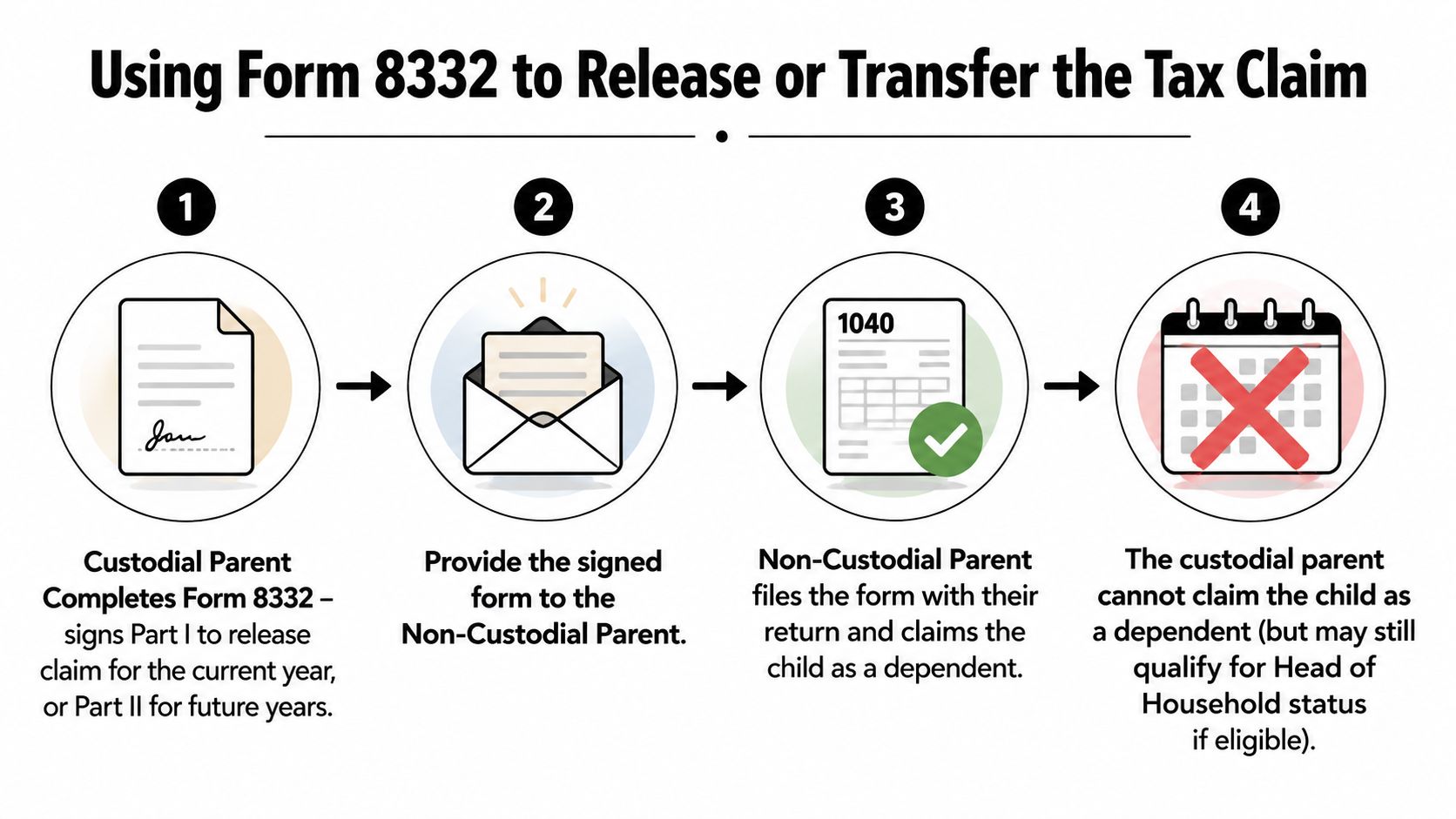
Form 8332 is the federal document that usually makes the transfer work. The custodial parent, generally the parent with the greater number of overnights, signs the release. The noncustodial parent attaches the signed form, or a substantially similar statement, to the tax return for the year claimed.
The IRS explains that Form 8332 can release the dependency claim and, when applicable, the Child Tax Credit, the Additional Child Tax Credit, and the Credit for Other Dependents. It doesn't transfer every tax benefit associated with the child. In particular, the noncustodial parent generally can't use the child for Head of Household, Earned Income Credit, or Child and Dependent Care Credit purposes under the release.
The paperwork process
- The custodial parent completes the form. Part I can release the claim for the current year. Part II can address future years. The parent should read the release carefully and confirm that the year or years match the custody agreement.
- The parent signs the release. A Texas decree may require a parent to sign, but the federal return still needs the properly executed release.
- The noncustodial parent receives the signed form. Keep a complete copy with the custody order and tax records.
- The noncustodial parent attaches the form to the return. Filing the child-related claim without the required release can lead to rejection or a later dispute.
A parent may use a release for a single year or for multiple future years. The language must be clear, and the parents should make sure the release matches the court order. Don't rely on an informal text message or a verbal promise.
The custodial parent can later revoke a prior release by following IRS requirements. The revocation generally requires written notice, and the IRS materials address the required notice period before the revocation takes effect. Because revocation can affect a future filing, handle it in writing and keep proof of delivery. Review the official Form 8332 guidance from the IRS before signing or revoking a release.
Common Joint Custody Tax Scenarios and Outcomes
The cleanest way to understand these disputes is to compare the schedule, the paperwork, and the benefit involved. The following examples use common Texas custody arrangements without assuming that every parent qualifies for every credit.
| Scenario | Custodial Parent Claims | Noncustodial Parent Claims | Key Requirement |
|---|---|---|---|
| Standard possession schedule, primary parent has roughly 220 nights | Generally claims the child and may claim qualifying benefits tied to custodial status | May claim the dependency-related benefits transferred by release | Signed Form 8332 attached to the noncustodial parent's return |
| True 50/50 schedule with tied nights | The higher-AGI parent wins the IRS tie-breaker | The lower-AGI parent generally cannot claim the child without a valid release | Count actual nights and apply the IRS tie-breaker |
| Parents alternate years by agreement | Claims in the assigned year if the release is valid, and may retain benefits tied to custodial status when eligible | Claims in the assigned year only with the required release | Form 8332 must cover the applicable year or future years |
| Noncustodial parent files without authorization | May file a valid claim if the IRS rules support it | Claim may be rejected or questioned, with possible examination risk | Do not file without the required release or qualifying IRS basis |
| Custodial parent later revokes a release | May claim future years after the revocation takes effect, if otherwise eligible | Loses the released claim for affected future years | Follow the IRS revocation procedure and notice rules |
The first scenario shows why possession time matters. A parent with roughly 220 nights will generally be the IRS custodial parent, even if the other parent has meaningful visitation. That parent may claim the child unless a valid release transfers the dependency-related claim.
The 50/50 example is different. Equal parenting time doesn't create two federal claimants. The parent with the higher AGI wins the IRS tie-breaker unless the custodial parent executes a valid release for the other parent.
Benefits do not travel together
Form 8332 may transfer the dependency claim and specified child-related credits. It generally doesn't transfer Head of Household status, the Earned Income Credit, or the Child and Dependent Care Credit. The parent who has the child for the greater number of nights may still be the only parent eligible for those custodial benefits, assuming all other IRS requirements are met.
Alternating years also require follow-through. If the custodial parent forgets to sign the release, the noncustodial parent may not be able to support the planned claim. Both parents should confirm the paperwork before filing rather than trying to fix a rejected return afterward.
Practical Steps to Protect Your Tax Rights
Treat the overnight record as evidence, not a memory exercise. A missed exchange, holiday change, school break, or extended visit can affect the annual count. Use a shared calendar or co-parenting app and record where the child sleeps, not merely when the child visits.
A workable parent checklist
- Track overnights carefully. Keep a calendar that both parents can review. Save related messages when the schedule changes.
- Review the order before filing. Compare the possession schedule with the actual nights and identify any tax clause.
- Address taxes during custody proceedings. If you're negotiating or seeking a modification, ask for clear language identifying the intended claimant and when Form 8332 is required.
- Complete Form 8332 promptly. Keep the signed form, the custody order, and proof of delivery with your tax records.
- Communicate before filing. Put the intended claim in writing so both parents don't submit competing returns.
- Get legal help if a parent refuses to cooperate. If the order requires a release and the other parent won't sign, a family-law attorney can evaluate enforcement options, including a possible motion for contempt.
Mothers and fathers should use the same standard. Don't assume the parent who pays more support automatically gets the claim. Don't assume the parent named “primary” automatically transfers it either. The IRS looks at its own requirements.
A parent needing help with custody, support, enforcement, or modification can consider the services of the Law Office of Bryan Fagan, PLLC, which handles Texas family-law matters involving parental rights and possession disputes. Legal advice is especially useful when the order and the overnight history point in different directions.
Key Takeaways and Next Steps for Texas Parents
The answer to who claims child on taxes with joint custody in Texas usually begins with nights. The IRS generally looks to the parent with whom the child lived for the greater period during the tax year. If the nights are exactly equal, the higher-AGI parent wins the tie-breaker.
The second rule is just as important: a Texas custody decree alone doesn't guarantee a federal tax claim. A custodial parent generally must sign Form 8332 before the noncustodial parent can claim the dependency-related benefits covered by that release. The noncustodial parent must attach the signed release to the return.
Use this short checklist:
- Track the child's overnight stays each year.
- Review the custody order and possession schedule.
- Confirm whether the order requires Form 8332.
- Complete and retain the form when a transfer is planned.
- Put tax agreements and filing intentions in writing.
- Separate the dependency claim from Head of Household, EITC, and dependent care benefits.
If a tax dispute has already caused a rejected return or IRS notice, a tax professional may help with tax-specific issues. Resources such as Omni Tax Help Texas tax relief may also be useful when a broader tax problem exists. For custody-related disputes, speak with a Texas family-law attorney before the next filing deadline.
If you need help with a child custody or visitation case in Texas, our experienced attorneys can guide you every step of the way. Contact The Law Office of Bryan Fagan, PLLC today for a free consultation. Visit Law Office of Bryan Fagan, PLLC to discuss your custody order, possession schedule, Form 8332 concerns, or enforcement options with a Texas family-law team.


