
When your child's future is on the line, you don't need speeches. You need a clear path through the custody rules, the evidence, and the traps that can sink a good case before a judge ever hears it.
Maybe your child is coming home upset after exchanges. Maybe school got harder, a medical need changed, or your job moved and the old schedule no longer works. Texas law does not let a parent change custody just because the current order feels unfair. You have to prove a material and substantial change in circumstances, and you still have to show the new order is in your child's best interest under Texas Family Code Chapter 153, as summarized by Texas Law Help.
A lot of parents wait too long, file the wrong paper, or bring the wrong kind of proof. That's why custody modifications can turn on procedure as much as substance. The law rewards the parent who can show a real change, tie it to the child's needs, and avoid the procedural potholes that get cases thrown out early.
When Your Child's Needs Outgrow the Current Order
A father calls because his middle-schooler is melting down after weekend exchanges and failing to keep up with homework. A mother calls because her ex's new work schedule keeps pushing pickups later and later, and the child is stuck in the middle. A grandparent calls because the child's parent moved, the school routine broke down, and the old possession schedule no longer fits real life.
Those are the moments when parents start asking whether the order still makes sense. Texas courts ask a harder one, whether the facts changed enough to justify modifying a court order that was already signed.
Practical rule: A judge cares less about how frustrated you feel and more about whether the child's daily life is now materially different from the day the last order was entered.
If you are trying to sort out whether a change in custody is even worth filing, start with when should you modify a custody order in Texas. That review helps you separate a real legal issue from a short-term conflict the court expects parents to handle themselves.
Texas family courts do not modify conservatorship, possession schedules, or access just because one parent wants a better setup. They look for evidence that the child's needs, the parents' circumstances, or the safety picture changed after the current order. The same pressure shows up in child care cases, which is why parents and providers often need to streamline child care center support when routines, pickups, or supervision break down and the child's day no longer matches the old order.
If the facts support a modification, the next step is proof. Bring documents, timelines, school records, medical notes, texts, and witness statements that show why the current order no longer fits your child's reality.
Understanding the Material and Substantial Change Standard
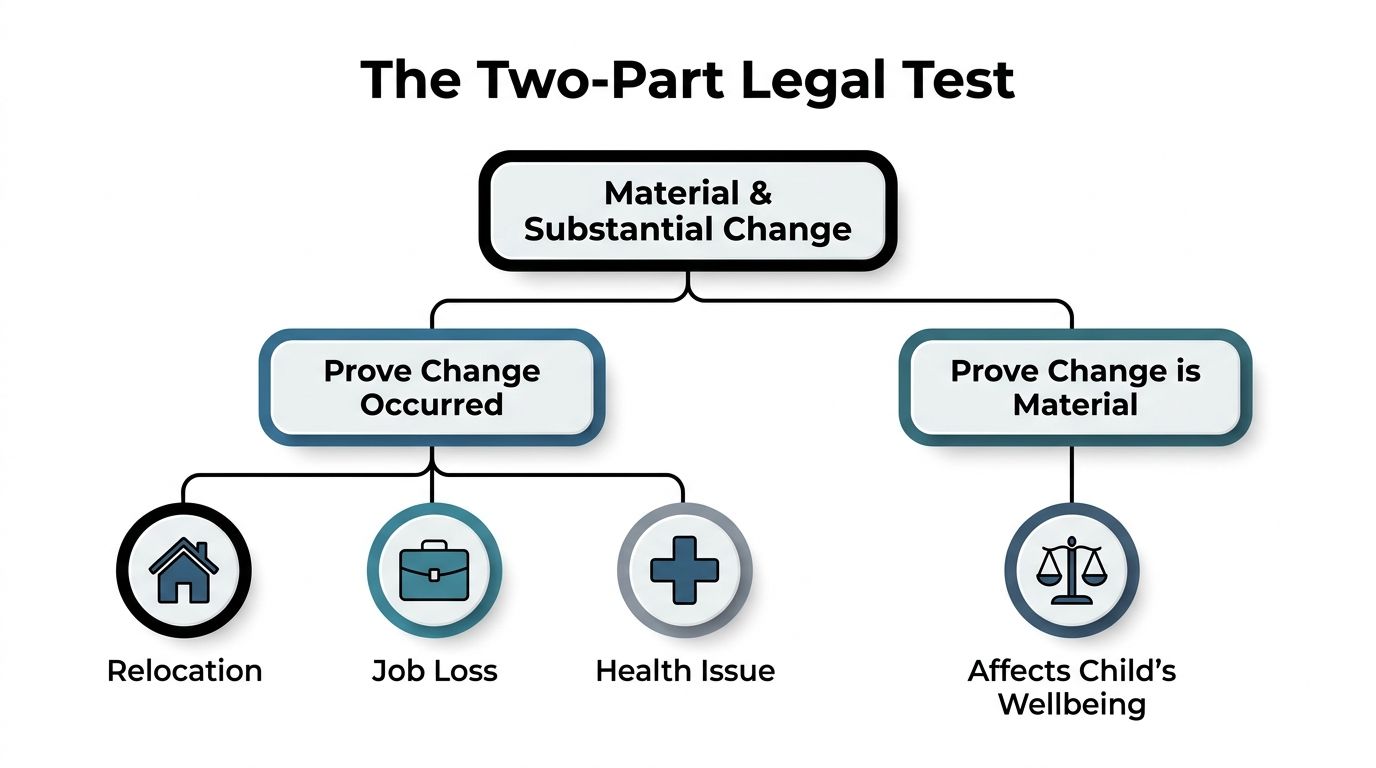
Texas uses a two-part legal test for custody modification. First, you must prove a material and substantial change in circumstances since the last order. Second, you must prove the change you want is in the child's best interest. Judges do not relax that test because a parent is frustrated, exhausted, or convinced the old order is unfair.
What material and substantial really means
“Material” means important. “Substantial” means significant enough to affect the child's welfare, not just create annoyance for a parent. A late pickup, a rude text, or a fight over bedtime usually will not carry a modification case on its own. A steady pattern that changes the child's stability, health, schooling, or safety is different.
A signed order does not reopen just because one parent wants a better deal. The court wants a real change in facts, not a change in attitude.
Texas law recognizes several examples that can satisfy the change requirement. One is when the child is at least 12 years old and tells the judge in chambers where the child wants to live. Another is when the primary custodian has allowed someone else to have primary care and possession for at least 6 months. Texas law also treats a parent or conservator's death as an express ground for modification, and that ground became effective on September 1, 2021. Those examples are not the only possible changes, but they show the kind of facts Texas courts take seriously. A plain overview appears in Modifying a Texas Custody Order, which explains how an existing order can be changed.
Why judges insist on both parts
A custody order is supposed to bring stability. If parents could reopen it every time life became inconvenient, children would live in a constant legal tug-of-war. That is why the court asks whether circumstances changed and whether the proposed arrangement serves the child.
A strong motion tells a simple story. The old order fit then, but it does not fit now, and the evidence shows the child is better served by a different structure.
You will also hear the phrase joint managing conservatorship. In plain English, that usually means both parents keep legal rights and duties, even if one parent has more day-to-day time with the child. A possession schedule is the calendar that sets each parent's time with the child. In modification cases, the dispute is often about changing that calendar, not erasing both parents' roles.
If you are sorting through school pickups, supervision, and daily routines, streamline child care center support is a useful reminder that courts look closely at stability and dependable caregiving. That same idea shows up in custody cases, because a child's routine matters.
Real Situations That Satisfy the Legal Standard
The cases that win usually share one trait, the child's day-to-day life changed in a way a judge can verify from records. A parent's move is one common example. If the move disrupted school nights, transportation, or access to family support, that can justify a modification when the facts show more than ordinary inconvenience.

Life keeps changing after the original decree, and custody orders do get modified when parents can prove a real shift in circumstances. That does not lower your burden. It means the court expects proof that holds up under scrutiny, not a story built on frustration.
Strong facts and weak complaints
The facts judges trust most involve substance abuse, neglect, school problems, medical issues, or a child's changing needs. A child who suddenly needs therapy, specialized treatment, or steady school support may justify a new order if the current schedule blocks that support. The same is true when a parent's conduct creates instability that affects the child's emotional or physical well-being.
Weak cases usually revolve around personality conflicts. One parent dislikes a new girlfriend, thinks the other parent is too strict, or believes the child prefers one home without proof. That may be upsetting, but irritation is not the same as a legally meaningful change.
The evidence judges take seriously
Judges care about records that show what changed and when. School records, medical notes, police reports, CPS involvement, counselor statements, and clean text threads carry far more weight than a parent saying, “Things got worse.”
Timing matters too. If relocation is part of your story, you need to show how the move affected the child, not just how it inconvenienced the adults. Parents dealing with a move should also review tips for family relocation, because relocation planning and child stability often overlap in real life.
When the facts are close, corroboration wins the day. A teacher's email matters more than a vague recollection. A doctor's note matters more than a parent's guess. A timeline that shows the change after the last order matters more than old problems that never got fixed. For parents who need the right paperwork before filing, the Texas custody modification forms guide is the place to start.
Navigating the One-Year Affidavit Requirement
Texas has a trap that catches parents all the time. If you file for modification within one year of the current order or a prior modification, you don't just file the petition. You also need a sworn affidavit that fits the statute. If that affidavit is weak, the case can get stopped before you ever reach a hearing on the merits.
The affidavit must allege one of three things, the child's current surroundings endanger the child's physical health or emotional development, the primary custodian has allowed another person to have primary care and possession for at least 6 months, or a child who is 12 or older has told the judge where they want to live. Outside that first year, the affidavit is not required, but you still have to prove changed facts later in the case. That timing rule is explained in the Texas-focused summary at Calabrese Budner's custody modification overview.
What the affidavit needs to do
This is not the place for vague language. A bare statement that “things have changed” usually won't do the job. The affidavit needs enough detail to show the court that one of the statutory exceptions really exists.
If your claim is danger, describe the facts with specifics. If your claim is six months of surrendered care, say who had the child, when, and how that arrangement worked. If your claim is the child's preference, the court still decides whether the request fits the child's welfare.
Timing can help or hurt you
Parents sometimes rush to court because the conflict feels urgent. That can backfire if the affidavit is thin. In other cases, waiting until you can document the problem gives you a stronger shot at surviving the first procedural challenge.
If you're trying to understand the paperwork side before you file, Texas custody modification forms is a practical place to see how the forms fit together. You still need the right facts behind the form, because the paper alone does not win the case.
File fast only when you truly have a statutory basis. Filing early with a weak affidavit can hand the other side a clean dismissal argument.
A judge is not going to overlook the one-year rule because the family conflict is stressful. The law is built to prevent rushed modifications unless the child's safety or living situation fits one of the specific exceptions. If you're inside the one-year window, that affidavit is not a technicality. It's the gatekeeper.
Building Your Evidence Checklist for Success
The best custody cases are built like a file, not like a memory. Start by collecting records that show the change, the date, and the effect on the child. Then organize them so the judge can follow the story without guessing.
Evidence that usually carries weight
School records can help when grades drop, attendance changes, or teachers document behavior concerns. Medical records matter when the child has new health needs, counseling notes, or treatment recommendations. Police reports and CPS records can support the case when safety concerns are documented by third parties.
Texts and emails matter too, but only when they prove something. A message about missed exchanges, refusal to follow the schedule, or admissions about caregiving can help. The same is true for witness statements from teachers, counselors, coaches, neighbors, or relatives who saw the child's condition change over time.
Practical rule: Your evidence should show a timeline. One isolated bad day rarely proves modification. A pattern across months is what moves a judge.
Compare the evidence types before you rely on them
| Evidence Category | Examples | Strength Level |
|---|---|---|
| School records | Report cards, attendance logs, teacher notes | Strong when they show a clear change after the last order |
| Medical records | Doctor visits, therapy notes, treatment plans | Strong when tied to the child's welfare |
| Official reports | Police reports, CPS records | Strong when they document safety or neglect concerns |
| Communications | Text messages, emails, app messages | Moderate to strong when preserved cleanly and in context |
| Witness statements | Teachers, counselors, caregivers | Moderate when specific and firsthand |
| Parent testimony | Your own account of events | Helpful, but weakest if unsupported |
If you want a broader look at how proof works in Texas custody disputes, what evidence matters most in a Texas custody case gives a good framework. Use that idea here, because modification cases live or die on the quality of the proof, not just the volume.
The mistake I see most often is disorganized evidence. Parents hand over screenshots, random dates, and emotional explanations with no timeline. That forces the judge to do your job, and judges don't like that. Put everything in order, label it, and connect each piece to the specific change you're claiming.
Anticipating and Countering Common Defenses
The other parent is not going to sit by and agree that your case is valid. They'll attack the facts, the timing, and your motives. If you're ready for that, you're already ahead.
“Nothing material changed”
This is the most common defense. The response is not to repeat your feelings, it's to point to records. School issues, medical documentation, missed exchanges, or third-party observations are the kind of proof that breaks the argument.
If the other parent says the problem is just ordinary conflict, you need evidence that the child's routine, safety, or development changed. A judge looks for impact, not drama.
“You're just trying to reduce support”
Some parents claim the financial motive outweighs the parental one. This argument weakens when your proof focuses on the child. If you've got school records, therapy notes, caregiving history, or documented schedule problems, the case looks much less like a support fight and much more like a child-focused request.
“You have your own problems”
That defense can matter if your conduct affects the child. Own it if you need to, then show what changed and how you've addressed it. Judges care about the child's current welfare, not whether either parent is perfect.
If both parents file competing modification requests, the court usually compares the evidence and decides which plan serves the child better. That's not a popularity contest. It's a best-interest analysis grounded in facts, consistency, and child-focused planning.
If you're preparing for a contested hearing, an attorney can help you tighten your theory before the other side tries to redefine it for you. A resource like Texas Child Custody Lawyer is one option for understanding how conservatorship, possession, and access issues fit together in a Chapter 153 case, and the Law Office of Bryan Fagan, PLLC can handle these disputes in a way that centers the child and the evidence.
Your Next Steps Toward Protecting Your Child's Future
The winning formula is simple, even if the case isn't. Prove a material and substantial change, show why the new arrangement is in your child's best interest, and don't ignore the one-year affidavit trap if your filing is recent. If your proof is thin, build it before you file. If your case is strong, move with precision.
Start by gathering records that show what changed after the last order. Bring school documents, medical notes, texts, emails, calendars, and any reports that back up your timeline. If your facts involve relocation or a shift in caregiving, organize them around the child's routine, not the adults' arguments.
A consultation is the right next step when the facts are messy, the other parent is already threatening court, or you're inside the one-year window. If you're comparing lawyers, check out Kiwiform for another way people organize intake and case information, then come prepared with your own documents and questions. Ask what evidence matters most, whether your affidavit is strong enough, and how the case will be framed around your child's needs.
If you're a mother, father, or grandparent trying to protect a child's stability, don't wait for the situation to settle itself. It usually won't.
If you need help with a child custody or visitation case in Texas, our experienced attorneys can guide you every step of the way. Contact The Law Office of Bryan Fagan, PLLC today for a free consultation. Visit Law Office of Bryan Fagan, PLLC to talk through your custody modification, your evidence, and the best way to protect your child's future.