
When your child's future is on the line, understanding your rights matters most. In Texas, school enrollment can turn a custody order from a stack of paper into a real-life fight at the front desk, especially when one parent says yes and the other says no. If you're standing in that kind of moment now, you're not alone, and you do have options.
When School Enrollment Becomes a Custody Battle
A parent walks into a school office in August with a custody order in hand, ready to enroll a child. The registrar looks down, checks the system, and says the other parent already enrolled the child across town. That's the moment many families realize that custody and school enrollment Texas questions are not abstract legal issues, they're practical problems that hit fast.
School enrollment often becomes the first real flashpoint after a divorce or SAPCR because both parents have to act on a deadline. There's paperwork, residency proof, immunization records, and a court order that may or may not say enough. If the order is clear, the school usually has a straightforward path. If it's vague, everyone starts guessing, and guessing rarely helps children.
Texas law makes school enrollment a legal event, not just an office errand. Parents with legal control under a court order have authority to enroll a child in public school, and the district must record the enrolling adult's name, address, and date of birth (Texas Education Code Chapter 25). If a parent or legal controller enrolls the child, the prior district must furnish records needed for the new enrollment (Texas Education Code Chapter 25).
Practical rule: the school office usually follows the clearest legal authority on file, not the loudest argument at the counter.
The rest of the process comes down to four questions. What does the court order say? What documents does the district require? What can the school decide on its own? And when does the issue need an attorney or emergency court relief? That's the roadmap most parents wish they had before August started.
How Custody Orders Shape School Decisions in Texas
Texas family courts start with the best interest of the child when they decide conservatorship, possession, and access (Texas Family Code § 153.002). In plain English, the judge looks at what protects the child's physical, emotional, and developmental needs, not what either parent prefers. That standard matters in school disputes because a school choice can affect routines, transportation, services, and stability.
Joint managing conservatorship usually means both parents keep some rights and duties, including educational decisions, unless the order says otherwise. Joint Managing Conservatorship in Texas explains the presumption favoring joint conservatorship and what it means in daily life. One parent may still have the exclusive right to designate the child's primary residence or make school decisions, and that language controls if it appears in the order.
Custody terms and what they mean for school enrollment
| Term | School Enrollment Effect |
|---|---|
| Joint managing conservatorship | Both parents may share educational rights unless the order says one parent has final authority |
| Exclusive right to designate primary residence | Often affects which district the child can attend |
| Exclusive school decision-making | One parent can usually choose the school without the other parent's approval |
| Possession schedule | Shows when the child is with each parent, but doesn't always decide school choice |
| Best interest of the child | The court's main test if parents need a judge to decide |
Possession and conservatorship are not the same thing. A parent can have the child more often and still not control school choice, or vice versa. That's why school district boundaries and physical possession don't always line up neatly.
If your order does not clearly give one parent the school decision, don't assume the school will resolve the dispute for you.
A helpful Texas custody guide on this issue is available here, especially if you're trying to connect the words in your decree to the school office process.
Documents You Need to Enroll a Child in Texas
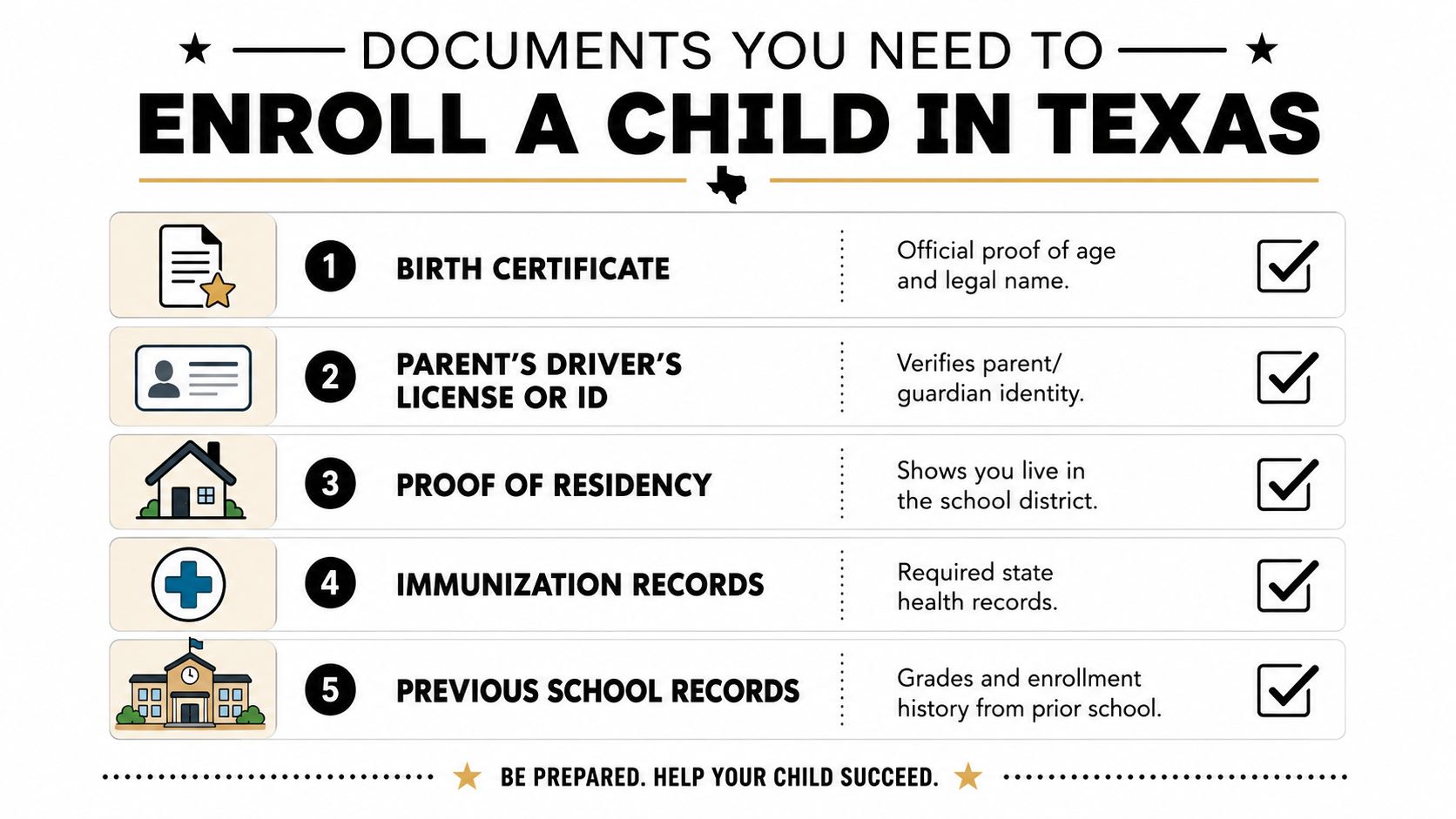
Most Texas schools want two things from the start, proof that the child belongs in the district and proof that the child can legally be enrolled. Texas Education Agency guidance says schools ask for records establishing the student's identity and either immunization records or a valid exemption (TEA parental rights handbook). If those pieces aren't ready, enrollment can stall even when the parent has the right to proceed.
The front desk usually asks for a small stack of documents, not a single magic form. Bring the child's birth certificate, a parent photo ID, proof of residency such as a utility bill or lease, immunization records, prior school records or withdrawal paperwork, and the court order itself. The order matters because it shows who has legal standing and whether the other parent needs notice about school decisions.
What school staff actually do with those papers
Schools can copy the records they need, and they usually return the originals after reviewing them. The district may also require written proof of identity and residency before it accepts the student into the campus system (TEA enrollment guidance). If immunization records come from another state, expect extra time while the school checks whether the records meet Texas requirements.
Parents also have a right to inspect broad school records, including medical records, attendance, grades, discipline, counseling, and health information under Texas Education Code Chapter 26 (Texas Education Code Chapter 26). That can help when a district says it needs more information before enrolling a child or when you need a complete paper trail after a school change.
If you don't have a copy of the final order handy, this step-by-step resource on obtaining a copy of your final custody order in Texas can save time before you go back to the campus. That small preparation step can make the difference between same-day enrollment and a week of back-and-forth.
Reading Your Court Order for School Language
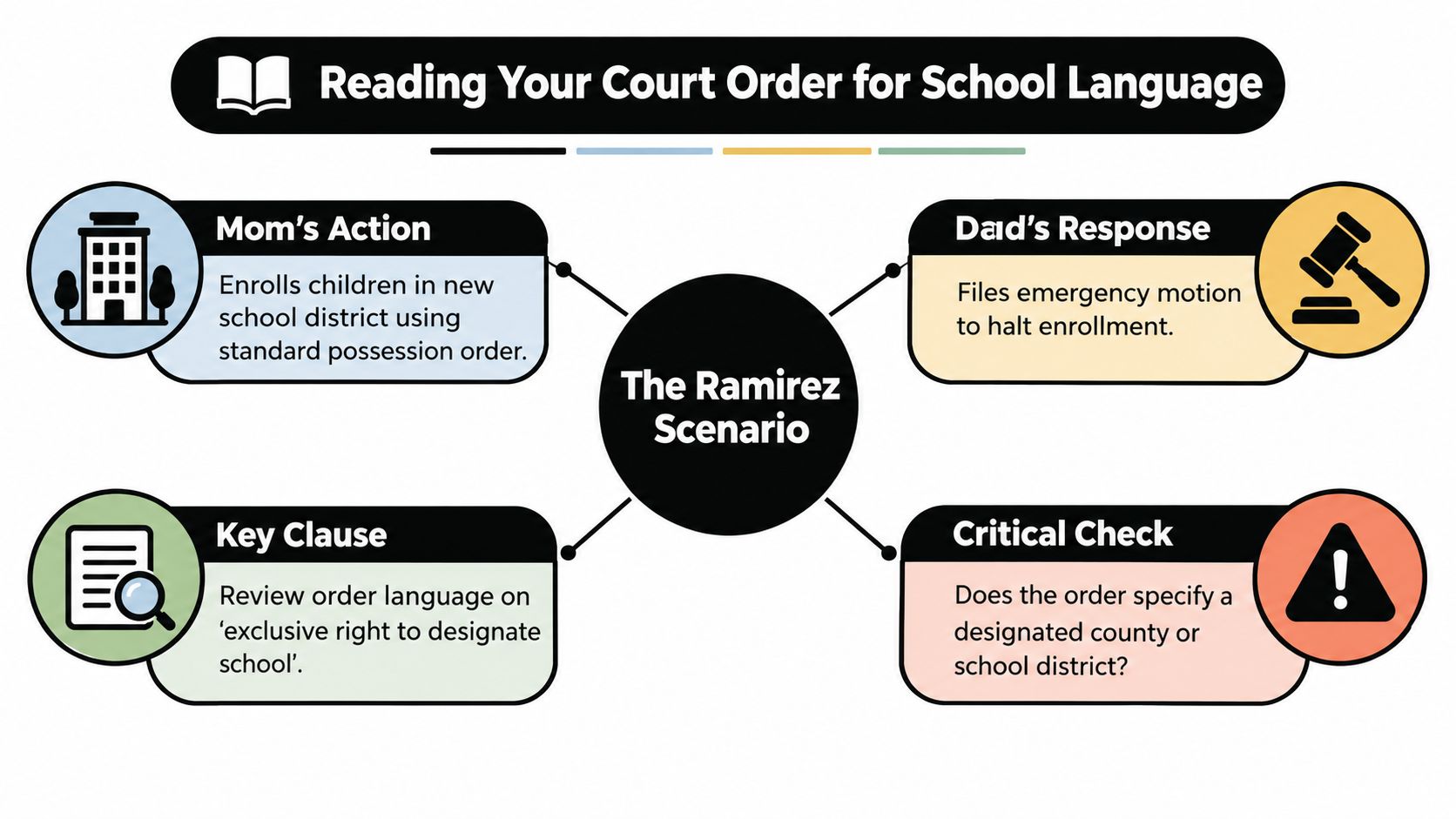
A mother moves with the children to a new apartment and enrolls them in a nearby district using a standard possession order. A week later, the father learns about the change and files a motion because the decree did not clearly give either parent school authority. That kind of dispute usually turns on the exact words in the order, not on who got to the school first.
The phrases that matter most
Look for the clause that says one parent has the exclusive right to designate the child's primary residence. That language often affects school placement because the child's residence can determine which district is available. Look next for wording about joint decision-making, educational decisions, or any clause that gives one parent final say if the parents disagree.
If the order is silent on education, many parents assume they can act alone if the child lives with them most of the time. That assumption can backfire. Geographic restrictions, county limits, or a named school district in the decree can control the issue even when a parent has day-to-day possession.
The legal point is simple. An exclusive right means the named parent can usually decide without asking the other parent first. A tie-breaker or final say clause means one parent gets the last word after consultation, while a silent order often leaves the parents needing agreement or court help.
The difference between a custody label and a school choice is easy to miss, which is why many parents read the decree too quickly. A possession schedule tells you where the child sleeps on certain days. It does not automatically tell you who may choose the campus.
For a useful discussion of how document language becomes legally binding in practice, the article on contract signatures and consent gives a helpful framework for reading signed legal papers.
An instructional video on reading these clauses can also help you spot the key terms before you call the school.
What the School District Can and Cannot Decide
A parent may walk into the front office with a clear court order and still hit a wall. The school can ask for proof of residency, identity, immunization records, and the papers showing who has legal authority to enroll the child. It can review those documents, but it cannot decide which parent should prevail in a custody dispute.
Texas law keeps those roles separate. The district handles enrollment eligibility under Texas Education Code Chapter 25, while the court controls conservatorship, possession, and later changes to the order. TEA also treats enrollment as a local matter, so districts use their own procedures for residency and records checks, not a family-law ruling from the front desk.
A school administrator can verify residency. The administrator cannot resolve a custody dispute.
| Decision Area | Family Court Decides | School District Decides |
|---|---|---|
| Custody and conservatorship | Yes | No |
| School-choice rights in the order | Yes | No |
| Residency in attendance area | No | Yes |
| Immunization compliance | No | Yes |
| Records release and copies | No | Yes |
| Emergency changes to the order | Yes | No |
That division matters when one parent lives in the district and the other objects. A notarized residency affidavit may help the district complete enrollment, but it does not override a conflicting court order. Beaumont ISD's custody guidance makes the same point in plain terms, school enrollment forms do not decide the parent-child relationship, and a person claiming parent status without the right legal connection is not entitled to enroll or withdraw the child (Beaumont ISD custody matters).
Schools are document checkers, not judges. Once the paperwork is clear, the district can enroll the child if the legal requirements are met. If the paperwork points in two directions, the district may pause until the order, the residency facts, or both are clarified.
Emergency Relief and When to Call an Attorney
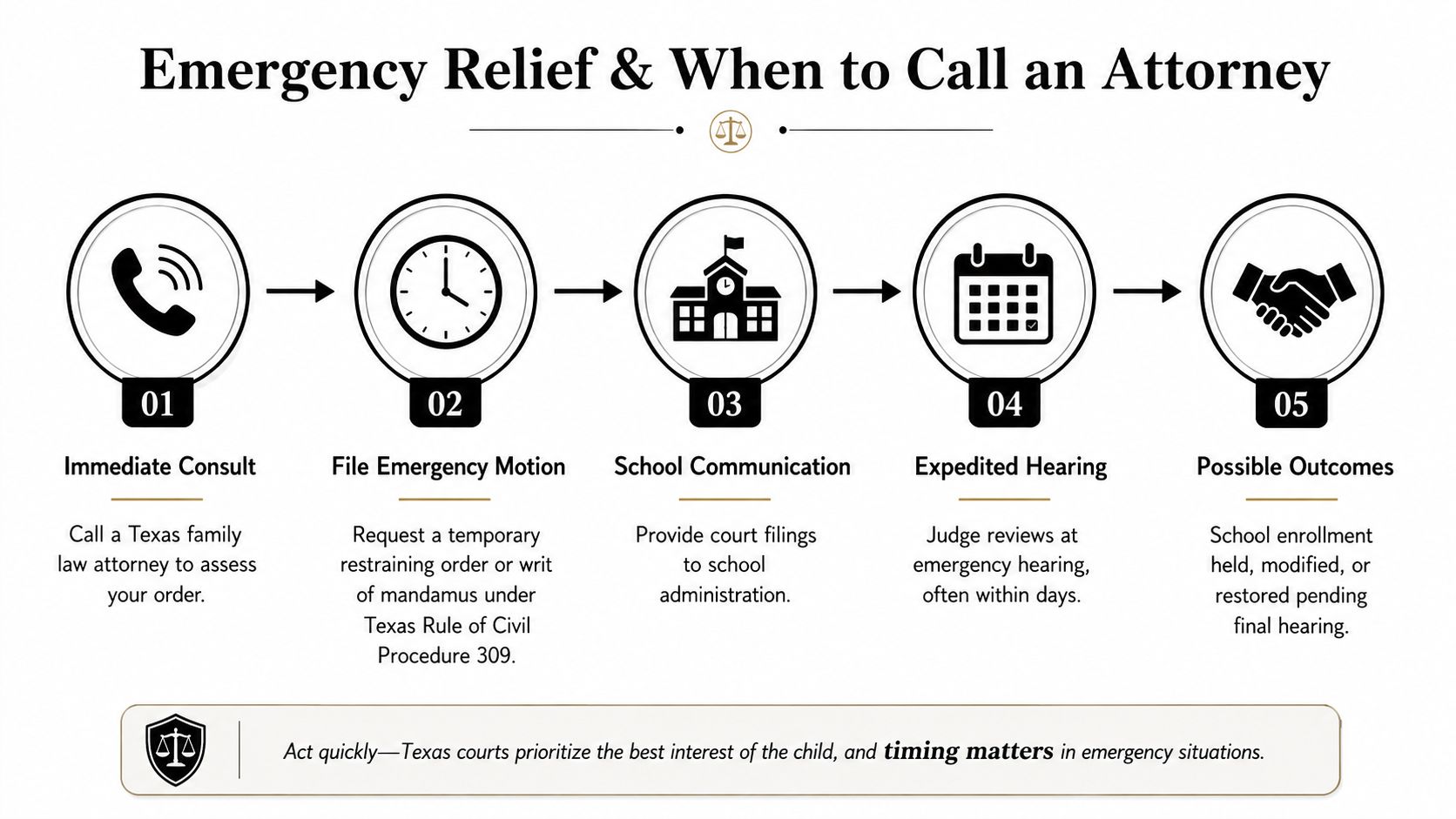
When enrollment is blocked and the school year is close, parents usually have three paths. The first is emergency relief, which may include a temporary restraining order or other expedited court request when a child could lose a spot in a program or face an immediate harm. The second is modification, which is the slower route when the dispute needs evidence and long-term changes. The third is a consultation with a lawyer who can read the order and tell you which path fits your facts.
Texas emergency procedure can move quickly when the paperwork supports it. A parent may need a verified petition, affidavits, and a request for an expedited hearing if the issue cannot wait. If a child might lose a magnet placement or a school seat without immediate action, that's the kind of situation where delay can cause a real problem.
For a broader overview of what an emergency hearing looks like in Texas custody cases, this resource on emergency custody hearings in Texas is a useful starting point. It helps parents understand why the court calendar matters so much when school deadlines are close.
Modification is different. Texas Family Code § 156.101 requires a material and substantial change before a court usually modifies a prior order. That route works better when the issue is ongoing, like repeated enrollment obstruction, a move across district lines, or a long-term change in the child's school needs. It's slower, but it can give the court the full picture.
When you should stop trying to handle it alone
Call an attorney quickly if the order has a geographic restriction problem, the other parent keeps blocking enrollment, safety is part of the dispute, or the deadline is close enough that the school year starts in less than 30 days. If the other parent already has counsel, the sooner you get advice, the better your chances of protecting the child's place and your rights.
Bottom line: if the school window is closing, the wrong delay can become the biggest mistake in the case.
Your Next Steps and How We Can Help
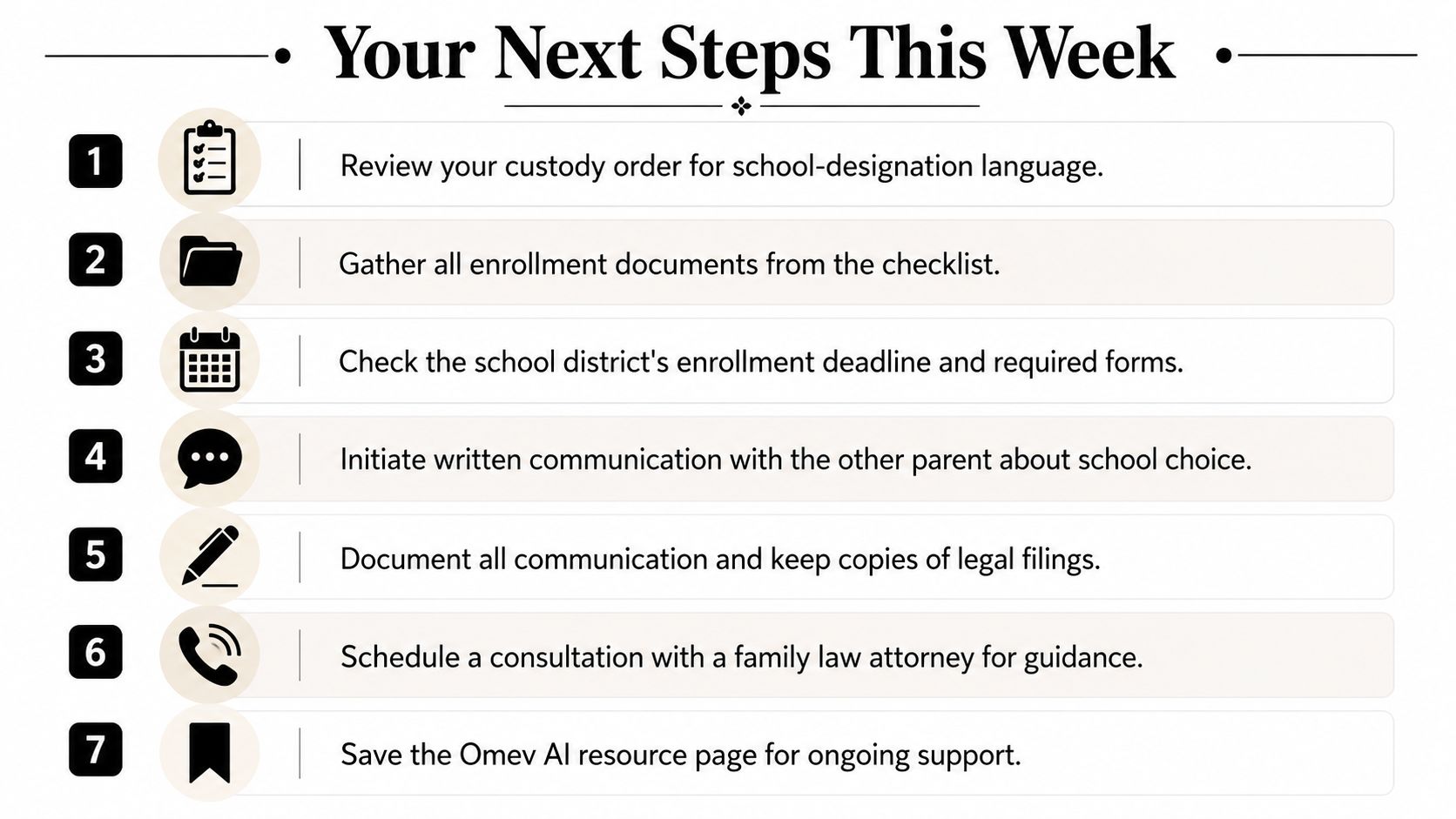
A calm plan helps when the school office and the custody order seem to point in different directions. Start with the order, gather the right papers, and keep everything in writing. Small steps can protect a child's enrollment while you decide whether the bigger issue belongs in court.
Your next steps this week
- Review your custody order for school-designation language.
- Gather enrollment documents, including the order, ID, residency proof, and immunization records.
- Check the school district's deadline and required forms.
- Put your school choice concerns in writing to the other parent.
- Save every email, text, and filing in one folder.
- Schedule a consultation with a family law attorney if the order is unclear.
- Keep one clean copy of the paperwork ready for the school office.
If your household needs help keeping communication organized, some families also use outside administrative support to track paperwork and follow-up tasks, and a service like hire legal receptionist can be useful for firms and busy legal teams handling the logistics behind the scenes. For parents, the bigger point is the same, documentation matters, and someone has to stay on top of it.
This issue is stressful because it touches your child's routine, your legal rights, and your sense of control all at once. A first consultation can sort through the court order, identify immediate enrollment rights, and separate short-term fixes from longer-term options. That conversation can also help mothers, fathers, and grandparents understand whether the next step is a school meeting, a written demand, or a court filing.
If you're stuck between a registrar's rules and the words in your decree, you don't have to guess. The right guidance can make the process steadier and a lot less overwhelming.
If you need help with a child custody or visitation case in Texas, our experienced attorneys can guide you every step of the way. Contact The Law Office of Bryan Fagan, PLLC today for a free consultation.