
When your child's future is on the line, understanding your rights matters most. A Laredo parent may be trying to keep a child's school routine steady, manage a commute across the border, or respond after the other parent suddenly says, “I'm filing for divorce, and I want the children.” Fear and confusion are normal, but Texas law gives you legal options.
In Texas, child custody is usually handled through a Suit Affecting the Parent-Child Relationship, or SAPCR. The Texas State Law Library explains that a SAPCR is the legal vehicle used to request court orders for custody, visitation, or child support. The state's conservatorship rules are found in Texas Family Code Chapter 153, while jurisdictional questions are addressed through the Texas Uniform Child Custody Jurisdiction and Enforcement Act, adopted on September 1, 1999. You can review the Texas State Law Library's child custody and support guide for a starting point.
Laredo families often balance long commutes, bilingual communication, military service, and help from abuelas, tíos, and other relatives. A child custody lawyer in Laredo can translate the law into a workable parenting plan while protecting your relationship with your child.
What a Child Custody Lawyer in Laredo Actually Does for Your Family
A mother in Laredo may hear her husband announce that he's filing for divorce and wants the children. Her first questions usually aren't about courtroom procedure. She wants to know where the children will sleep, who will take them to school, and whether she'll still have a voice in medical and educational decisions.
A lawyer starts by separating custody from the everyday meaning of the word. Texas generally uses conservatorship to describe parental rights and responsibilities. Think of two co-pilots sharing flight control. Both may have authority to make important decisions, even if one parent handles more of the child's daily transportation. In another arrangement, one parent may act as the primary pilot while the other has defined decision-making rights and scheduled possession.
Turning Chapter 153 into a workable plan
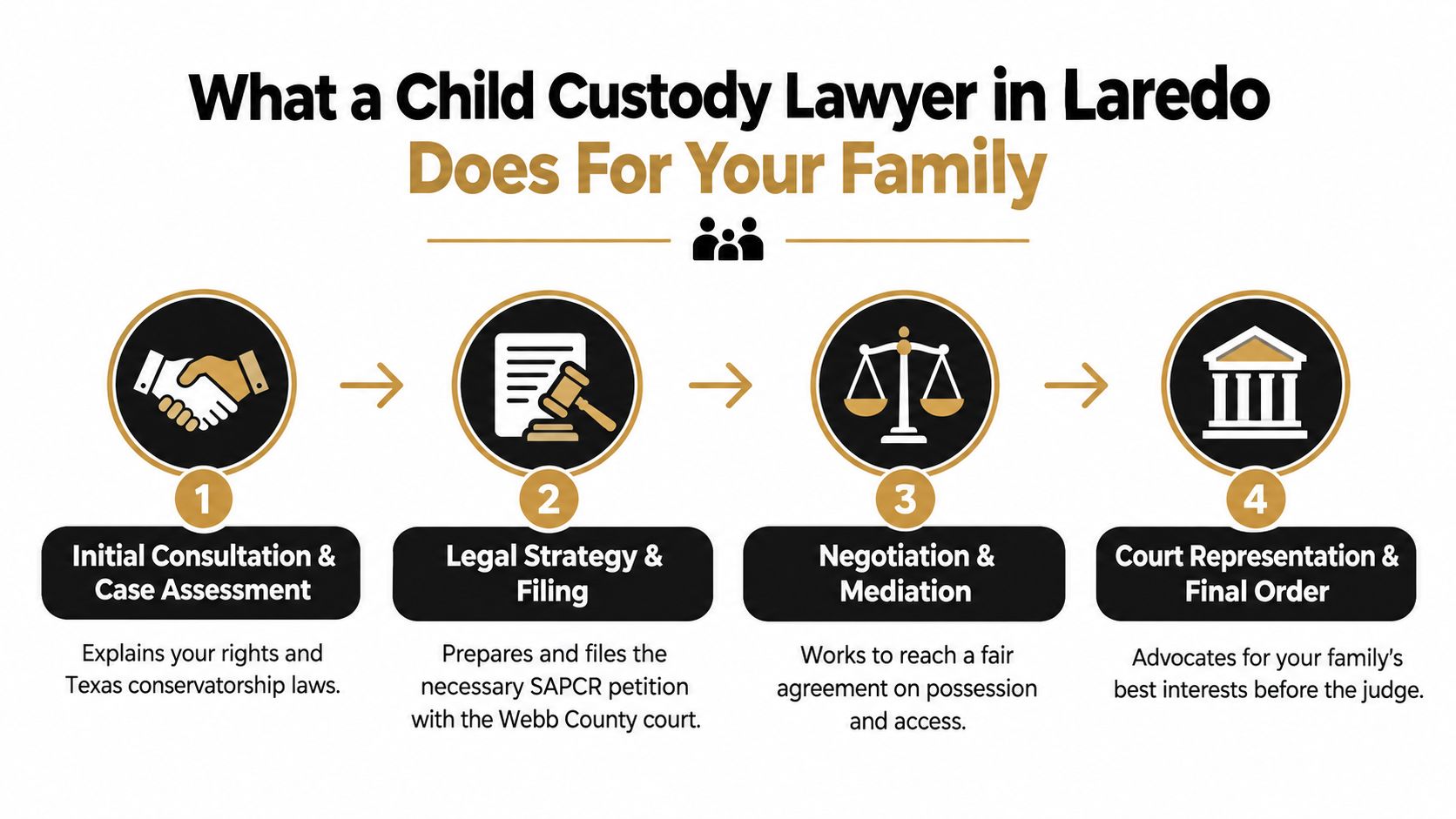
A Laredo custody lawyer typically helps you:
- Assess the situation: Review your child's living arrangements, school, health, safety, and relationship with each parent.
- Prepare the SAPCR: Draft the petition requesting orders for conservatorship, possession, access, and support.
- Address immediate needs: Request temporary orders so school mornings, exchanges, and financial responsibilities don't collapse while the case is pending.
- Communicate with the court: Handle filings and procedural matters involving the Webb County District Clerk.
- Negotiate or mediate: Work toward an agreement when cooperation can protect the child from unnecessary conflict.
- Present the case: Prepare evidence and advocate before the judge if settlement isn't safe or realistic.
Local knowledge matters because a parenting plan must fit real life in Webb County. A parent may work across the border, depend on grandparents for afternoon care, or face deployment-related changes. Spanish-language communication can also help a family understand each step without relying on children or relatives to translate important legal information.
Practical rule: A good plan isn't the one that sounds most aggressive. It's the one your family can follow on an ordinary school week.
Mediation through a local dispute-resolution provider, including the Laredo Resolucion de Disputas center, may offer a more cooperative path than trial. Settlement isn't appropriate in every case, especially where safety is involved, but a carefully written agreement can give parents more control over exchanges, holidays, travel, and communication.
How Texas Decides Custody in Webb County Courts
Texas courts don't decide custody by asking which parent feels more deserving. The controlling question is the best interest of the child, a legal standard that focuses on the child's safety, stability, needs, and relationships. Texas Family Code Section 153.002 identifies the child's best interest as the central consideration in conservatorship and possession decisions.
The law also distinguishes between two ideas that parents often combine under the word custody:
- Managing conservatorship concerns decision-making rights, such as education, medical care, and other significant matters.
- Possessory conservatorship concerns possession and access, meaning when the child is physically with each parent.
Texas Family Code Section 153.131 creates a rebuttable presumption that appointing both parents as joint managing conservators is in the child's best interest. That presumption doesn't require equal parenting time. It addresses legal authority, while the possession schedule may still give one parent the majority of school nights or the exclusive right to designate the child's primary residence. The snapshot on Joint Managing Conservatorship in Texas explains that distinction.
What the judge may weigh
A Webb County court may consider the child's home and school stability, each parent's history of caregiving, emotional bonds, and any safety concerns. Family violence can affect the analysis under Texas Family Code Section 153.004. Siblings and extended family may also matter, especially in a Laredo household where relatives help with meals, transportation, homework, or child care.
Large family networks can support a child, but they can also create disagreements about boundaries. A judge is likely to focus on whether the arrangement serves the child, not on how many relatives are involved.
| Decision Area | Joint Managing Conservatorship | Sole Managing Conservatorship |
|---|---|---|
| Major decisions | Parents may share decision-making rights as ordered | One parent receives exclusive authority over specified decisions |
| Primary residence | One conservator may receive the exclusive right to designate residence | The sole managing conservator generally holds that primary-residence authority |
| Parenting time | Possession is set by agreement or court order | The other parent may still receive possession and access |
| Court focus | Whether shared authority serves the child's best interest | Whether exclusive authority is necessary for the child's best interest |
Before filing, review practical guidance on filing for custody in the correct Texas county. County selection, existing orders, and the child's residence can affect how a case proceeds.
The Laredo Custody Case Timeline From Filing to Final Order
A custody case often begins with a consultation, not a courtroom appearance. The lawyer gathers information about the child, the other parent, current living arrangements, school, safety concerns, and what orders already exist. That first conversation helps identify whether the case needs immediate temporary relief or can begin with negotiation.
The case is generally filed as a SAPCR with the Webb County District Clerk. The other parent must receive legal notice through service of citation or another legally valid method. Texas law also includes a waiting period in many family cases, so parents shouldn't assume that filing means a final order will be entered immediately.
What happens after filing
A typical path may include:
- Initial consultation: You explain the facts and gather documents.
- SAPCR filing: The petition asks the court to establish custody, possession, support, and related relief.
- Service or waiver: The other parent receives notice or signs a legally valid waiver when appropriate.
- Temporary orders: The court may set short-term rules for possession, exchanges, support, and decision-making.
- Information exchange: In contested matters, each side may request documents, answers, and testimony.
- Mediation or trial: Parents may reach an agreement, or a judge may decide disputed issues.
- Final order: The signed order controls the family's rights and responsibilities.
An uncontested case may move more efficiently because the parents agree on the major terms. A contested case can take substantially longer when the court must address evaluations, testing, competing witnesses, or disputed evidence. The timing depends on the court's schedule, service, the number of disagreements, and whether the parties cooperate.
A temporary order isn't the final answer, but it can prevent weekly uncertainty. It may establish where the child attends school, when exchanges occur, and how parents communicate while the case continues.
This video provides another general explanation of the custody process:
Possession Schedules, School Choices, and Real-Life Parenting Plans
Consider a composite family, the Riveras of Del Mar Hills. One parent works night shifts, while the other commutes across the bridge. Their parenting plan has to do more than divide weekends. It must explain who handles school pickup, how missed time is addressed, and where the child goes when a holiday interrupts the regular schedule.
A Standard Possession Order commonly uses a pattern involving first, third, and fifth weekends, along with weekday periods and holiday rotations. Texas Family Code Chapter 153 also contains a summer-access rule. If the managing conservator gives written notice by April 15, that parent receives possession for one weekend during the other parent's summer period, from Friday at 6 p.m. to Sunday at 6 p.m. If the possessory conservator has the child for more than 30 consecutive days, the managing conservator can receive two such weekends. The statutory language is summarized in this Texas Standard Possession Order resource.
A calendar that matches the child's week
| Period | Who Has the Child | Example Dates |
|---|---|---|
| First weekend | Possessory parent | Friday after school through Sunday evening |
| Thursday period | Possessory parent | After school or 6 p.m. through the next morning, as ordered |
| Third weekend | Possessory parent | Friday through Sunday |
| Fifth weekend | Possessory parent | Friday through Sunday when the month includes one |
| Holiday period | Parent assigned under the order | Christmas, spring break, and other listed holidays |
| Summer period | Parent receiving extended summer possession | Dates selected and noticed under the order |
The exact dates depend on the final order and the school calendar. A plan for a child attending LISD or United ISD should account for teacher workdays, early releases, band practice, soccer at the Soccer Complex, and school events. The parent who has authority to designate the child's primary residence may also have a specific role in enrollment decisions, but the order should state who makes each decision.
Día de las Madres and Christmas can be especially sensitive. Parents should write down exchange times, locations, transportation duties, and what happens if a parent works overnight. A neutral school pickup may be calmer than a crowded parking lot, while a convenient H-E-B location may work when school is closed.
Bilingual communication deserves the same care. Use clear written messages in the language both parents understand, keep the tone respectful, and avoid relying on the child to interpret adult disagreements. A written parenting plan is safer than a verbal handshake because it gives everyone a common reference.
Emergency Orders, Relocation, and Military Custody in Laredo
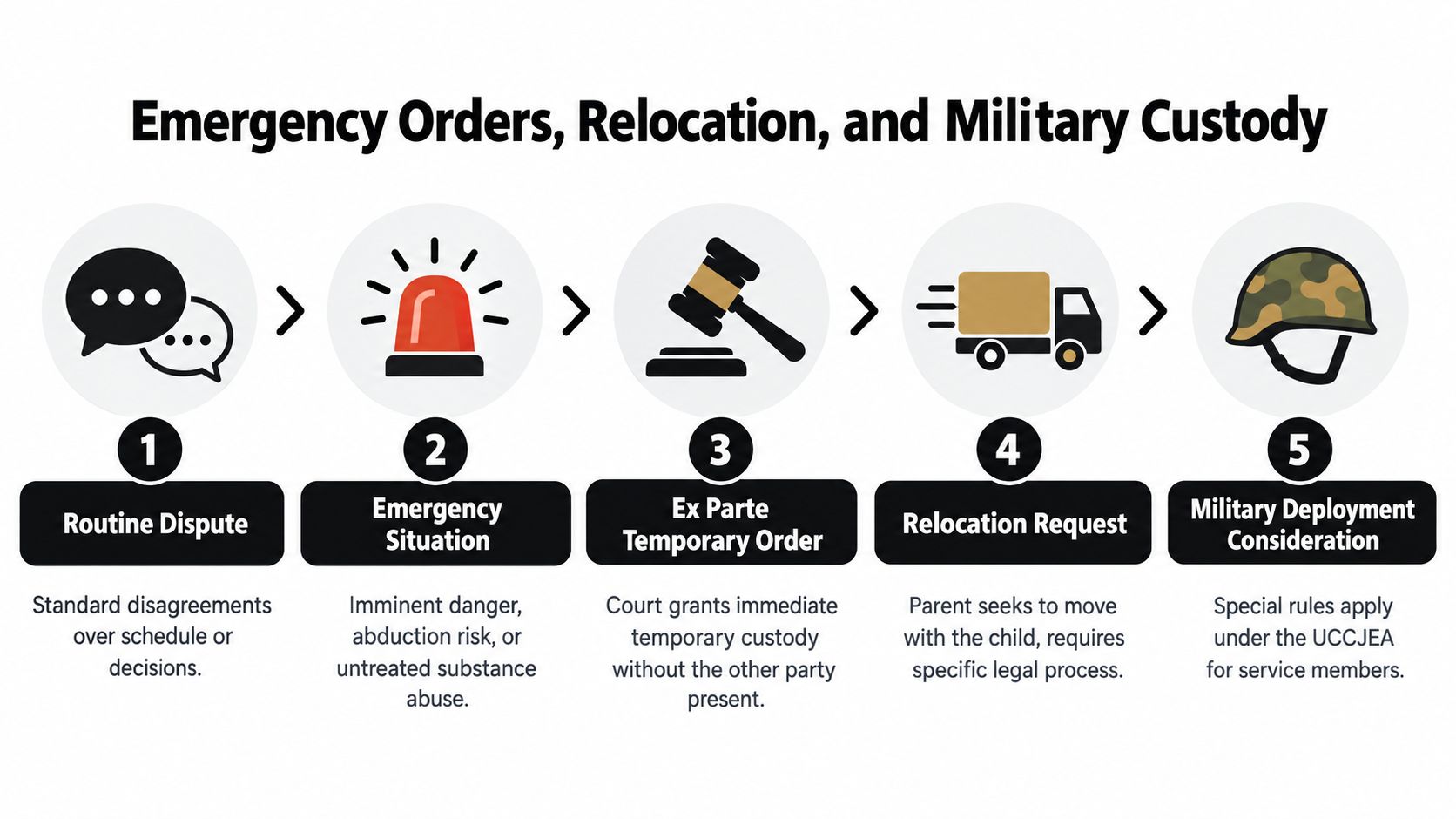
Not every urgent disagreement is a legal emergency. A true emergency may involve imminent danger, a credible abduction concern, or untreated substance abuse that places the child at immediate risk. A parent seeking emergency relief must present specific facts and supporting evidence, not only a general belief that the other household is unsafe.
Texas custody-modification guidance identifies school records, medical records, police reports, drug-test results, and communications as valuable evidence when they connect conduct to harm or disruption. If the concern involves immediate danger, a lawyer may ask the court for an ex parte temporary restraining order or another temporary remedy, followed by a hearing where both sides can be heard.
Relocation and border travel
A move to San Antonio, Eagle Pass, or another state may conflict with geographic restrictions in an existing order. Relocation alone doesn't automatically change the child's primary-residence designation. The parent requesting a modification generally must show a material and substantial change in circumstances and prove that the requested change serves the child's best interest. The court with continuing, exclusive jurisdiction generally keeps the case unless jurisdictional rules shift.
Cross-border travel requires special care in a border city. Review the SAPCR order for notice, consent, passport, and travel terms. If the order doesn't protect the child adequately and the concern is credible, legal advice may be needed before the trip occurs.
You can review a practical discussion of emergency ex parte custody orders while gathering documents for counsel.
Military service creates another layer. A parent connected to Fort Sam Houston, Laughlin, or the Texas Army National Guard armory may need a plan for deployment, temporary caregiving, communication, and return. The Servicemembers Civil Relief Act can affect court proceedings, and Texas custody law contains protections concerning military deployment. A lawyer can coordinate the court order with a family-care plan rather than leaving relatives to guess what authority they have.
Webb County recorded 414 abuse-and-neglect cases in 2024, according to a local legal analysis citing county data. That figure underscores why families facing safety concerns need concrete instructions about temporary orders, affidavits, and evidence, not only broad explanations of custody law. Review the discussion of Texas grandparent and caregiver rights for related threshold issues.
Evidence, Modifications, and How a Lawyer Builds Your Case
A custody case is stronger when the evidence shows the child's actual routine. Angry messages may express real pain, but a judge needs reliable information that connects a parent's conduct to the child's needs, safety, or stability.
Useful records can include:
- Parenting logs: Record dates, exchanges, school involvement, missed visits, and important events without editorial comments.
- School and medical records: Attendance, report cards, treatment history, and appointment information can show continuity or disruption.
- Communication records: Save relevant texts, emails, and notices that show cooperation, threats, interference, or missed arrangements.
- Witness information: Teachers, coaches, relatives, and caregivers may have firsthand knowledge of the child's regular care.
- Home and financial documents: Housing, employment, and household information can help explain whether a proposed plan is stable.
Building a modification record
To modify custody or visitation, a parent generally must prove that circumstances have materially and substantially changed since the prior order and that the modification serves the child's best interest. Examples may include a relocation, a serious change in housing or employment, or a major shift in the child's needs. A child who is at least 12 may express a preference in chambers about which parent should have the right to designate the primary residence, but the child's preference doesn't decide the case by itself.
The court may address requests for drug testing, psychological evaluations under Texas Family Code Section 153.008, or home studies when the facts justify them. Those tools should support a focused legal strategy, not serve as punishment or a way to increase conflict.
A lawyer adds value by organizing records into a clear story. That may include preparing exhibits, identifying witnesses, preparing for mediation, and connecting evidence to the best-interest factors recognized in Texas custody cases, including the considerations commonly associated with Holley v. Adams. The strongest presentation usually shows what the child needs, what each parent has done, and why the requested order is practical.
Evidence should answer a simple question: How does this fact affect this child's safety, stability, or relationship with each parent?
Fees, Consultations, and Choosing the Right Laredo Attorney
Parents often worry about cost before they know what kind of case they have. Fees may be structured by flat fee, hourly billing, or a retainer arrangement, but the actual amount depends on the lawyer, the court work required, and whether the other parent contests the case. Ask for a written explanation of what the quoted fee covers.
Some charges may be separate from attorney fees, such as filing fees, mediation costs, guardian ad litem fees, record retrieval, or testing. Don't assume a consultation price or retainer covers every future service. A clear agreement should explain billing increments, replenishment requirements, communication policies, and costs paid to third parties.
Prepare for the first consultation
Bring organized information rather than a box of loose papers:
- Existing orders: Divorce decrees, SAPCR orders, protective orders, and child-support documents.
- A written timeline: Important events, separations, moves, missed visits, safety concerns, and prior court involvement.
- School and health records: Attendance concerns, medical information, and activity schedules.
- Relevant communications: Messages showing arrangements, interference, threats, or attempts to cooperate.
- Your proposed plan: Where the child would live, how exchanges would work, and how school and work schedules fit.
Ask how the attorney handles communication, whether they regularly appear in Webb County courts, how they approach mediation, and what risks they see in your position. You should leave with a clearer understanding of possible outcomes, even if nobody can promise a result.
A good fit usually includes local court familiarity, honest strategy discussions, transparent billing, and a calm approach to family conflict. Be cautious if a lawyer guarantees victory, pressures you to litigate every issue, or gives vague answers about fees. The right attorney should help you make informed decisions, not replace your judgment.
Focused Answers for Fathers, Mothers, and Grandparents
For fathers
Texas law doesn't give mothers an automatic preference in custody decisions. The law's presumption favoring joint managing conservatorship applies to parents, although the final order still depends on the child's best interest and the evidence.
If legal parentage hasn't been established, start there. A father may need an Acknowledgment of Paternity or DNA testing before seeking enforceable custody or visitation rights. Once parentage is established, he should document caregiving, school involvement, medical participation, housing, work schedules, and a realistic possession proposal. A request for parenting time is stronger when it explains how the child will get to school and maintain important relationships.
For mothers
A mother who has handled most daily care should document that role without turning the case into a competition over every task. Keep school communications, appointment records, activity information, transportation details, and evidence of the child's routine.
If the other parent threatens to move the child, review the current geographic restrictions and seek advice before agreeing to travel or relocation. Texas Family Code Section 153.001 recognizes a public policy supporting frequent and continuing contact between children and parents when contact is safe and appropriate. That policy doesn't require a parent to ignore credible danger. Safety concerns should be presented with specific records and a requested legal remedy.
For grandparents and relatives
Grandparents don't have an automatic right to possession or access. The Texas State Law Library explains that a grandparent must meet statutory standing and best-interest requirements, with qualifying circumstances that may include divorce, incarceration, death, incompetence, abuse or neglect, or the child living with the grandparent for at least six months. The court must also address whether denying access would significantly impair the child's physical health or emotional well-being. Review the Texas grandparent visitation guidance before filing.
Texas standing rules changed effective September 1, 2025. The law now requires exclusive care, control, and possession instead of “actual care, control, and possession,” and it deleted a separate standing provision that had helped some relatives file. Families should be careful with older online explanations.
In Laredo's extended-family community, abuelas and tíos may provide daily care, but family support alone doesn't guarantee standing. Gather records showing the child's residence, caregiving history, parental status, and any harm or risk connected to denial of access. A confidential consultation can help a father, mother, grandparent, or caregiver understand the correct legal path before taking action.
The Law Office of Bryan Fagan, PLLC helps Texas families with SAPCR filings, custody and visitation disputes, modifications, emergency orders, relocation, paternity, support, and military-related custody concerns. Visit Law Office of Bryan Fagan, PLLC to schedule a free consultation and discuss a practical plan for your child's needs. If you need help with a child custody or visitation case in Texas, our experienced attorneys can guide you every step of the way. Contact The Law Office of Bryan Fagan, PLLC today for a free consultation.