
When your child's future is on the line, understanding your rights matters most. You may be sitting awake with a newborn who still smells like milk while a custody petition rests on the kitchen counter. You're worried about feeding, sleep, bonding, and whether a court will understand what your baby needs.
A custody schedule for a newborn in Texas usually doesn't look like the familiar schedule for a school-age child. Texas law gives courts room to create an infant-specific plan, and that plan should protect the baby's stability while supporting a healthy relationship with both parents.
Why a Newborn Custody Case Feels Different in Texas
A parent facing custody after a baby's birth often feels pulled in two directions. One parent may fear losing precious time during a short and demanding stage. The other may worry that a rigid visitation schedule will interrupt breastfeeding, recovery, sleep, or the baby's daily routine.
The Standard Possession Order, often called the SPO, was built around an older child's life. It typically includes recurring weekends, a weekday evening, holidays, and summer possession. That structure makes more sense when a child attends school and can manage longer blocks away from a primary home. It doesn't automatically fit a newborn who wakes frequently, feeds on demand, and depends on familiar caregivers.
Texas draws a clear legal distinction for children under three. The standard possession order is designed to apply to children age 3 or older, and the court must instead create a prospective order for the period before the child's third birthday. You can review the statutory language in Texas Family Code Section 153.251.
Three practical differences
A newborn plan commonly addresses:
- Shorter, more frequent visits: Several brief visits may help the baby build familiarity with both parents without creating long separations.
- Feeding and breastfeeding: The schedule can account for nursing, pumping, stored milk, bottle acceptance, and the parent's need to maintain feeding routines.
- Predictability over equal time: A judge may favor a dependable plan that protects sleep and caregiving continuity rather than dividing hours evenly.
That doesn't mean one parent is unimportant. Fathers and other nonprimary caregivers can develop meaningful, secure relationships with a baby through regular hands-on care. It means the schedule should match the child's actual needs instead of treating equal time as the only measure of fairness.
Practical rule: A strong newborn order describes how parenting time will expand as the baby demonstrates stability. It doesn't simply state that the child will follow the older-child schedule later.
For parents, this distinction is reassuring. Texas law gives you an opportunity to present the feeding history, caregiving routines, distance between homes, work schedules, and other facts that make your baby's situation unique. The right plan turns those facts into clear exchange times, visit lengths, transportation rules, and transition points you can follow and defend.
The Legal Framework Every Texas Parent Should Know
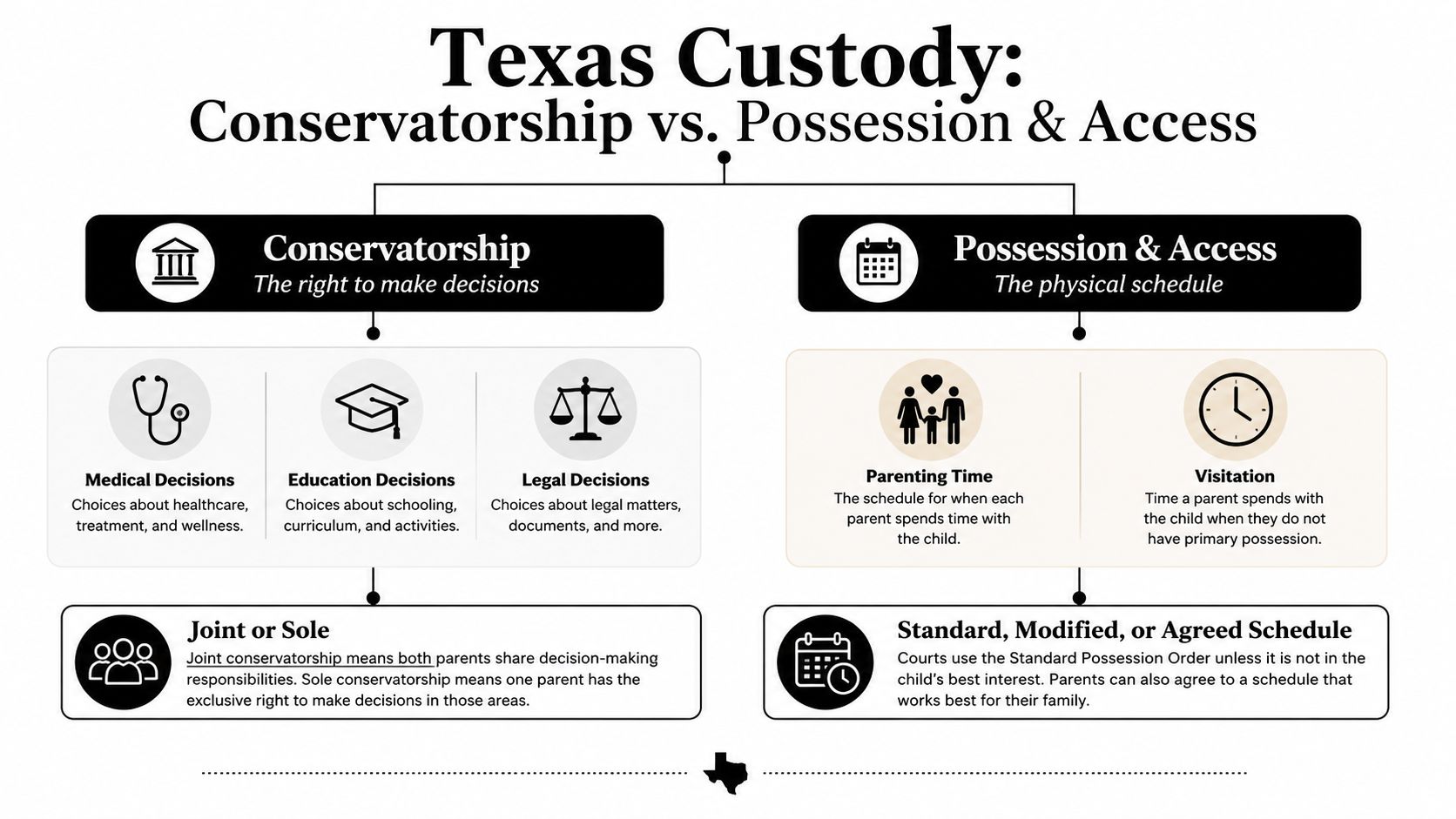
Texas Family Code Chapter 153 uses several terms that sound similar but address different rights. Conservatorship concerns decision-making authority. Possession and access concerns when a parent physically spends time with the child.
A court may appoint parents as joint managing conservators, which generally means both parents share parental rights and duties, even if the child lives primarily with one parent. Joint managing conservatorship doesn't automatically mean equal physical time. One parent may have the exclusive right to designate the child's primary residence, while both parents continue to participate in important decisions under the order.
A parent may also be appointed a sole managing conservator in some circumstances. The label matters, but the specific rights in the written order matter more. Read carefully before signing an agreement that gives up a right, limits access, or creates a restriction you may later struggle to change.
The best-interest standard
Under Texas Family Code Section 153.002, the child's best interest is the court's primary consideration in conservatorship, possession, and access decisions. In plain English, the judge starts with the baby's welfare and stability, not with either parent's preferred schedule. The statute is available through Texas Family Code Section 153.002.
For an infant, that analysis may include feeding, sleep, medical needs, caregiving history, the safety of each home, and each parent's ability to follow a predictable routine. Texas law also encourages frequent contact with both parents, but it allows the court to shape contact around the child's age and circumstances.
The age-three line
Texas Family Code Section 153.254 requires a court to render a prospective order taking effect on the child's third birthday. That order will presumptively be the standard possession order. Texas Family Code Section 153.254 explains why the infant period is a separate phase rather than a smaller version of the later schedule.
For a newborn, the court may issue a customized plan that gradually changes before the child turns three. The plan may include daytime visits, conditions for overnights, transportation details, and a later transition to the SPO.
You can also review a plain-language discussion of infant custody rights in how custody works for infants in Texas. The important point is that parents can agree to a different plan, but if they can't agree, the judge decides what serves the child's best interest.
This video offers another visual explanation of custody concepts:
Factors Texas Courts Weigh for Infants and Toddlers
A Texas judge doesn't decide an infant schedule by asking only which parent wants more time. The court examines the facts connected to the baby's emotional and physical welfare, then turns those facts into practical scheduling choices.
A breastfed newborn may need short, frequent daytime visits with limited or no overnights at first. A baby who accepts a bottle and has a parent who can manage nighttime care may be ready for longer periods sooner. Neither result is automatic. The judge will look at the actual caregiving pattern and the child's response.
| Best-Interest Factor | Typical Schedule Impact |
|---|---|
| Emotional and physical needs | Supports stable routines, familiar caregivers, and transitions the child can tolerate |
| Feeding method and timing | May support frequent daytime contact, pumping arrangements, or delayed overnights |
| Primary caregiving history | Can preserve continuity while the other parent builds hands-on experience |
| Each parent's caregiving ability | May support expansion when a parent reliably handles feeding, soothing, bathing, and sleep |
| Distance between homes | Close residences can make brief, frequent visits more workable |
| Work and childcare schedules | May determine whether visits occur during the day, evening, or weekends |
| Safety concerns and family violence | Can justify restrictions, supervision, protected exchanges, or emergency relief |
| Willingness to support the other relationship | Cooperative communication can support a broader, more flexible plan |
The court may also consider medical records, pediatric guidance, the parents' physical and mental health, the stability of each home, and whether either parent has previously neglected or endangered the child. A parent's gender doesn't decide the schedule. Mothers and fathers both strengthen their position by showing safe, consistent, hands-on care.
Turning facts into a defensible plan
Suppose the mother has handled nearly all feedings and the father lives nearby but has limited newborn-care experience. A judge may view frequent daytime visits, with the father completing feedings and diaper changes, as a sensible starting point. If those visits go well and the baby develops a predictable sleep routine, longer periods may follow.
Distance can change the answer. Parents who live close together may exchange the baby for brief visits without exhausting travel. Parents living far apart may need fewer, longer blocks, but the plan still has to address the child's age and feeding needs.
The central question is stability. A schedule that looks equal on paper may be less suitable than one that gives the baby dependable care and frequent contact with both parents.
Sample Age-Specific Schedules You Can Build From
The following examples are planning frameworks, not guaranteed court orders. Texas courts customize possession for children under three, and parents should adapt every detail to the baby's feeding, sleep, medical, and safety needs.
A 0–3 month starting framework
For a healthy newborn whose parents live close together and have no safety concerns, a starting plan might provide the nonprimary parent with frequent daytime visits that fit the baby's feeding and wake windows. A visit could be arranged around a two- to three-hour period, with the parent handling feeding, burping, diapering, soothing, and supervised sleep as appropriate.
The baby might return to the primary home for overnight care. The parents could also identify a neutral exchange location or use a calm handoff at one parent's home. A written plan should state who supplies diapers, clothing, medication, pumped milk, and emergency contact information.
If a parent has never cared for the baby alone, the schedule might begin with visits at the primary home or another safe setting. Supervised visitation may remain appropriate when there are credible safety concerns, substance-related risks, family violence, or a court-identified need for observation.
A 3–6 month expansion framework
As the baby develops a more predictable routine, the plan may add longer daytime blocks and consider a single overnight if the child accepts the arrangement and the parent can manage feeding and sleep safely. The order should identify what supports that transition, such as successful bottle feeding, reliable exchanges, consistent caregiving, and the child's tolerance for separation.
A parent shouldn't treat an age range as an automatic trigger. The court may require a review, a written agreement, or a specific milestone before expanding possession.
| Schedule Element | 0–3 Months | 3–6 Months |
|---|---|---|
| Visit length | Short visits built around feeding and wake periods | Longer daytime blocks when the routine is stable |
| Frequency | Frequent contact during the week | Regular daytime contact with added flexibility |
| Overnight progression | Usually limited while feeding and sleep needs remain intense | A single overnight may be considered when appropriate |
| Developmental triggers | Feeding support, comfort, safe caregiving, predictable handoffs | Bottle acceptance, overnight tolerance, stable sleep and caregiving routines |
| Logistics | Close exchanges and supplies transferred at each visit | Clear overnight instructions, emergency contacts, and return times |
Parents can trade a weekday visit for an evening block, add a video call when distance makes travel difficult, or extend weekend time when the baby handles transitions well. Any change should preserve feeding and sleep rather than reward conflict.
For a broader explanation of the older-child framework, see the Texas Standard Possession Order. The Texas Standard Possession Order Explained describes how the default Texas visitation schedule works, but that template isn't automatically appropriate for a newborn.
Filing, Temporary Orders, and Modifications
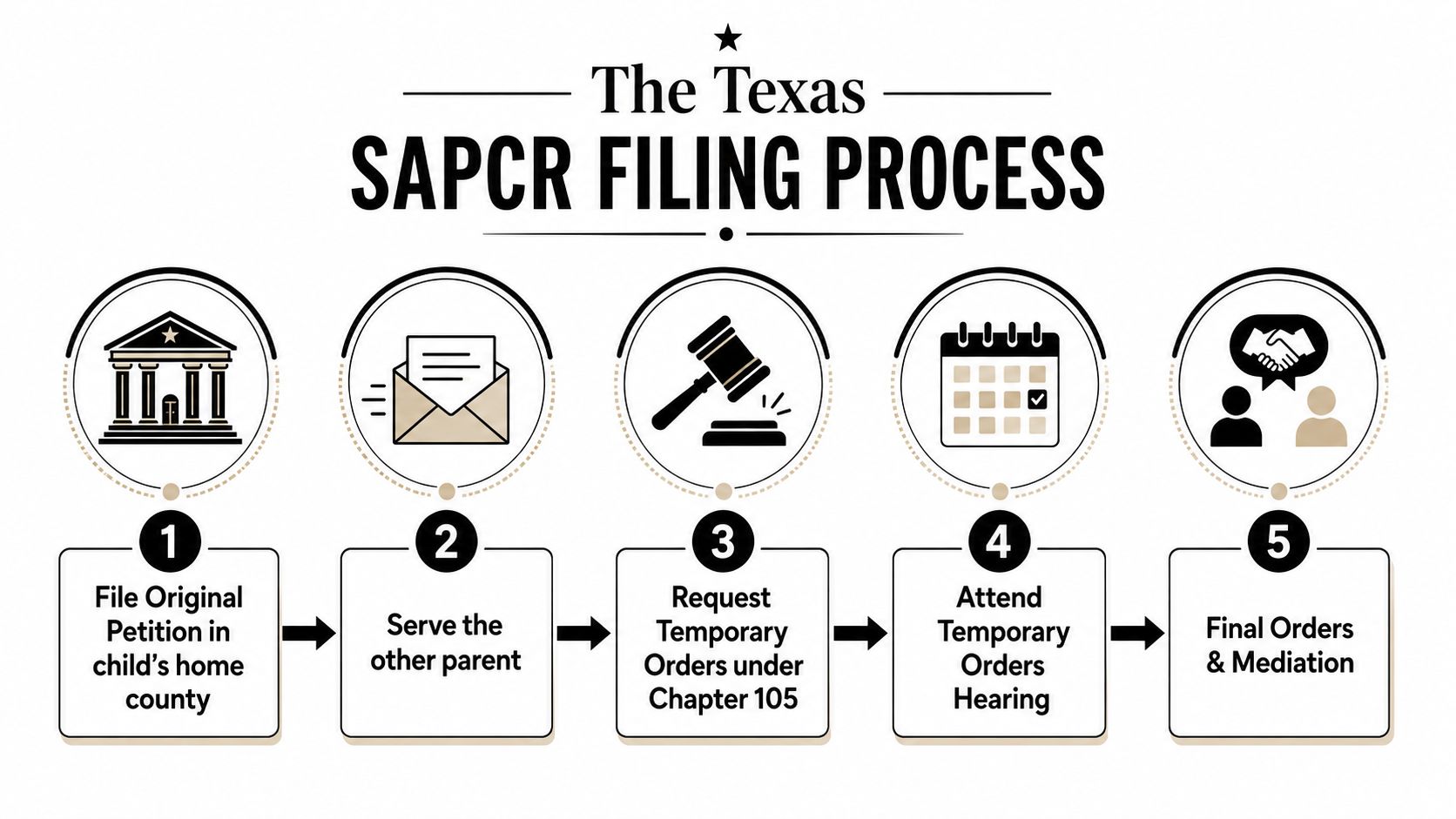
A custody case involving a newborn often begins with a Suit Affecting the Parent-Child Relationship, commonly called a SAPCR. The case is generally filed in the county connected to the child's home, and the other parent must receive formal service unless they voluntarily appear or agree through the proper legal process.
Parents commonly request temporary orders while the case is pending. Under Texas Family Code Chapter 105, the court can address temporary conservatorship, possession, support, and safety issues before final orders are entered.
A practical filing path
- File the Original Petition: State the requested conservatorship and possession terms.
- Serve the other parent: Follow formal service rules or obtain a valid waiver.
- Request temporary orders: Ask the court to establish a workable schedule while the case continues.
- Prepare for the hearing: Organize evidence showing the baby's routine, needs, and safety concerns.
- Resolve or litigate: Parents may negotiate, mediate, or present disputed evidence to the court.
Useful evidence can include feeding logs, pediatrician records, daycare receipts, work calendars, transportation details, and testimony from people who have observed each parent's bond with the baby. Keep records factual. Write down dates, missed exchanges, feeding problems, medical instructions, and messages about schedule changes without adding insults or speculation.
A clear intake packet helps an attorney understand the timeline quickly. Parents can use these intake form best practices for family law to organize key facts, documents, witnesses, and questions before a consultation.
When a parent threatens to take the baby out of state, refuses to return the child, or presents an immediate safety risk, ask an attorney about emergency remedies. The appropriate filing depends on the facts, and emergency proceedings require specific evidence.
Temporary Custody Orders During a Texas Case addresses how custody is handled while a case is pending. You can also learn about what happens at a temporary orders hearing in Texas custody cases.
As the baby grows, circumstances may change. A parent may seek modification when the existing order no longer serves the child's best interest and the required legal standard is met. Don't assume a court will change an order because the child reached a particular age. Review the order with counsel before changing possession on your own.
Co-Parenting and Breastfeeding Logistics That Hold Up in Court
Breastfeeding can create genuine scheduling challenges, not a bargaining tactic. A nursing baby may need frequent access to the breastfeeding parent, while the other parent still needs meaningful opportunities to provide care. Texas law addresses established breastfeeding in a specific context, and parents should discuss the facts with counsel rather than rely on broad promises about what a court “always” does.
A workable plan can state when pumping occurs, how milk is labeled and transported, how bottles are warmed, and what happens if the baby refuses a bottle. A pediatrician's guidance may help parents choose a safe introduction plan, but the order should remain practical enough to follow during a difficult exchange.
A useful proposal sounds like this: “I want you to have regular, hands-on time with the baby. Let's begin with visits that fit feeding and sleep, use the shared feeding log, and review an overnight after the baby is tolerating the routine.”
That approach helps a father show he wants to parent, not merely collect hours. It also helps a mother explain that protecting feeding and recovery isn't an attempt to block the relationship.
Details that prevent conflict
Use one written communication channel for schedule changes. Confirm exchange times, record the supplies transferred, and keep the tone neutral. A shared feeding log can include the last feeding, approximate amount taken, sleep information, medication instructions, and the baby's behavior at exchange.
Parents dealing with intimidation or high conflict may benefit from structured communication practices, including the family-focused guidance in Be Your Best Self Thrive co parenting. The court won't reward hostility. It will care whether each parent can protect the baby from adult conflict and follow the order.
If an adjustment is needed, propose a specific alternative instead of making a vague demand. For example, a parent might request a shorter visit during a difficult feeding period and offer a replacement daytime block when the baby is rested. Cooperation doesn't mean surrendering legal rights. It means creating a record that shows the child's needs come first.
Key Takeaways and When to Call a Texas Custody Attorney
A newborn custody dispute can feel personal, frightening, and urgent. You still have legal options, whether you're a mother protecting feeding and recovery, a father seeking a dependable relationship, or a grandparent or caregiver trying to support the child safely.
Keep these principles in mind:
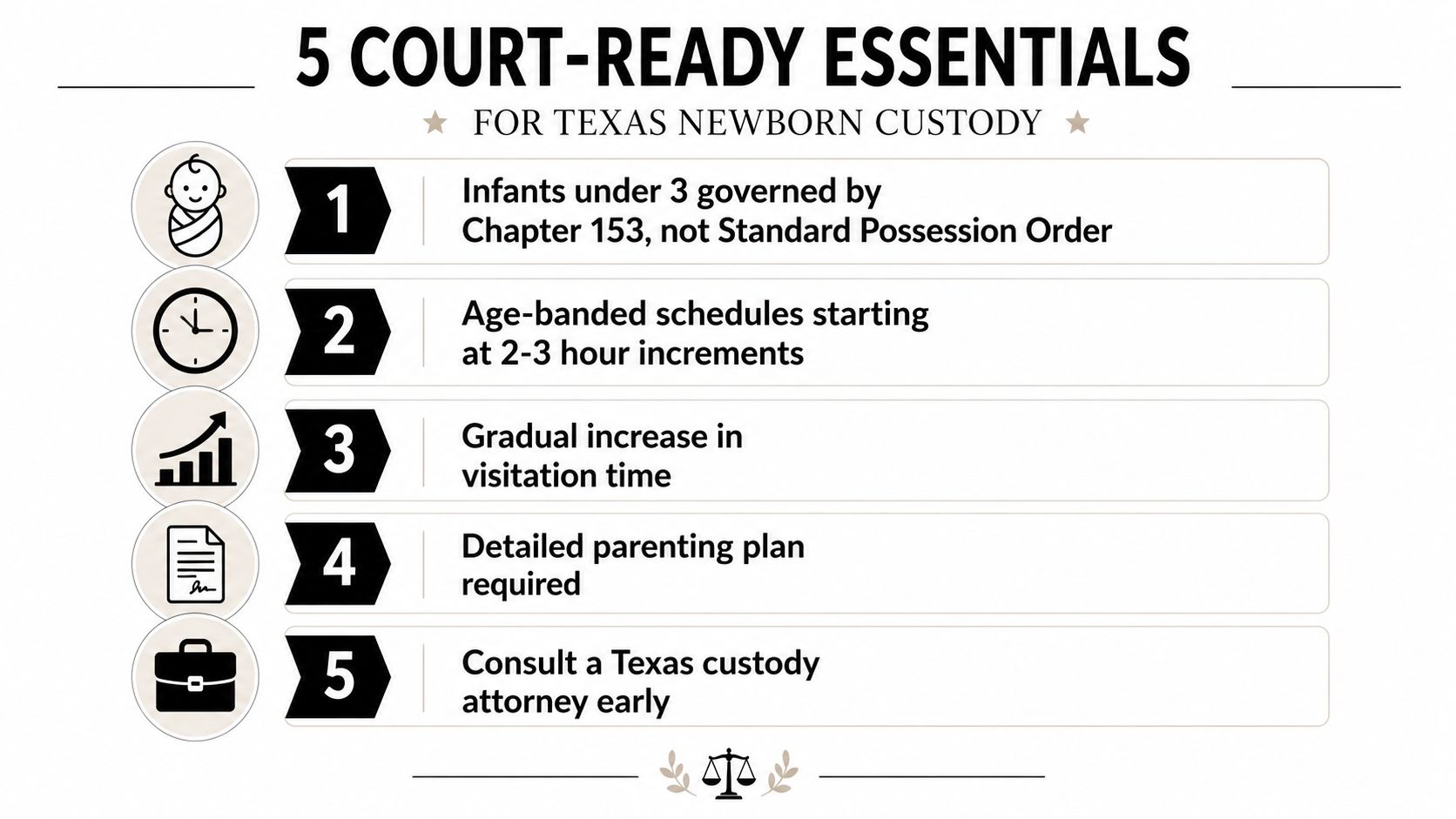
- Infants under three follow a different legal track: Texas law requires an age-appropriate order before the child's third birthday, rather than automatically applying the ordinary school-age schedule.
- Short, frequent contact can work well early: Brief visits may protect feeding and sleep while helping both parents build a caregiving bond.
- Best interest controls: The court weighs stability, safety, caregiving history, feeding needs, distance, work schedules, and cooperation.
- Temporary orders can create structure: A SAPCR or emergency request may provide enforceable rules while the case is pending.
- The plan should evolve: A newborn's needs change, so parents should revisit the order through agreement or the proper modification process.
Contact a Texas custody attorney promptly if there's domestic violence, substance abuse, denied access, disputed paternity, a threat to move the child out of state, or an active CPS investigation. These facts can change the appropriate court strategy and may require immediate protective action.
Next steps for a worried parent
Gather the baby's medical and feeding information, write down the current caregiving routine, save relevant messages, and identify the schedule you believe protects both safety and stability. Don't rely on a verbal promise when the parents disagree. A lawyer can help you understand conservatorship, possession, temporary orders, enforcement, and modification before a rushed decision becomes difficult to undo.
If you need help with a child custody or visitation case in Texas, our experienced attorneys can guide you every step of the way. Contact The Law Office of Bryan Fagan, PLLC today for a free consultation.
The Law Office of Bryan Fagan, PLLC helps Texas parents develop newborn possession plans, request temporary or emergency custody orders, establish paternity, and seek modifications as children grow. Schedule a free consultation to discuss your facts, your baby's routine, and the legal steps available to protect your relationship with your child.