
When your child's future is on the line, understanding your rights matters most. A deployment order can bring pride, fear, and a long list of unanswered questions at the same time. Parents may worry about who handles school pickup, whether the current possession schedule still works, and what happens to their relationship with the child while they're away.
Texas law gives military parents a temporary-deployment framework. Deployment alone doesn't permanently change custody, but it can justify temporary adjustments that protect the child's routine and preserve the deployed parent's role. The right plan usually involves a court order, a workable possession schedule, a trusted caregiver when appropriate, and clear communication terms.
When Orders Come In Before Orders Go Out
A Fort Hood staff sergeant receives orders for a deployment lasting more than sixty days. Her existing Standard Possession Order assumes she'll handle regular exchanges, school pickups, and weekend possession. Her three-year-old's daily routine depends on those arrangements, but the orders give the family little time to solve every detail informally.
That parent now faces two clocks. The military unit has readiness deadlines, while the Texas family court system has its own requirements for possession, conservatorship, service, hearings, and temporary modifications. Waiting for the other parent to “work it out” can leave important rights unsupported when the servicemember leaves.
Practical rule: Deployment changes availability. It doesn't erase parenthood.
A parent who takes no legal action may face missed school pickups, confusion about exchanges, and an informal caregiving arrangement that a court later refuses to recognize. The other parent could also file a SAPCR-related request while the servicemember is overseas, asking the court to change possession or decision-making terms without the deployed parent being prepared to respond.
Texas law provides a better route. A deployed parent may seek temporary relief, request a deployment-specific possession arrangement, and, when appropriate, designate another person to exercise possession under Texas Family Code § 153.705. The military orders example can help parents understand why the wording and timing of official orders matter in a family law case.
Federal law may offer another important tool. Under the Servicemembers Civil Relief Act, an active-duty parent whose service materially affects participation may request a stay of proceedings. The initial stay is typically 90 days when properly requested in writing, although any further delay depends on the judge's discretion. The parent should address both tools before departure, not assume one will solve every problem.
The strongest plan keeps the child's home, school, medical care, and emotional connections stable while preserving the servicemember's legal position. It also makes the return transition clear, so temporary arrangements don't become permanent by default.
How Texas Custody Law Treats Military Parents
Texas uses the term conservatorship instead of saying “custody.” Conservatorship describes the rights and duties a parent has, including participation in major decisions about education, medical care, and the child's general welfare. Possession and access means the time a parent spends with the child, often called visitation in everyday conversation.
A joint managing conservatorship means both parents share parental rights and responsibilities. It doesn't necessarily mean equal time, and it doesn't automatically answer which parent handles the child's primary residence. The possession schedule supplies those practical details.
A SAPCR, or Suit Affecting the Parent-Child Relationship, is the Texas case used to establish or modify conservatorship, possession, access, and related child issues. If parents already have an order, the usual request is a motion to modify within that existing case. If there's no controlling case or order, an original SAPCR may be necessary.
The child's best interests control
Texas Family Code § 153.001 places the child's best interests at the center of custody decisions. In plain English, the judge asks what arrangement supports the child's safety, stability, emotional needs, relationships, and daily care. The court doesn't decide based only on a parent's military status, gender, or personal preference.
Texas Family Code §§ 153.701 through 153.705 provide temporary deployment-related procedures. They allow the court to address possession during deployment and, when appropriate, approve a designated person to exercise the deployed parent's possession. Texas Family Code § 156.101 generally governs modification requests, but deployment by itself isn't the required material and substantial change for permanently modifying an existing order under § 156.105. Texas's military relocation and child custody guidance provides useful context for families dealing with service obligations and changing locations.
For parents who were never married, Custody for Unmarried Parents in Texas explains how custody works when the parents were never married.
Deployment is temporary, not abandonment
The federal definition used in this custody context is specific. Deployment means movement or mobilization under official orders for more than 60 days but not more than 540 days, when the orders are unaccompanied or otherwise don't permit family members to travel to the location. That time-bound definition supports Texas's temporary approach.
The key point is simple. Deployment may require a temporary change in possession, but it doesn't automatically strip a parent of conservatorship or permanently end parenting rights. Mothers and fathers should focus on a concrete plan that serves the child, preserves contact, and explains how the schedule will work during and after service.
Preparing Your Custody and Visitation Plan Before Deployment
The best time to address deployment custody is before the report date becomes urgent. Start by reading the existing SAPCR order line by line. Mark every possession period, holiday arrangement, exchange location, transportation duty, and decision-making provision that could be affected by the absence.
Collect the official deployment orders and preserve a complete copy. The court needs reliable information about the service dates, duty location, and whether the assignment meets the legal definition of deployment. Don't rely on a text message or verbal notice from a unit representative when official documentation is available.
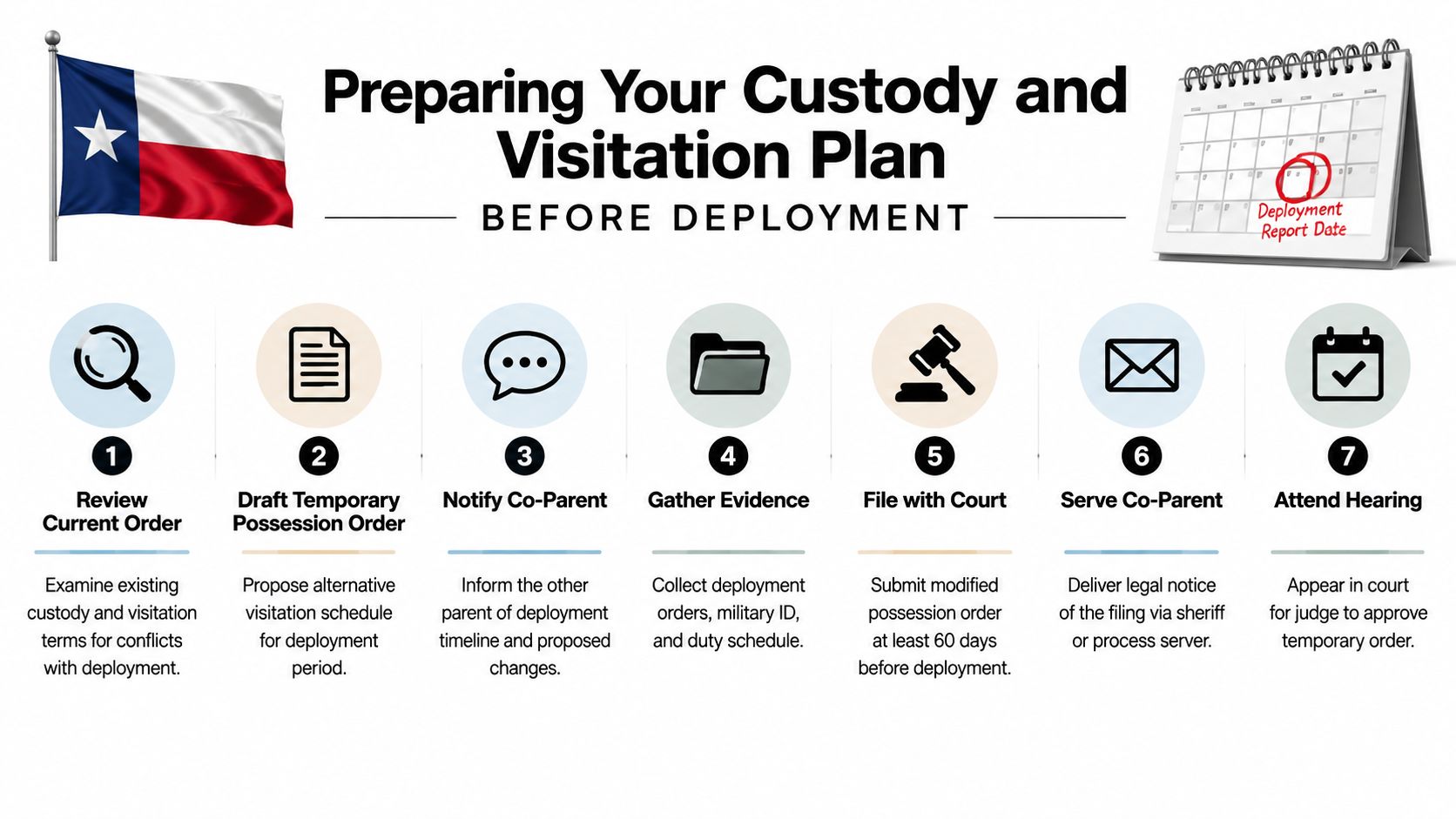
Build the proposed schedule
Draft a temporary possession schedule that answers practical questions:
- Daily care: Identify where the child will live, who handles school, and how ordinary routines will continue.
- Parenting time: Explain which periods the other parent will exercise and whether the deployed parent's possession can be exercised by a designated caregiver.
- Communication: Set out video calls, phone calls, messages, and reasonable alternatives when duty conditions interfere.
- Transportation: Assign pickup, drop-off, exchange locations, and travel responsibilities.
- Return transition: State how the family will move back to the prior order when the servicemember returns, unless the child's safety or best interests require another arrangement.
Texas Family Code § 153.015 recognizes electronic communication as part of a parent's relationship with a child. A useful plan should preserve communication channels rather than treating contact as an afterthought. The resource on long-distance and virtual possession offers additional planning ideas for parents separated by distance.
Choose and prepare the caregiver
If the deployed parent has authority to designate someone for possession, identify a person who is stable, trusted, available, and familiar to the child. Confirm that the caregiver can manage transportation, school contact, routine medical needs, and communication with both parents. A relative may be appropriate, but the right choice depends on the child's best interests, not solely family connection.
Coordinate with the other parent as early as possible. A written agreement about the temporary schedule can reduce conflict and may allow the parties to present agreed temporary orders instead of forcing a contested hearing. Even when cooperation is difficult, a clear proposal shows the court that the servicemember planned around the child's needs.
A military family care plan should align with command requirements and Texas custody law. It shouldn't replace a court order when the arrangement changes legal possession or decision-making rights. Consider a limited power of attorney for specific child-related decisions before leaving the state, and give the caregiver copies of the order, orders, identification, school information, medical details, emergency contacts, and communication instructions.
Filing for Temporary Relief When Deployment Is Imminent
When deployment is only weeks away, informal promises aren't enough. The proper legal vehicle is usually temporary relief under Texas Family Code § 105.001, paired with the deployment-specific provisions in Chapter 153.
If there's already a custody case and order, the parent generally files a motion to modify in that existing case. If no case establishes the parent-child relationship or no controlling order exists, an original SAPCR may be required. A Texas family law attorney can identify the correct filing based on the existing pleadings, orders, and jurisdiction.
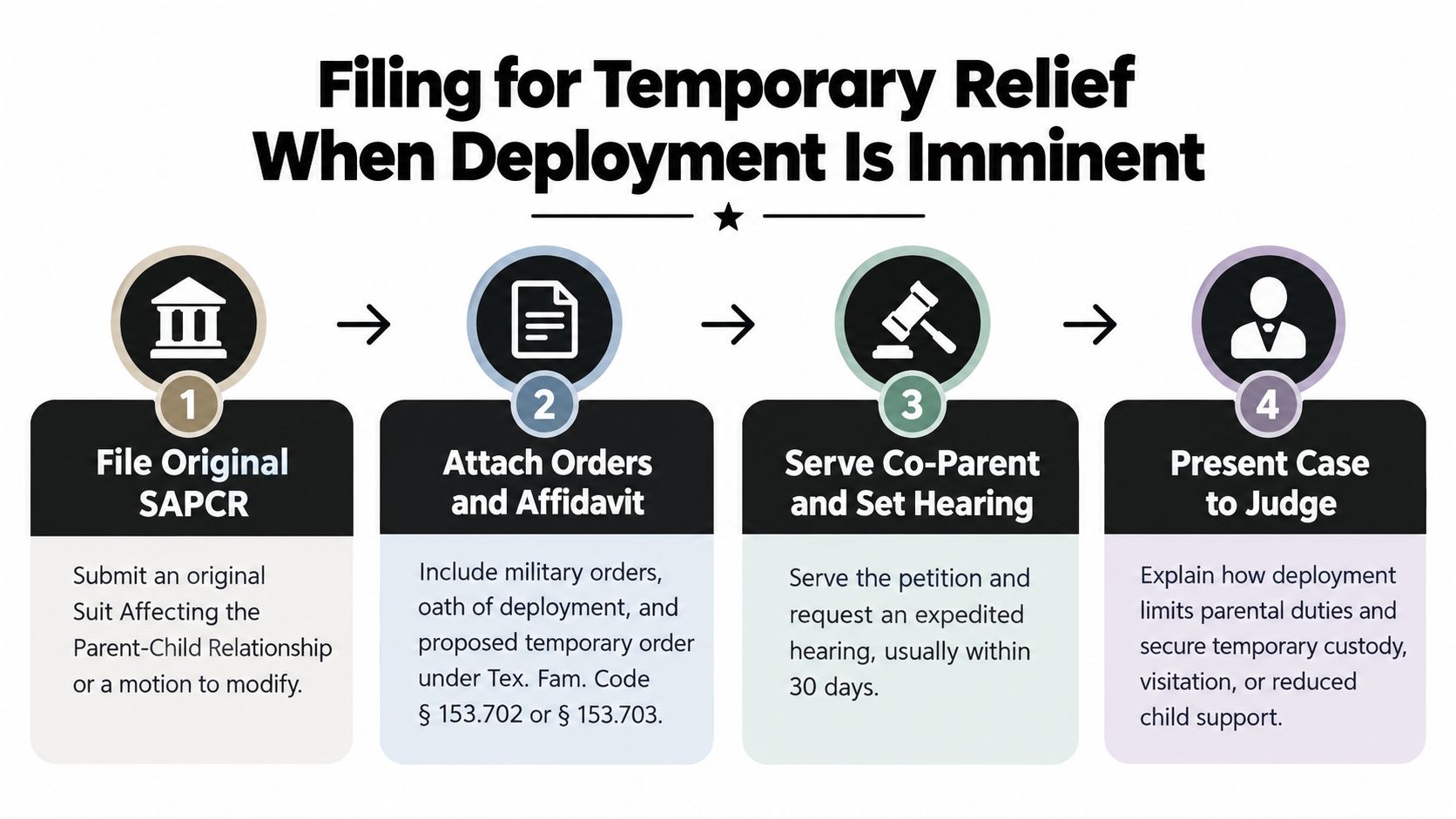
Assemble a focused filing
The filing should give the judge a complete, practical solution. Include the official deployment orders, a proposed temporary possession schedule, information about the designated caregiver, and a draft temporary order that the court can review and sign.
A caregiver designation should be supported with a sworn statement addressing the caregiver's relationship with the child, availability, living arrangements, and ability to follow the order. The proposal should also address school attendance, medical care, transportation, electronic communication, and the return process.
Request an expedited hearing when deployment is imminent. Courts vary in scheduling, but local counsel can identify the right procedure and communicate the service deadline clearly. An associate judge may conduct the temporary hearing depending on the county and assignment. The deployed parent may be able to appear by telephone or proceed through an affidavit under the applicable provisions, including § 153.704, but the court's specific requirements must be confirmed in advance.
Address the other parent's objections
The non-deploying parent may object to the proposed caregiver, question the schedule, or argue that the arrangement disrupts the child. Those concerns deserve a direct response, not a personal attack. Show how the plan keeps the child in a familiar school setting, preserves regular care, supports communication with both parents, and gives the other parent reliable possession.
The judge's focus remains the child's best interests. A parent who asks for a caregiver should explain why that person is safe, dependable, and connected to the child. A parent opposing the designation should identify concrete concerns about the child, not merely argue that deployment should end the other parent's rights.
Service and filing requirements matter. The other parent must receive legally sufficient notice, and the court may require filing fees, verified pleadings, proposed orders, and supporting affidavits. Local counsel should enter an appearance before the servicemember leaves whenever possible, so the case doesn't depend on rushed communication from overseas.
Powers of Attorney and Designated Caregivers
A limited power of attorney and a statutory caregiver designation serve different purposes. A limited power of attorney gives a trusted adult authority for specified tasks, such as communicating with a school, consenting to routine medical services, or handling defined administrative matters. It should state the powers granted, the effective period, and any limits.
A general power of attorney is broader and may create confusion if it doesn't match the custody order. A child-care-specific power of attorney is usually easier for schools, providers, and caregivers to understand because it addresses the child's needs directly. Neither type permanently changes conservatorship or creates a new custody order.
Texas Family Code § 153.705 provides the court-recognized caregiver route. When a conservator who doesn't have the exclusive right to designate the child's primary residence is deployed, mobilized, or placed on temporary military duty, the court may award possession to a person the deployed conservator designates if that arrangement serves the child's best interests. The designated person receives the possession periods the deployed conservator would have had and is treated as a possessory conservator during that period.
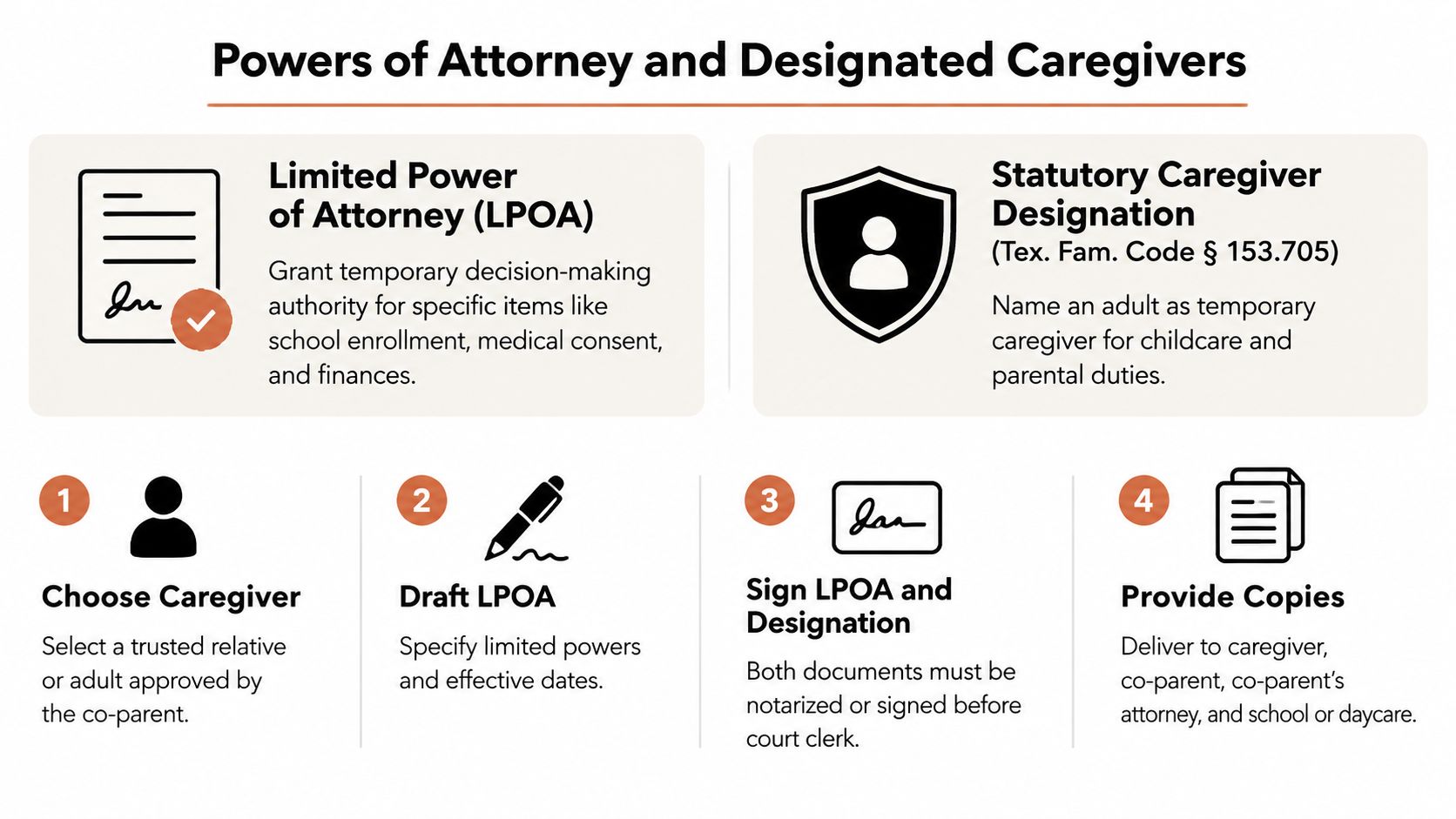
Use each document for the right job
The caregiver designation supports possession under the court's temporary order. The power of attorney supports specific daily decisions. A caregiver may need both, but the documents should not contradict the existing order or attempt to give away rights the deployed parent doesn't possess.
Prepare a practical document packet:
- Court order: Include the current SAPCR order and any temporary deployment order.
- Military records: Give the caregiver the deployment orders and relevant identification information.
- School records: Provide enrollment details, pickup permissions, school contacts, and emergency instructions.
- Medical information: Include insurance details, provider contacts, prescriptions, and consent documents.
- Communication plan: Write down approved call windows, backup methods, and the child's contact information.
- Travel documents: Address authorization for travel and identify situations requiring court approval or the other parent's consent.
Choose a caregiver who can support the child's relationship with both parents. The court may look at stability, familiarity, maturity, availability, and willingness to follow the order. A caregiver should never use the arrangement to block the other parent's lawful possession or communication.
Sign and notarize documents when required, file the designation when the case calls for court recognition, and provide copies to the caregiver, co-parent, school, and medical providers. A power of attorney can't permanently alter custody, authorize a prohibited relocation, or replace a judge's approval for major legal changes.
Using Federal and State Protections During Deployment
The SCRA stay and Texas's temporary deployment provisions solve different problems. The SCRA can protect an active-duty parent who cannot participate meaningfully in a civil proceeding because of service. Texas law supplies the custody framework for handling the child's schedule during the absence.
Under 50 U.S.C. § 3952, an eligible servicemember may request a stay when military service materially affects participation. The initial stay is typically 90 days when requested in writing, while any additional delay remains within the judge's discretion. The stay delays the proceeding. It doesn't automatically cancel a hearing forever, erase child support duties, or create a possession schedule.
Texas Family Code §§ 153.701 through 153.705 address the child's immediate needs. A court may approve temporary possession for a designated caregiver and structure contact with the deployed parent. The temporary order generally ends when the servicemember returns, unless another arrangement is required by the child's safety or best interests.
| Feature | SCRA Stay, 50 U.S.C. § 3952 | Texas Family Code §§ 153.701–153.705 |
|---|---|---|
| Main purpose | Pause or delay a civil proceeding when service materially affects participation | Address temporary possession, access, and caregiver arrangements during deployment |
| Typical initial period | 90 days when properly requested in writing | Tied to the deployment and generally ends when the servicemember returns |
| What it protects | The servicemember's ability to participate in the case | The child's stability and the deployed parent's continuing role |
| What it doesn't do | It doesn't decide the final custody arrangement | It doesn't create a permanent modification based on deployment alone |
| Best use | Request when a parent can't adequately attend or respond | Seek a concrete temporary schedule and caregiver authorization |
Military families are also managing practical preparation beyond the courtroom. For guidance on how military families move pets, review the logistics early so pet care doesn't undermine the child-care plan.
Deployment cannot, by itself, strip a parent of conservatorship, permanently change a final order, or justify reducing child support without a separate legally supported basis. Use the SCRA when participation is the problem. Use Texas temporary orders when the child's schedule and care need a court-backed solution.
Your Next Steps and When to Call a Texas Attorney
Create one deployment file instead of scattering documents across email, a phone, and a desk drawer. Include the current possession order, official military orders, proposed temporary orders, the § 153.705 caregiver designation, limited power of attorney, communication plan, and any written agreement with the other parent.
Use this preparation checklist
- Review the order: Mark every possession period, exchange duty, holiday provision, and geographic term affected by deployment.
- Prepare the caregiver documents: Make the designation and power of attorney consistent with the court order.
- Draft the temporary plan: Cover residence, school, medical care, transportation, communication, and return.
- Preserve proof: Keep official orders, service dates, duty information, and records showing your involvement with the child.
- Protect participation: Request an SCRA stay if service materially affects your ability to participate in a pending proceeding.
- Confirm notice and service: Don't assume a text or email satisfies legal service requirements.
- Plan for enforcement: If the other parent violates an order, review the firm's resource on enforcing a Texas custody and possession order for general information about available remedies.
Waiting until departure is close creates avoidable risk. Informal caregiving without written authority may fail when a school, doctor, or other parent objects. A modification request that skips the temporary-orders path may also ask the court for the wrong remedy.
Contact a Texas family law attorney soon after receiving official deployment orders, before signing a family care plan, when the other parent contests temporary relief, or when an existing order appears inconsistent with § 153.705. Bring the military orders, current custody order, proposed possession schedule, and caregiver information to the first meeting. Early advice gives counsel time to correct jurisdiction, notice, filing, and service problems before they become urgent.
Next step: Don't leave your child's routine and your parental rights to an informal promise. Put the temporary plan in writing and obtain court authority when the arrangement changes possession.
If you need help with a child custody or visitation case in Texas, our experienced attorneys can guide you every step of the way. Contact The Law Office of Bryan Fagan, PLLC today for a free consultation.
The Law Office of Bryan Fagan, PLLC helps Texas military parents prepare temporary possession orders, caregiver designations, communication plans, and SCRA-related filings before deployment. Visit Law Office of Bryan Fagan, PLLC to schedule a free consultation and bring your military orders, current custody order, and proposed possession schedule for personalized guidance.