
When your baby's future is on the line, even a simple question about bedtime can feel overwhelming. You may be wondering whether your infant is ready to spend the night with the other parent, whether a judge will approve it, and how to protect your child without cutting off an important relationship.
Texas law doesn't answer overnight visitation for an infant with one automatic schedule. Courts focus on the best interests of the child, the child's developmental and physical needs, each parent's caregiving history, and the safety and stability of the proposed arrangement. A gradual plan often gives parents a practical way to address those concerns while helping the infant build secure relationships with both parents.
A First Night Away From Mom or Dad
The diaper bag is open on the floor. There are spare clothes, diapers, wipes, a bottle, stored milk, a sleep sack, and a note explaining the baby's usual bedtime routine. The baby is only three months old. One parent is checking the feeding instructions again, while the other is trying to sound confident about handling a nighttime waking.
Neither parent wants the baby to feel unsettled. Both parents love the child. Still, the conversation has become tense. Who gets the last feeding? What happens if the baby won't sleep? Should the other parent call during the night? Is this overnight too soon?
These questions are common because infant care is personal, physical, and demanding. A parent who has handled most feedings may fear that an overnight will disrupt the child's routine. A parent who has had daytime visits may worry that refusing overnight time will weaken the bond with the baby or suggest that the court doesn't recognize their role.
Texas courts step into this private caregiving decision through a legal standard, not a universal age rule. The court may look at the infant's age, health, feeding and sleep patterns, the history of each parent's hands-on care, the distance between homes, and whether each home can safely support overnight care. The court may also consider family violence, abuse, neglect, or other facts that affect the child's safety.
A well-designed schedule can reduce uncertainty. It may begin with frequent daytime care, move to longer visits, include evening routines, and later introduce overnights when the child and parents are ready. That approach doesn't guarantee a particular result, but it gives the court concrete information instead of forcing a choice between all or nothing.
The central question: The court isn't deciding which parent “deserves” the baby more. It's deciding what schedule best supports the infant's safety, stability, and relationships.
What Texas Law Calls Custody and Visitation
Texas family law uses several terms that can sound interchangeable but control different parts of a custody order.
Conservatorship describes the legal relationship between a parent and child. A parent may be named a joint managing conservator, which generally means both parents share certain rights and duties involving important decisions. Joint managing conservatorship does not automatically mean equal time or equal overnights.
Possession and access describes the parenting schedule. It answers practical questions such as when a parent picks up the child, where the child stays, and when the child returns. Overnight visitation for an infant is primarily a possession issue, not a conservatorship label. Two parents can be joint managing conservators while following a schedule in which one parent has more overnights during infancy.
Child support is a separate issue. Parenting time and financial support can affect one another in some legal contexts, but a parent doesn't lose the right to seek possession because support is disputed.
Texas courts often use a Standard Possession Order, but Texas does not apply its standard presumption to children younger than three. Texas guidance explains that courts generally tailor possession for children under three, and short, frequent visits are often preferred over longer, less frequent periods. The Texas State Law Library describes a possession order as the court document that sets when each parent spends time with the child in a SAPCR case. Texas custody and possession guidance from the State Law Library provides useful background for reading that order.
| Legal Term | Plain-English Meaning | Why It Matters for Infant Overnights |
|---|---|---|
| Conservatorship | The legal relationship and decision-making structure between parent and child | Joint managing conservatorship doesn't require equal overnight time |
| Possession and access | The schedule for when the child is with each parent | This is where the order addresses daytime visits, exchanges, and overnights |
| Best interests of the child | The legal standard guiding the judge's decision | The infant's needs and safety come before either parent's preferred schedule |
| Child support | Financial support for the child | It's separate from the question of whether a parent can have possession |
Parents who want to understand how evidence may affect a custody position can also review Casewell for custody evidence. A resource like this can help organize questions and documents before speaking with a Texas family lawyer, though it can't replace advice based on the facts of your case.
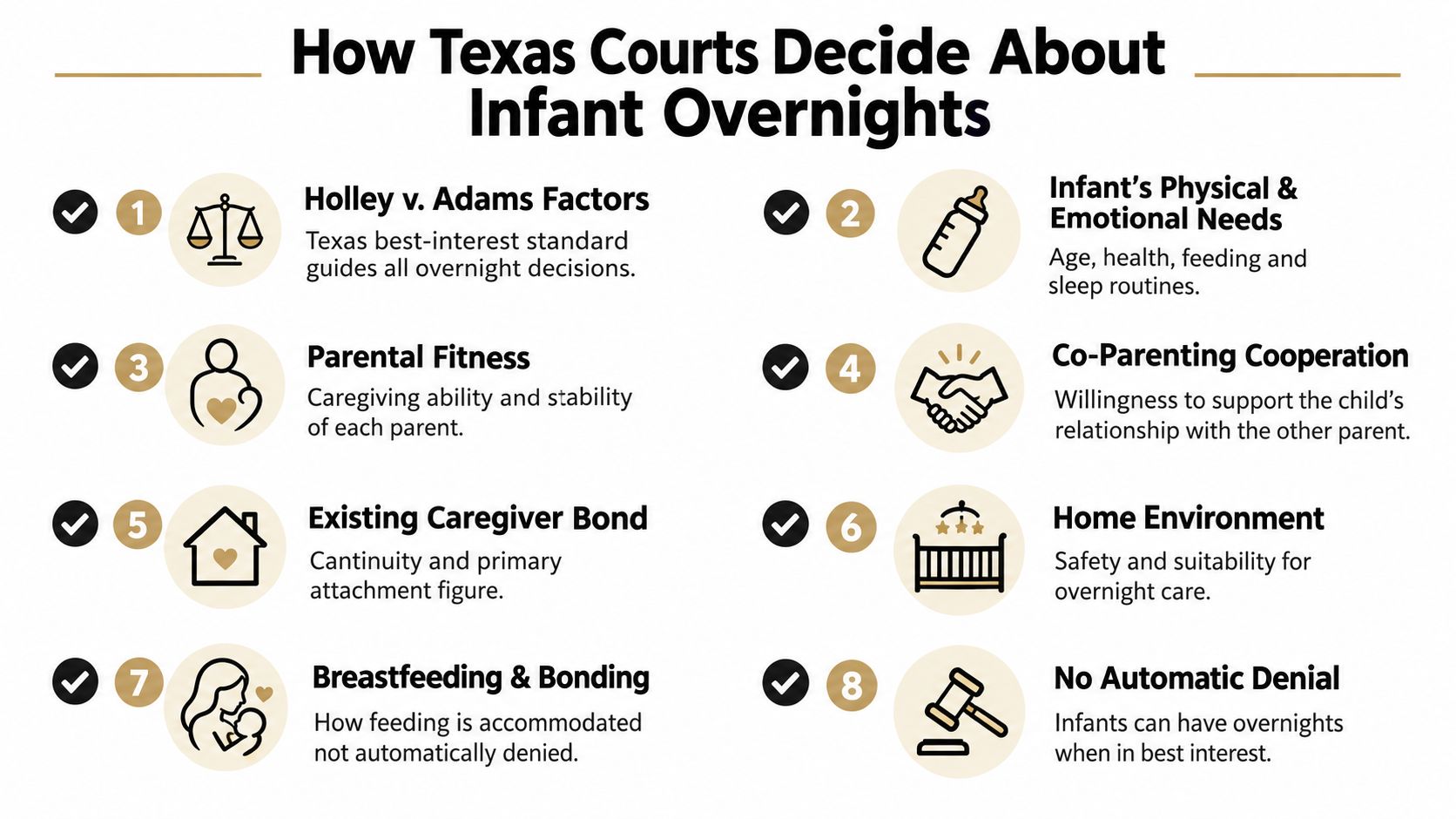
How Texas Courts Decide About Infant Overnights
Texas Family Code Section 153.002 makes the child's best interest the primary consideration in custody, visitation, and access decisions. In plain language, the judge starts with the infant's physical and emotional well-being, not with what either parent wants.
Texas courts may also consider the best-interest factors associated with Holley v. Adams. These factors are not a checklist that mechanically decides a case. They help a judge evaluate the child's needs, the likely effect of a proposed arrangement, each parent's abilities, and any circumstances that could place the child at risk.
For an infant, the evidence often centers on daily care. A judge may want to know who has handled feedings, diaper changes, soothing, bathing, medical appointments, and nighttime waking. The court may consider whether the other parent has practiced those tasks and whether the proposed overnight home has a safe sleeping space and a dependable routine.
The court can also examine cooperation. Texas Family Code Section 153.134 identifies factors involving each parent's ability to prioritize the child's welfare, encourage a positive relationship with the other parent, and support the child's needs. Geographic proximity and the parents' prior caregiving roles can matter as well.
Family violence receives serious attention. A history of family violence removes the presumption favoring joint managing conservatorship. Credible evidence of abuse or neglect creates a rebuttable presumption that unsupervised visitation isn't in the child's best interest. Those concerns can change the analysis from gradual expansion to supervised or restricted contact.
The often-discussed age-three guideline shouldn't be treated as a hard statutory cutoff. Texas guidance says the Standard Possession Order presumption doesn't apply to children younger than three, leaving the court to tailor the schedule. A Texas legal review also discusses an attachment-based guideline that may caution against overnights before age three when a noncustodial parent hasn't actively participated in regular caregiving, while newer research summaries question blanket restrictions and support individualized, step-up arrangements. The landmark Fragile Families study found an association between frequent overnight stays and insecure attachment classifications among infants in separated or divorced families, especially during infancy, but it did not prove that overnights caused the attachment outcomes. The study's full discussion reflects why this topic requires care rather than an automatic answer.
Building a Gradual Overnight Transition Plan
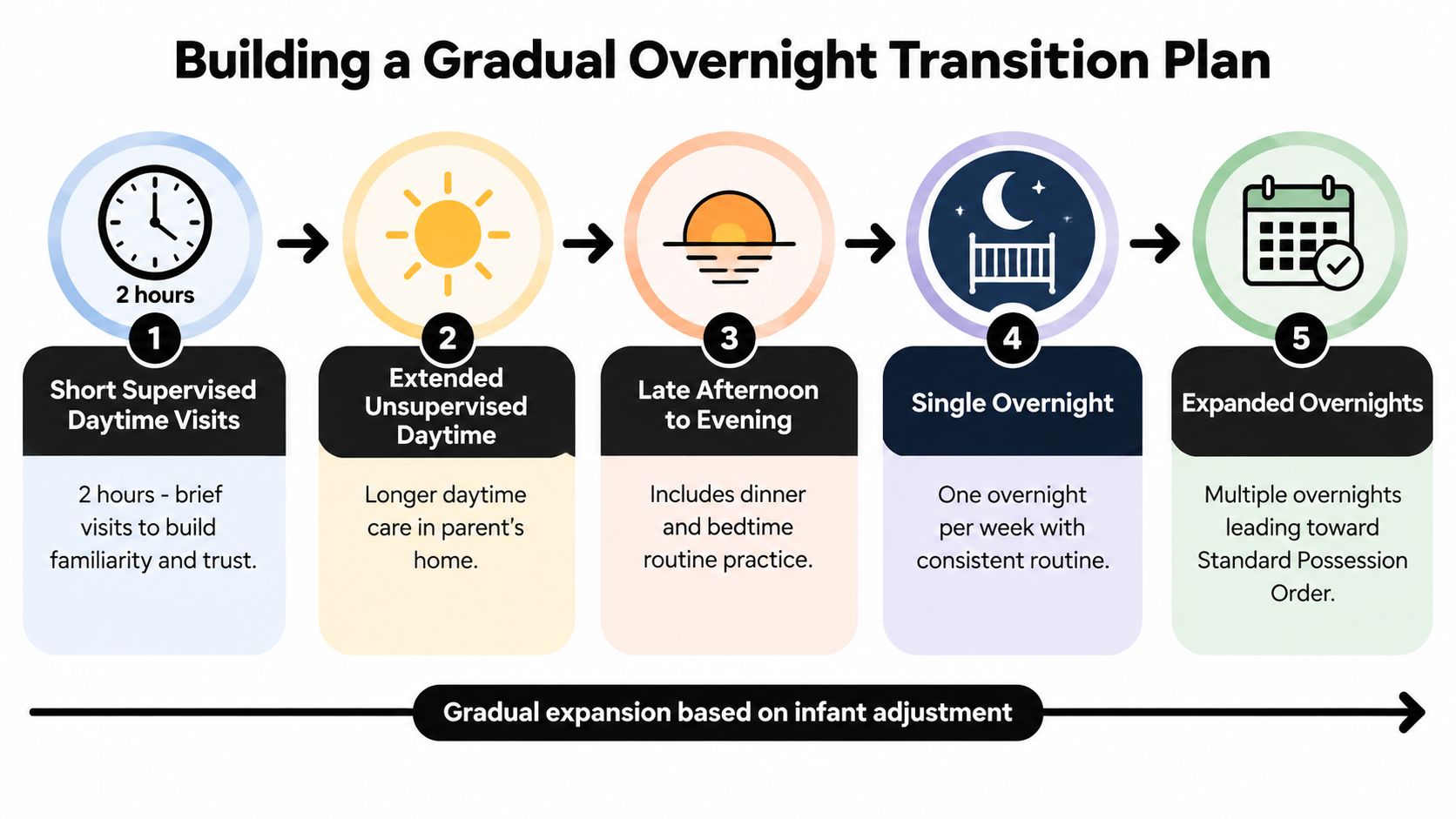
A step-up plan gives the court a way to protect continuity while supporting meaningful involvement by both parents. It also gives parents clear milestones. Instead of arguing only about whether an infant should have an overnight, the parents can address what care will look like before, during, and after the transition.
A proposal might begin with short daytime visits in a familiar setting. The visiting parent should be an active caregiver, not merely a guest. Feeding, diapering, soothing, and naps provide useful practice and help the infant become comfortable with that parent's care.
A practical progression
Short daytime visits: Begin with brief visits that allow the parent to manage ordinary care while the other parent remains available if needed. The exact duration should reflect the infant's routine and health.
Extended daytime care: Move to longer periods in the visiting parent's home. This lets the parent practice feeding, naps, medication instructions, and safe transportation.
Evening routine: Add dinner, a bath, or the bedtime routine before returning the infant. This stage can reveal whether the parent can calmly handle fussiness and sleep preparation.
A single overnight: If the earlier stages have gone well, propose an overnight with a consistent pickup and return time, familiar supplies, and a safe sleep arrangement.
Expanded overnights: Increase overnight time only as the infant adjusts and the parent demonstrates reliable caregiving. The long-term schedule should remain subject to the child's needs and any court order.
Sample language might read: “The possessory parent may exercise daytime possession at the child's home or the parent's home, with exchanges at the child's daycare or another agreed location. After successful completion of the daytime stages, the parent may exercise one overnight from Saturday at 6:00 p.m. until Sunday at 10:00 a.m. The parents will exchange written feeding, medication, and sleep information. The schedule may be reviewed if the child's pediatrician identifies a medical or developmental concern.”
That language is only a starting point. A lawyer should adapt it to the infant's actual feeding method, medical needs, transportation, work schedules, and safety concerns. Parents can keep a neutral record of completed visits, smooth transitions, missed time, and adjustments. A history of successful stages may help support a later request for expanded possession.
Parents dealing with a newborn schedule can review this Texas custody schedule resource for newborns when preparing questions for counsel. A move can create additional complications, and Parental Relocation and Move-Away Cases in Texas addresses how custody may be affected when a parent wants to move with the child.
This short video may also help parents think through practical scheduling concerns:
Evidence That Helps and Evidence That Hurts
Infant overnight cases often turn on ordinary caregiving details. A parent who wants more time should be ready to show more than affection. The strongest presentation usually connects the parent's relationship with the child to specific, safe caregiving habits.
A mother or father can strengthen a request by documenting pediatric appointments, feeding practice, sleep routines, diapering, transportation, and the conditions in the proposed overnight home. A stable crib or bassinet, a workable plan for stored milk or formula, and clear emergency contacts can make the proposal easier for a judge to evaluate.
The opposite evidence can support limits. Missed visits, repeated late returns, unsafe sleep surfaces, substance use, untreated mental health concerns that affect care, or disregard for medical guidance may raise serious questions. A parent shouldn't use a label as a substitute for proof. The court needs reliable facts tied to the infant's safety and well-being.
| Evidence Type | Supports Overnights | Limits Overnights |
|---|---|---|
| Caregiving history | Records of regular feeding, soothing, bathing, and diapering | Little hands-on care or repeated refusal to learn routines |
| Medical involvement | Attendance at appointments and compliance with instructions | Ignoring medical guidance or withholding important health information |
| Sleep environment | Safe, stable sleeping space and a consistent bedtime plan | Unsafe sleep surface, smoking exposure, or chaotic conditions |
| Reliability | Completed visits, timely exchanges, and respectful communication | Missed visits, unexplained delays, or repeated conflict at exchanges |
| Safety concerns | Appropriate supervision and emergency planning | Family violence, abuse, neglect, substance misuse, or immediate danger |
A parent can use a calendar, visitation log, daycare records, pediatric communications, and neutral messages about exchanges. Keep records factual. “The child slept for one hour” is more useful than “the other parent was terrible.”
These documents may be relevant in temporary orders and final hearings in counties such as Harris, Dallas, and Travis, but local procedures and judicial expectations can differ. The distinction between legal authority and parenting time is also explained in Conservatorship vs. Possession and Access in Texas, which can help parents understand why a parent may share decision-making authority without receiving equal possession.
Negotiation, Mediation, and Emergency Options
Parents don't always need to begin with a trial. If the infant is safe and both parents can communicate, a written agreement may resolve the immediate dispute. The agreement should identify exact exchange times, feeding instructions, sleep arrangements, transportation, video calls, and what happens if a visit is missed.
Parent-led mediation offers another path. A neutral mediator can help parents build a step-up schedule without requiring them to argue every issue in front of a judge. Texas Family Code Section 153.0072 addresses court-ordered mediation, which may be required before trial in some cases. Mediation works best when both parents can negotiate freely and disclose the information needed to create a safe plan.
Temporary orders may be appropriate when parents need a court-enforced schedule before a final hearing. Under Texas Family Code Section 105.001, a judge may address temporary issues affecting possession and access. A temporary order can give the family a clear interim structure while the case continues.
Emergency relief is different. A parent seeking immediate action generally needs facts showing a serious and immediate concern, such as abandonment, family violence, or danger to the child. Depending on the facts, an emergency motion or a writ of habeas corpus may be relevant. Emergency procedures are not a shortcut for an ordinary scheduling disagreement.
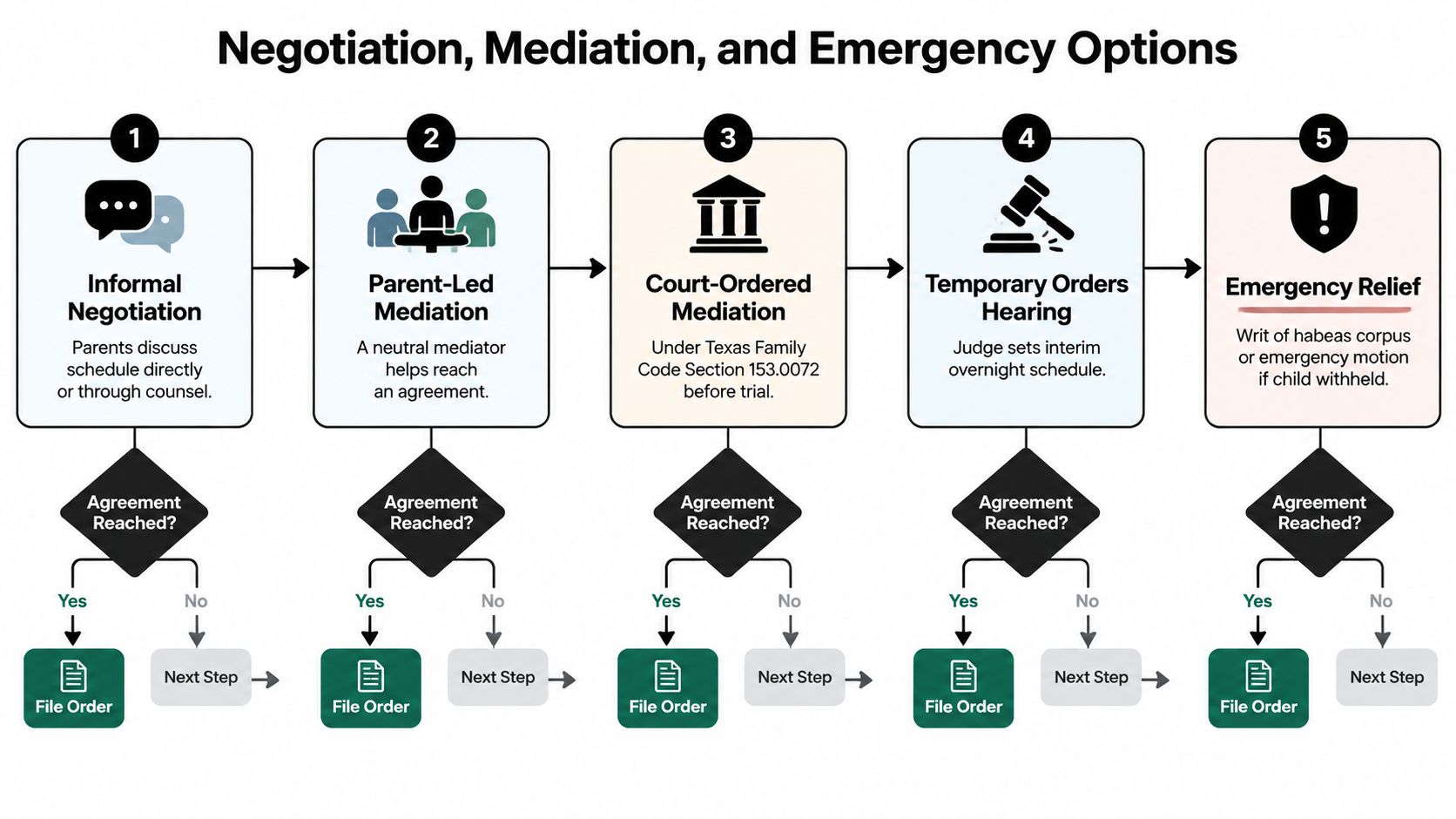
A practical decision path looks like this:
- Start with a written proposal: Put the infant's routine and the transition stages in concrete terms.
- Use mediation if safe: Ask a neutral professional to help resolve disagreements.
- Request temporary orders when needed: Seek an enforceable interim schedule when informal arrangements fail.
- Use emergency procedures only for urgent danger: Provide specific facts, dates, and supporting records.
- Follow the signed order: Parents can agree to changes when legally appropriate, but a court order should not be ignored.
If supervised visitation is part of the proposed plan, this Texas supervised visitation resource explains the concept in practical terms. Mediation may reduce conflict and expense, but litigation may be necessary when a parent refuses to cooperate or the child's safety is at issue.
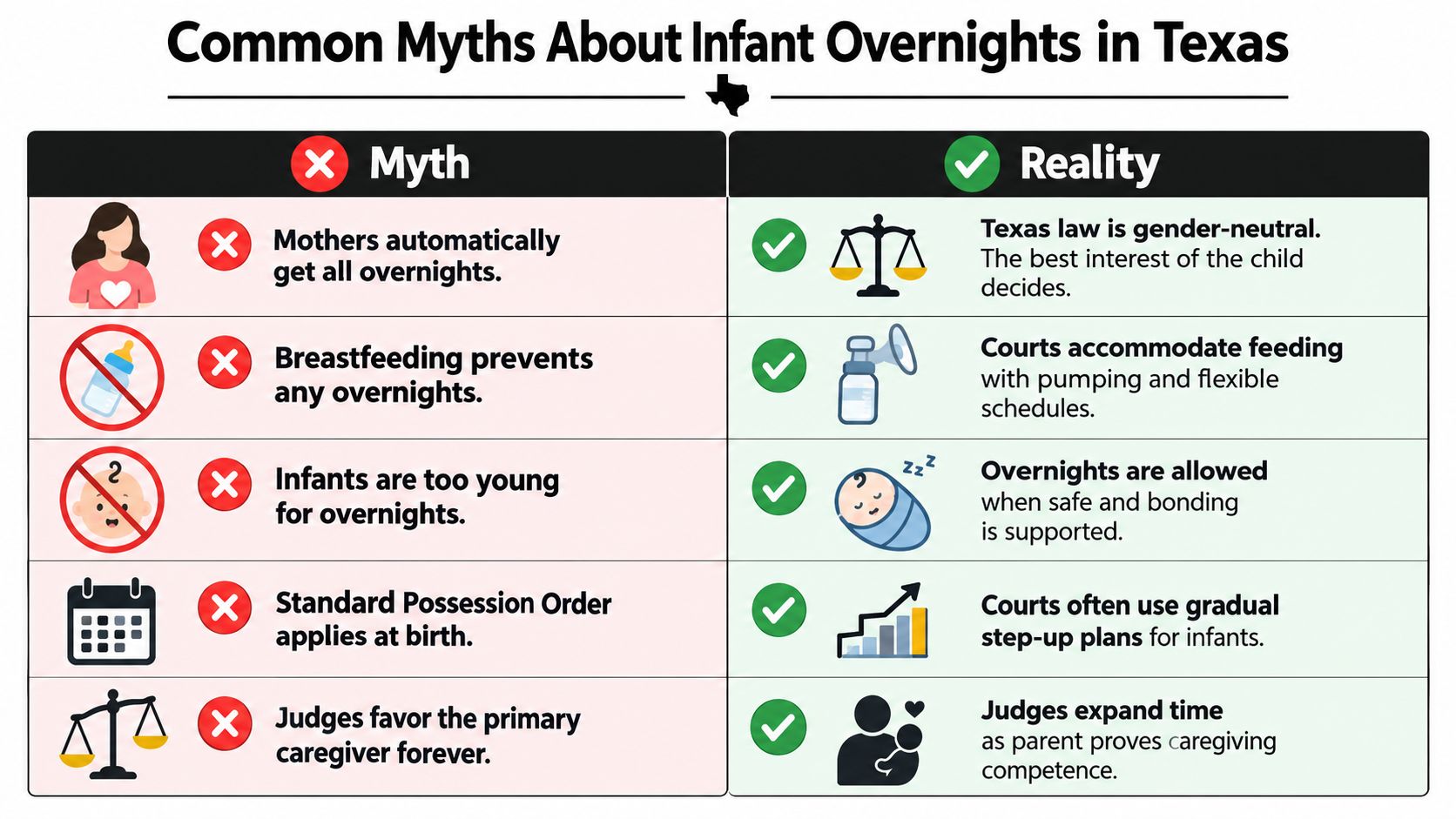
Common Myths About Infant Overnights in Texas
Parents often enter these disputes believing one label will decide everything. Texas courts generally need a fuller picture. The infant's age matters, but so do caregiving history, safety, routine, and each parent's ability to meet the child's needs.
Myth: Texas has a hard age-three rule.
There isn't a statute that automatically prohibits infant overnights until age three. Texas does not apply the Standard Possession Order presumption to children younger than three, and the court instead considers an individualized schedule. Age can influence the result, but it doesn't decide the case alone.
Myth: Breastfeeding automatically prevents overnight time.
Breastfeeding can be highly relevant, especially when the infant needs frequent nursing or the parent cannot use stored milk. But the court can consider how feeding will be handled, whether pumping is workable, and whether the proposed schedule protects the infant's needs.
Myth: Equal possession is the default for an infant.
Joint managing conservatorship doesn't mean a fifty-fifty schedule. Texas courts can modify the ordinary possession framework for young children and may use a gradual plan that gives the infant frequent contact without immediately dividing overnights equally.
Myth: Only one parent can be the caregiver.
The court examines what each parent has done. A parent who has consistently handled feedings, appointments, naps, and soothing may present stronger evidence of readiness, but the other parent can build competence through regular hands-on care.
Myth: Moving out ends a parent's overnight rights.
Leaving the marital home doesn't automatically eliminate possession rights. The parent still needs a safe, workable proposal that accounts for distance, exchanges, and the infant's routine.
The discussion around the former “tender years doctrine” can create confusion, so parents may find this Texas tender years doctrine explanation useful. The practical lesson is simple: evidence of bonding, routine, and safe caregiving usually matters more than calling one parent the primary caregiver.
Key Takeaways and Next Steps
There is no automatic age cutoff that answers every overnight visitation infant Texas case. Texas courts apply the child's best-interest standard and may consider the infant's age, developmental needs, feeding and sleep routines, each parent's caregiving history, home stability, geographic distance, cooperation, and any evidence of family violence or danger.
A gradual schedule can be persuasive because it connects parenting time to demonstrated readiness. It may move from daytime visits, to extended daytime care, to evening routines, to a short overnight, and then to expanded possession. The schedule should be specific enough that both parents know what happens at each stage.
Practical steps for parents
- Gather calendars and records: Keep visitation logs, medical information, daycare records, and written communication about exchanges.
- Describe caregiving clearly: Note who handles feedings, naps, diapering, appointments, and nighttime care.
- Draft a proposed schedule: Include pickup times, return times, feeding instructions, sleep arrangements, and adjustment procedures.
- Protect the status quo: Follow existing orders, arrive on time, and avoid conduct that could create negative inferences.
- Consider mediation: Use it when both parents can negotiate safely.
- Consult counsel before filing: A Texas family law attorney can help match the request to the facts and the applicable Family Code provisions.
Mothers don't have to surrender legitimate safety concerns to support the other parent's relationship with the child. Fathers don't have to accept indefinite uncertainty when they're prepared to provide safe, hands-on care. Grandparents and other caregivers may also have information that helps explain the infant's routine and support system.
The right plan depends on the child and the evidence. A careful legal review can help you identify what to request, what to document, and whether negotiation, mediation, temporary orders, or emergency relief fits your situation.
If you need help with a child custody or visitation case in Texas, our experienced attorneys can guide you every step of the way. Contact The Law Office of Bryan Fagan, PLLC today for a free consultation. Visit Law Office of Bryan Fagan, PLLC to discuss an infant possession schedule, a step-up plan, modification, or urgent safety concerns with a Texas family law team.