
When your child's future is on the line, uncertainty can feel overwhelming. A co-parent's family ties abroad, sudden passport activity, or talk of leaving Texas may raise serious fears. At the same time, an international connection alone doesn't prove that a parent plans to abduct a child.
Texas Family Code § 153.502 gives courts a structured way to separate a genuine abduction concern from a high-conflict custody dispute. The law focuses on evidence, specific conduct, and practical recovery concerns. Understanding that framework can help you protect your child without relying on assumptions that could weaken your position.
When Your Child's Safety Crosses Borders
A parent may start worrying after seeing a message about a possible move, learning that the other parent renewed a foreign passport, or hearing that a child might visit relatives overseas. Those fears become more intense when parents are already fighting over possession, relocation, or decision-making rights. You may wonder whether the other parent can leave with your child before a court has time to respond.
Texas generally treats joint managing conservatorship as the starting point. Unless evidence shows otherwise, Texas guidance explains that it can be in a child's best interest for both parents to remain managing conservators. Conservatorship concerns parental rights and decision-making, while possession and access describe the parenting schedule.
That starting point doesn't prevent a court from acting when credible evidence indicates a potential international abduction risk. Section 153.502 directs the judge to examine concrete indicators, including prior concealment, threats, recent planning, violence, and violations of court orders. The law recognizes that an ordinary custody disagreement can become much more serious when a child might be taken beyond the practical reach of a Texas court.
Consider a parent who has never hidden the child, has consistently followed the possession schedule, and wants to visit grandparents abroad with advance notice. That situation is different from a parent who has threatened to disappear, recently obtained travel documents, stopped sharing the child's location, or violated an existing order. The legal question is conduct, not nationality.
Practical rule: Protecting your child starts with documenting what happened, when it happened, and how it relates to an actual risk of removal.
A court can use preventive measures when the evidence supports them. The process is designed to address danger before a child is wrongfully removed, while preserving the child's relationship with safe and involved parents.
Understanding the Statutory Framework for Abduction Risk
Section 153.502 works like a two-stage security checkpoint. A judge first looks for credible evidence of a specific behavioral risk. Only after that threshold is met does the court examine the parent's international ties and connection to the United States.
Step one focuses on conduct
The first stage includes indicators such as:
- Prior interference: The parent previously concealed, retained, or removed the child in violation of another person's possession or access rights.
- Abduction threats: The parent threatened to take or keep the child.
- Weak economic ties: The parent lacks a financial reason to remain in the United States.
- Recent preparation: The parent engaged in activity that could facilitate removal.
- Family violence: The parent has a history of domestic violence.
- Disobedience or criminal history: The parent has violated court orders or has a relevant criminal history.
The statute doesn't require every factor to appear. Texas appellate authority explains that credible evidence supporting even one subsection (a) factor may allow a court to find a potential abduction risk and move to the next stage. That means a single serious threat or documented concealment can matter, even if the parent has otherwise maintained a job or home in Texas.
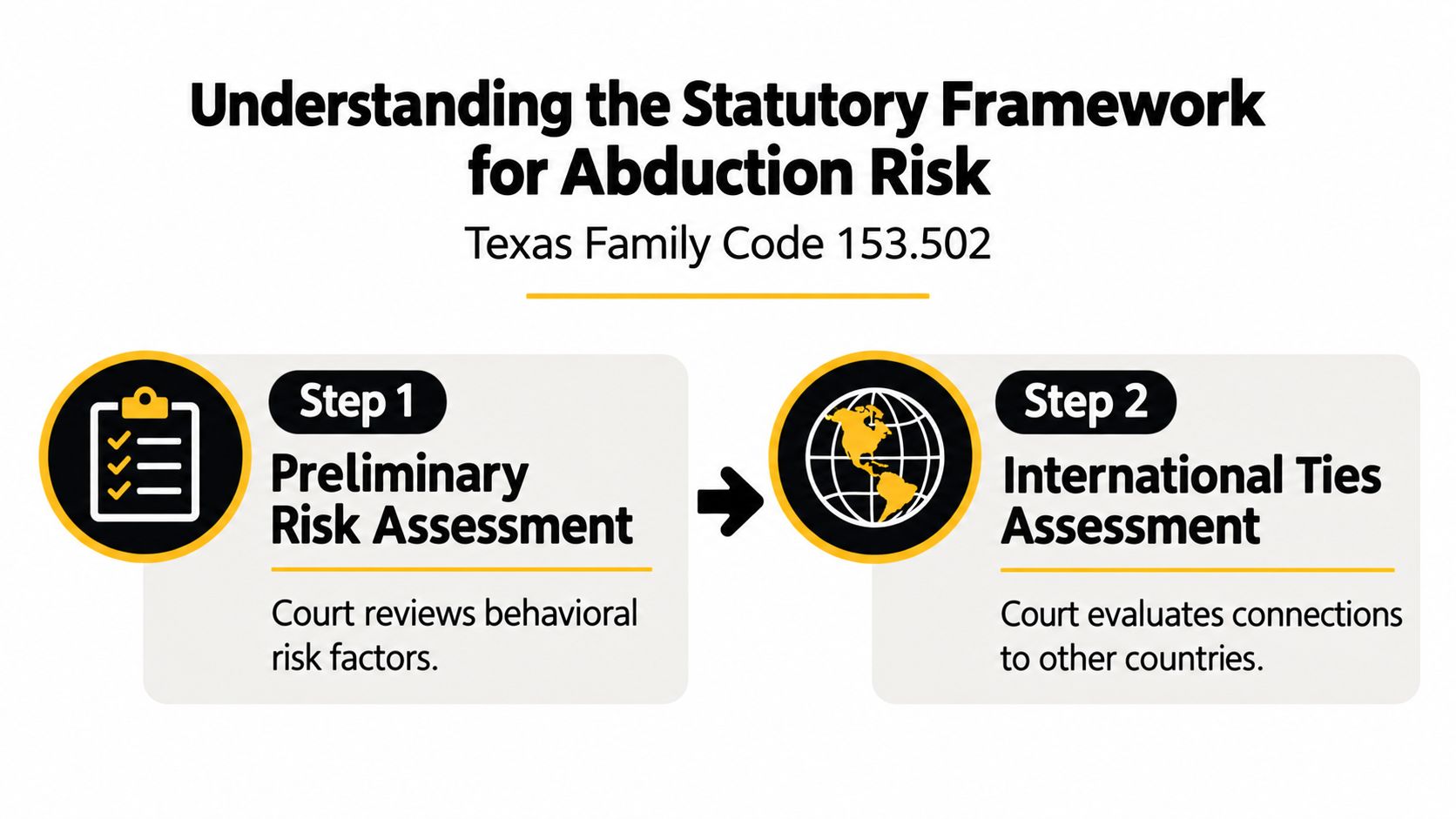
Step two examines international connections
Once the threshold is met, the judge evaluates whether the parent has strong familial, emotional, or cultural ties to another country, particularly one that isn't compliant with the Hague Convention. The court also considers whether the parent lacks strong ties to the United States.
This sequence matters. A parent's foreign relatives, language, citizenship, or cultural identity may be relevant in the second stage, but those facts generally don't replace the need for credible evidence of an initial risk indicator. The framework helps courts avoid treating ordinary cross-border family life as proof of dangerous intent.
The child's overall welfare still matters in the custody case. For a plain-English explanation of The Best-Interest Standard and the Holley Factors, parents can review the factors Texas courts use to decide custody.
The Specific Red Flags Texas Courts Evaluate
Texas courts look for behavior that suggests a parent might remove a child, keep the child away from the other parent, or make recovery difficult. The question isn't whether a parent has traveled before. It's whether the available evidence shows preparation, concealment, threats, or disregard for legal obligations.
Prior concealment or unauthorized retention
Prior conduct often carries significant weight. A parent who previously hid the child, kept the child beyond an authorized possession period, or prevented the other parent from exercising court-ordered access may create a documented pattern of interference.
The details matter. A late exchange caused by a traffic problem isn't the same as turning off a phone, refusing to disclose the child's location, and keeping the child after repeated demands for return. Save messages, exchange records, police reports, and court filings that show what occurred.
Threats to abduct
A threat can be direct or implied. Statements about taking the child somewhere the other parent could never find them, leaving permanently, or refusing to return after a trip may become important evidence. Context matters too. A frustrated statement during an argument may be evaluated differently from a repeated threat accompanied by travel preparation.
Don't edit or exaggerate messages. Preserve the complete conversation, including dates, surrounding statements, and the identity of the sender. Courts need reliable evidence, not a summary based only on fear.
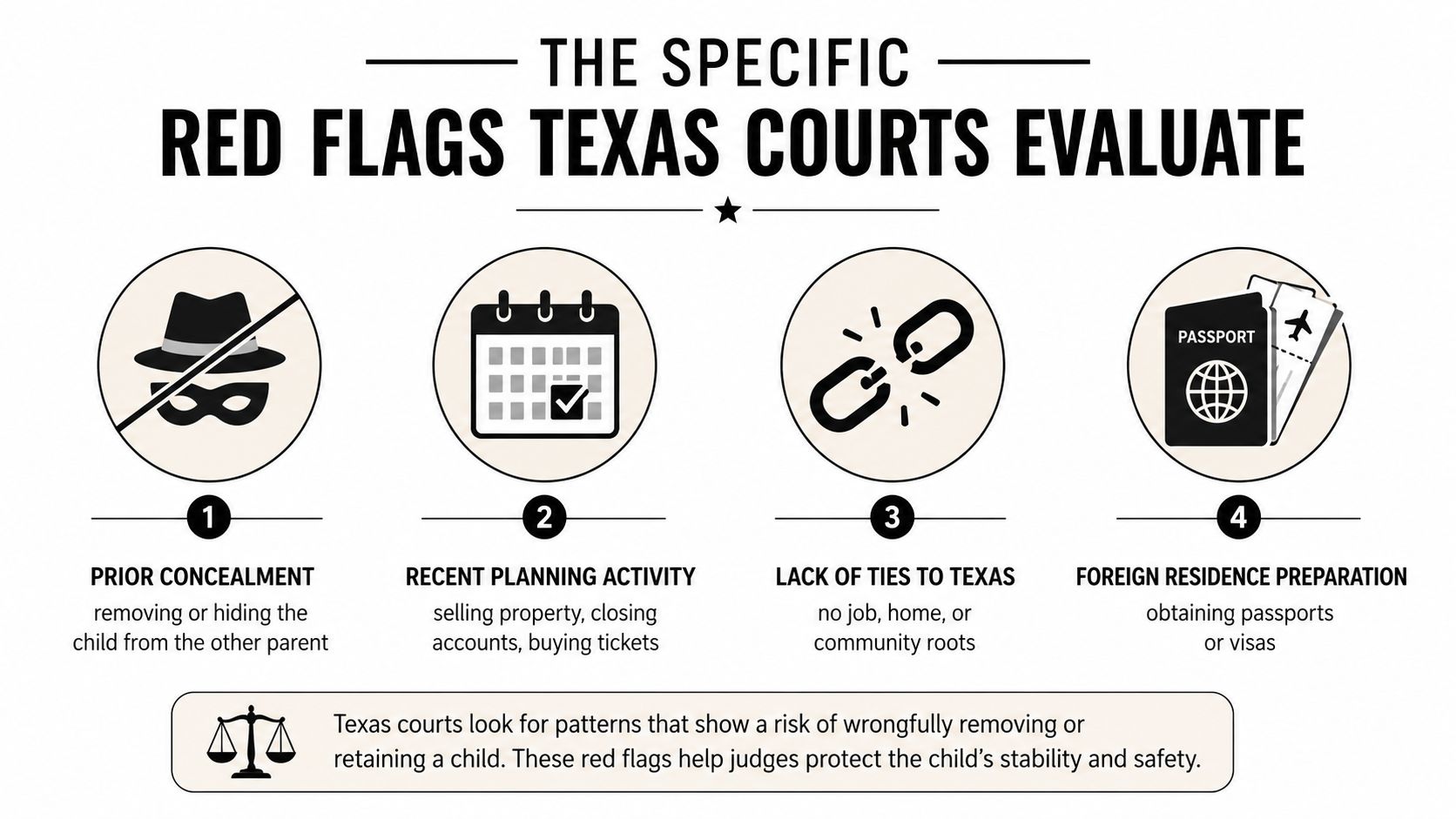
Recent planning activity
Recent activity may suggest preparation for departure when it appears alongside other warning signs. Examples can include arranging travel documents, making plans that would facilitate removal, changing housing or employment, or withdrawing support for remaining in the United States.
A single ordinary travel purchase doesn't automatically establish risk. A pattern can be more significant, such as secret travel arrangements, plans to withdraw a child from school, or efforts to move personal affairs abroad while refusing to provide basic information required by a custody order.
Limited reasons to remain in the United States
Section 153.502 permits courts to consider whether a parent lacks a financial reason to remain in the United States. A weak employment, housing, or community connection may be relevant when combined with other evidence.
That factor shouldn't be confused with income level or immigration status. A parent doesn't become dangerous because they have limited finances or family abroad. The court is assessing whether the parent has meaningful practical ties that make remaining in the United States more likely.
Violence and court-order violations
A history of domestic violence can change the safety analysis. Violence may increase the risk of coercion, retaliation, or sudden removal, especially when the parent has also made threats or ignored court requirements. Prior violations of custody orders can show that the parent doesn't reliably follow legal boundaries.
For a focused discussion of how abuse or violence can affect custody presumptions, see Custody When There Is a History of Family Violence. Parents can also review evidence that may move a judge when proving a parent unfit in Texas, while remembering that abduction risk and general fitness are related but distinct legal questions.
How International Ties and the Hague Convention Factor In
International ties become especially important after credible evidence supports a preliminary risk factor. The court may consider family, emotional, cultural, or financial connections to another country, as well as the parent's lack of strong ties to the United States.
The Hague Convention on the Civil Aspects of International Child Abduction provides a framework for seeking the prompt return of a child who has been wrongfully removed or retained across borders. A country's participation can make legal coordination more available, but it doesn't guarantee a fast or certain result. A country that isn't compliant with the Convention can present greater practical obstacles because the treaty framework may not provide the same recovery path.
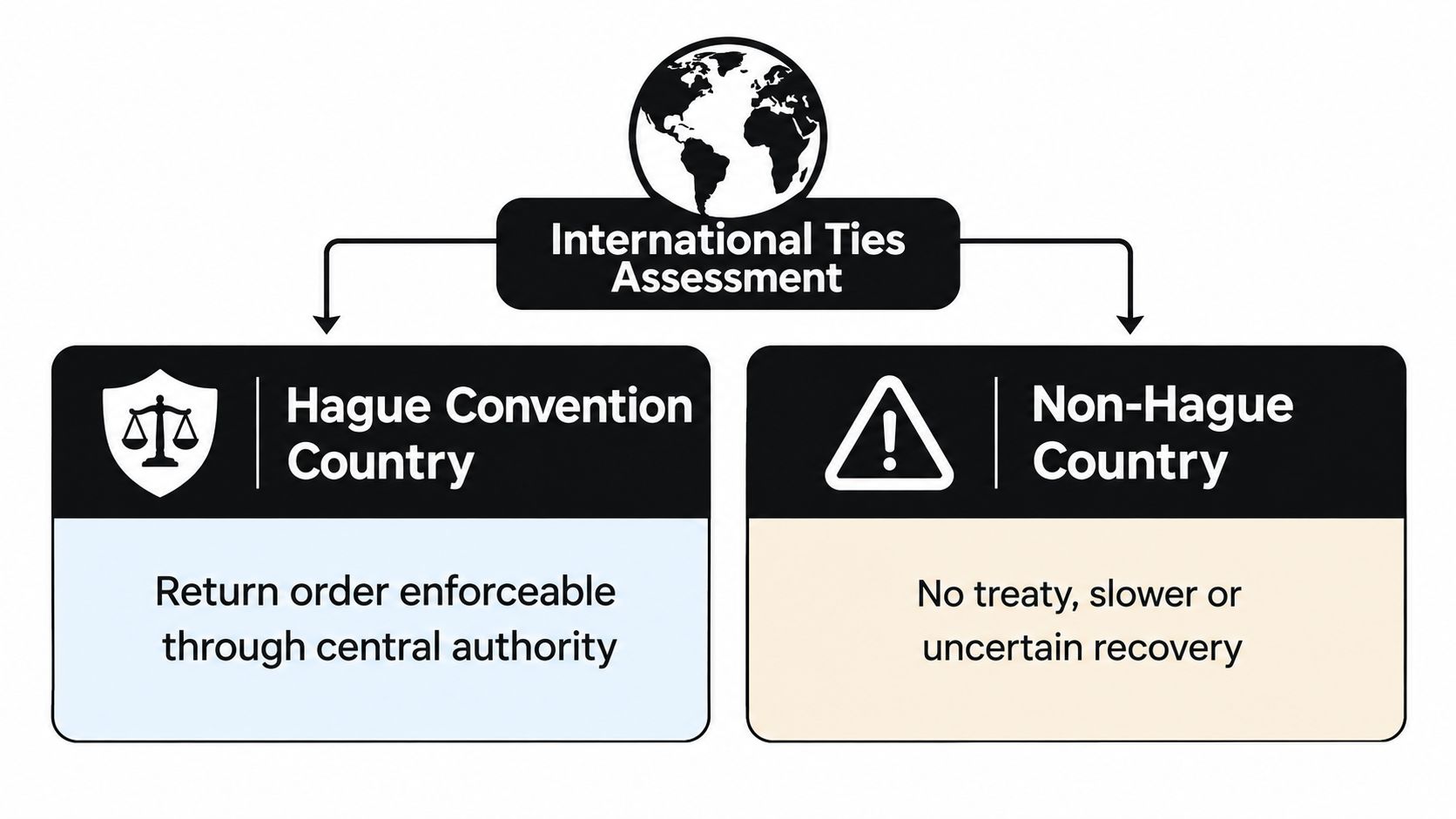
Texas law's focus reflects the fact that recovery abroad can involve unfamiliar courts, different procedures, and difficulty enforcing a Texas order. It's preventive law, not a finding that every parent with foreign ties intends harm.
Familial abduction is the central concern
A Texas legislative resolution noted that more than three-quarters of abducted children in the United States are taken by a family member, typically a parent. That context explains why Section 153.502 concentrates on custody conduct, threats, possession interference, and court-order violations rather than focusing only on stranger danger.
The statute also distinguishes between genuine removal planning and actions connected to fleeing family violence. A parent seeking safety from abuse shouldn't automatically be labeled an abduction risk just because they need support from relatives elsewhere. The facts, timing, and purpose of the conduct matter.
For parents considering travel or relocation, traveling out of the country with a child during a Texas custody case can raise questions about notice, court orders, and legal protection. Families may also benefit from reviewing bond conditions explained for families when separate immigration or release conditions affect travel decisions.
Practical Steps to Protect Your Child and Your Rights
Fear becomes more useful when you turn it into organized evidence and a specific legal request. Whether you're a mother, father, grandparent, or caregiver, avoid confronting the other parent in a way that could escalate the conflict or create new allegations. Preserve facts and speak with a Texas family law attorney promptly.

Build an evidence file
Create a dated record with documents that show conduct rather than conclusions.
- Save communications: Keep complete texts, emails, voicemails, and social media messages involving threats, travel, concealment, or refusal to return the child.
- Record possession problems: Note missed exchanges, unexplained delays, unauthorized retention, and efforts to prevent your access.
- Preserve travel clues: Keep copies of travel notices, ticket information, passport communications, visa references, and statements about leaving.
- Identify witnesses: List relatives, teachers, caregivers, or others who personally observed relevant conduct.
- Protect originals: Store copies securely and avoid altering screenshots or deleting surrounding messages.
Parents should also gather the current custody order, school information, contact details, and any prior enforcement filings. A clear timeline helps your attorney connect individual events to the statutory factors.
A lawyer may ask the court for temporary relief, a temporary restraining order, or an emergency ex parte custody order when the circumstances are urgent. Texas courts can consider restrictions involving possession, travel, passports, communication, and other safeguards, depending on the evidence and requested relief. The court's order must be specific enough for both parents and law enforcement to understand what it requires.
This video provides additional educational context about custody concerns and protective court action:
Ask for protections that match the risk
A broad request to “stop the other parent” may be less persuasive than targeted protections tied to documented facts. Depending on the circumstances, a parenting plan may address:
- Passport control: Identify who may hold the child's passport and whether either parent may apply for travel documents.
- Advance notice: Require written travel details, dates, destination, lodging, and emergency contact information.
- Geographic limits: Define where the child may live and where possession may occur.
- Supervised possession: Use supervision when violence, concealment, or immediate safety concerns justify it.
- Communication safeguards: Require regular contact with the child during authorized travel.
- Return requirements: Set clear deadlines and documentation for returning the child.
If the danger is immediate, ask counsel about an emergency ex parte custody order in Texas. Don't wait for a child to cross an international border before seeking advice. Prevention is usually more practical than trying to enforce a custody order after removal.
Separating Genuine Risk from High-Conflict Disputes
A parent's nationality, language, religion, cultural identity, or family abroad doesn't prove an abduction plan. Nor does a request to relocate for family support automatically show that the parent intends to cut off the other parent. Treating those facts as decisive can unfairly punish parents who maintain meaningful international relationships.
The stronger indicators are behavioral. Research on parental abduction profiles identifies threats, prior hiding, visitation interference, and distrust between parents as more meaningful concerns than nationality alone. Texas law reflects that distinction by requiring credible evidence of an initial risk factor before the court weighs foreign ties under the second stage.
A relocation request can still affect the child's best interests. The court may need to consider how the move would affect school, stability, daily care, and the child's relationship with both parents. But a parent who openly proposes a move, provides a parenting plan, and accepts court review is presenting a different situation from one who secretly prepares to leave.
Family violence requires careful attention
A parent fleeing family violence may need to leave quickly or seek help from relatives outside Texas. The law's treatment of planning connected to escape from violence is an important safeguard. Courts should distinguish protective action from a plan to wrongfully remove a child.
A cross-border connection may explain a parent's support system. It doesn't, by itself, establish an intention to abduct.
Parents should present the full context, including abuse records, safety concerns, proposed safeguards, and willingness to preserve the child's relationship with the other parent when safe. Overstating allegations can damage credibility, while minimizing real threats can leave a child exposed.
Next Steps for Securing Your Family's Future
Section 153.502 gives Texas courts a practical framework for evaluating family code 153.502 abduction risk factors in Texas custody cases. The first question is whether credible evidence supports a behavioral risk, such as concealment, threats, preparation, violence, or court-order violations. The second question concerns international ties, Hague Convention compliance, and the parent's connection to the United States.
Your next step should be organized and prompt. Preserve complete communications, create a timeline, collect the current orders, and identify the specific protection you need. If you're responding to an accusation, gather evidence showing consistent compliance, transparent travel plans, stable Texas ties, and your willingness to follow a detailed parenting plan.
A custody order can address more than who has the child on a particular day. Texas possession schedules may include precise dates and times, such as alternating spring-break periods under the standard possession order for parents who live 100 miles or less apart. Clear language can reduce conflict and make enforcement more practical.
You don't have to face these questions alone. A Texas family law attorney can help you evaluate whether the facts support emergency action, prepare evidence, and request safeguards that protect your child without unnecessarily damaging a healthy parent-child relationship.
If you need help with a child custody or visitation case in Texas, The Law Office of Bryan Fagan, PLLC can help you evaluate abduction concerns, emergency orders, travel restrictions, and parenting-plan protections. Contact the firm to schedule a free consultation and receive guidance that fits your family's circumstances.