
When your child's future is on the line, even a simple pickup can feel overwhelming. You may be trying to follow a possession order while avoiding conflict, managing work, and making sure your child gets safely from one parent to the other. The phrase “designated competent adult” can offer a practical solution, but only if you understand what the order and Texas law permit.
The focus of this guide is Family Code 153.014 designated competent adult possession, including how exchange facilities work, how the rule connects with Texas possession orders, and what parents should do when school, daycare, or the other parent creates an obstacle. This information is educational and doesn't replace advice about your specific order.
When Exchanges Become a Heavy Burden
At 5:45 p.m., a parent pulls into a gas station parking lot with the child already buckled into the car seat. The other parent is late again, texting while driving toward the meeting place. The child notices the tension. The parent holding the steering wheel wonders whether the exchange will be peaceful or become another argument in public.
These moments often continue long after the divorce papers are signed. A schedule can look orderly on paper, yet the actual transfer may involve traffic, work shifts, school dismissal, daycare rules, and difficult communication. For some families, the handoff itself becomes the most stressful part of possession.

Texas law provides tools that can make these transfers more structured. Under Texas Family Code § 153.014, a county may establish a visitation center or visitation exchange facility to facilitate court-ordered possession of or access to a child. A neutral location can reduce the need for parents to meet face to face, particularly when direct exchanges repeatedly lead to conflict.
A separate mechanism commonly appears in possession orders. Under Texas Family Code § 153.316(b)(6), either parent may designate a competent adult to pick up and return the child, and either a parent or the designated adult must be physically present at each exchange.
Practical point: A designated adult usually helps with the transfer. That person doesn't automatically receive the parent's entire possession period or gain authority to make custody decisions.
The details matter. A parent may have the right to choose a trusted adult, but a case-specific order may impose narrower rules. The child's school or daycare may also require separate authorization. Reading the decree carefully is the first step toward using these protections safely.
What Texas Family Code § 153.014 Actually Says
Section 153.014 is titled “Visitation Centers and Visitation Exchange Facilities.” It belongs to Chapter 153, which addresses conservatorship, possession, and access to children. In plain English, the statute lets a county create a structured location where court-ordered possession or access can begin, end, or be exchanged.
That purpose is narrower than awarding custody. Section 153.014 doesn't create a possession schedule by itself, and it doesn't tell a judge which parent should have the child on a particular day. Instead, it supports the practical operation of an existing court order when a neutral or supervised setting is needed.
The terms parents often confuse
A possession schedule answers when a parent may have the child. Possession is the period of physical time with the child, while access generally refers to contact or involvement that may not involve physical possession. Conservatorship concerns legal rights and duties, such as decision-making authority.
The designated-adult language addresses the transfer. The parent remains the person exercising possession under the order, while a selected adult handles pickup or return if the order permits it. Texas guidance also explains that case-specific language can override the standard mechanism, so parents must compare the decree with the general statute. Texas Law Help's discussion of visitation by nonparents is useful because it highlights the difference between helping with an exchange and having an independent right to visitation.
A Texas Child Custody Lawyer may assist with conservatorship, possession, and access matters under Chapter 153 when the wording of an order creates uncertainty.
Section 153.014 also doesn't supply a complete checklist for every exchange. It doesn't spell out how often a designation may be used or how long an exchange arrangement lasts. Those practical details usually come from the possession order, another court provision, or a written agreement that complies with the order.
Who Counts as a Designated Competent Adult
Texas law doesn't require the designee to be a relative. Depending on the order and the circumstances, a trusted friend, neighbor, stepparent, grandparent, or another responsible adult may be considered. The parent exercising the applicable possession right chooses the person, but the other parent should receive clear notice of who will arrive.
“Competent” is best understood as a practical safety standard. The adult should be mentally capable, sober, able to transport the child safely, and able to follow the order's instructions. The person also needs to understand that the role is limited to the authorized transfer unless the court order says more.
A practical screening table
| Usually Acceptable | Usually Disqualifying |
|---|---|
| A trusted grandparent who can safely transport the child and follow the order | A person subject to an active protective order that conflicts with the exchange |
| A responsible neighbor or family friend identified by name in advance | A person facing a pending felony charge involving violence or child endangerment |
| A stepparent who can communicate calmly and remain physically present | A person listed on the sex offender registry |
| An adult caregiver who understands the pickup and return instructions | A person who is impaired, unable to supervise the transfer, or unwilling to follow the order |
These categories are practical caution points, not a substitute for a judge's ruling. Available Texas materials quote the competent-adult rule but don't provide a complete statewide screening test for age, intoxication, financial responsibility, or every possible safety concern. That uncertainty is one reason a parent should choose conservatively and preserve information showing why the designee is reliable.
The safest choice is an adult who can make the exchange uneventful, not someone selected to send a message to the other parent.
The other parent may object. An objection alone doesn't necessarily cancel the designation, but a parent can ask the court to address a genuine safety issue or clarify whether a proposed adult is permitted. Don't use a designee to provoke conflict, bypass a restriction, or turn a routine handoff into a larger custody dispute.
Grandparents and other nonparents also need to understand the distinction between exchange assistance and visitation rights. As Texas guidance explains, a nonparent generally doesn't receive independent visitation because the person is helping with pickup or return. The authority comes from the parent's order and the limited exchange function, not from a new custody status.
How § 153.014 Works with Standard Possession Orders
The Standard Possession Order, often called the SPO, gives many Texas families a baseline schedule. For children age three or older, and when parents live 100 miles or less apart, the typical framework includes the first, third, and fifth weekends of each month, a Thursday visit during the school term, and about 30 days in summer, as described in Texas possession schedule guidance.
That schedule answers when possession occurs. The competent-adult provision answers who may handle pickup and return during that possession period. It doesn't transform the designee into a conservator, and it doesn't change which parent has the right to exercise the scheduled time.
Default language versus tailored language
Texas Family Code § 153.316(b)(6) permits either parent to designate a competent adult for pickup and return, with a parent or competent adult physically present at each exchange. Yet courts can adopt language that is more specific. An order may require advance notice, identify an approved exchange location, prohibit a particular person, or require a supervised facility.
Section 153.014 matters when the court uses a visitation center or exchange facility to make the transfer safer or more workable. A facility may be especially relevant where direct contact creates conflict, but the facility doesn't replace the underlying order. The parent still needs to follow the possession periods, notice provisions, and restrictions in the decree.
| Issue | § 153.014 Default | Typical Order Language |
|---|---|---|
| Exchange location | Supports a county visitation center or exchange facility | Names a specific neutral or supervised location |
| Designated adult | Works with the exchange process permitted by the order | Requires written notice, identification, or advance approval |
| Possession time | Doesn't create a schedule | Lists weekends, holidays, school breaks, or summer periods |
| Safety limits | Allows structure around court-ordered access | Prohibits named individuals or requires supervision |
| Conflicting terms | General statutory framework applies only to the extent consistent with the order | Case-specific restrictions control the exchange |
Parents should read the decree, any modification, and later enforcement or clarification orders together. A helpful explanation of the schedule itself appears in the Texas Standard Possession Order resource. The key question isn't just whether Texas law mentions a competent adult. It's whether your signed order permits that arrangement under the exact circumstances you're facing.
A 2025 Texas appellate opinion illustrates why wording matters. The court treated supervision and designated-adult exchange language as enforceable order terms, showing that these clauses aren't merely casual suggestions in a parenting conversation. The appellate opinion also reflects the continuing importance of reading the actual order rather than relying on a general summary.
How to Document or Request a Designated Competent Adult
A parent who wants to use a designated adult should make the arrangement easy to verify. Clear documentation protects both parents and helps a judge understand what happened if a disagreement later reaches court.
Start with the signed order
Read every provision addressing pickup, return, transportation, supervision, notice, and exchange locations. Check whether the order names a particular facility, limits who may transport the child, or requires notice before a third party appears.
Then evaluate the proposed adult. Ask whether the person can arrive on time, safely transport the child, communicate respectfully, and comply with every restriction. If the person has a history that creates a real safety question, choose someone else or seek legal guidance before making the designation.
Put the notice in writing
A text message, email, or parenting-app message can identify the adult and preserve the timing of the notice. Use the person's full name, relationship to the child, telephone number, and the date and location of the exchange. If a school or daycare will release the child, provide that information to the facility through its required authorization process.
A useful message might say:
“For the scheduled possession exchange on [date], [full name], my [relationship], will pick up the child at [location] and return the child at [location]. [Name] can be reached at [telephone number].”
Don't describe the person only as “my sister” or “a friend.” The other parent and the child's caregivers need to know exactly who will arrive.
Seek a court remedy when cooperation fails
If the other parent refuses a designation that appears to comply with the order, keep the messages, exchange logs, and any witness information. A parent may need to file a motion to clarify or enforce in the local district court. An attorney can help decide whether the facts support enforcement, clarification, modification, or temporary relief.
Parents sometimes also ask about a right of first refusal, which is a separate concept from a pickup designee. It may affect whether a parent must be offered care before another caregiver is used, so review the order carefully and consider how right of first refusal can work in Texas custody orders.
Sample language to discuss with counsel could read:
“Each conservator may designate a competent adult in writing at least 24 hours before each exchange. The designee shall present identification at pickup.”
That language is only a drafting starting point. Any agreed change should be reduced to a written order signed by the judge. A verbal understanding may help the parents cooperate, but it doesn't reliably replace the existing decree.
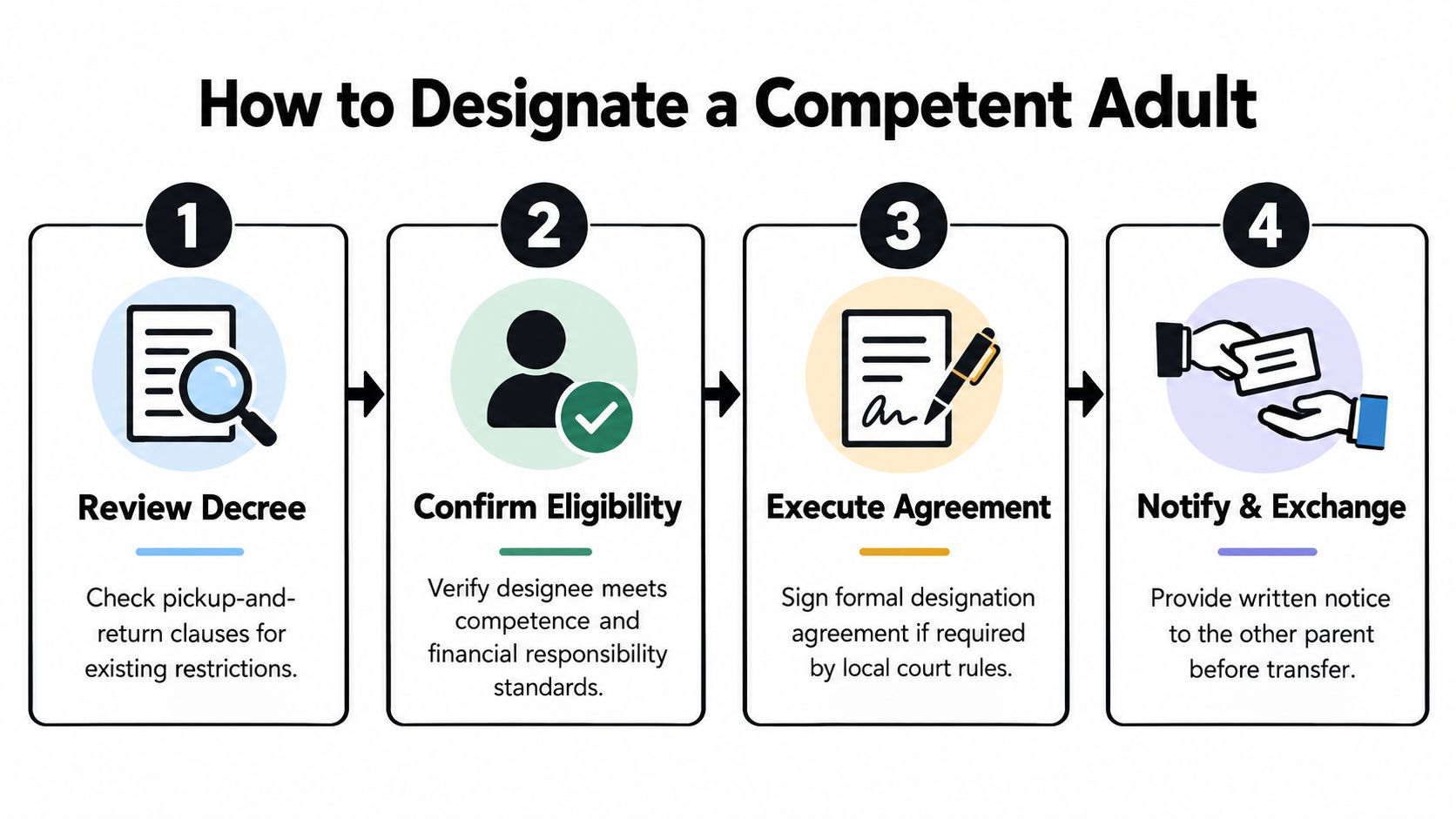
A short visual process can help a parent organize the paperwork before speaking with counsel.
Common Pitfalls and Enforcement Problems
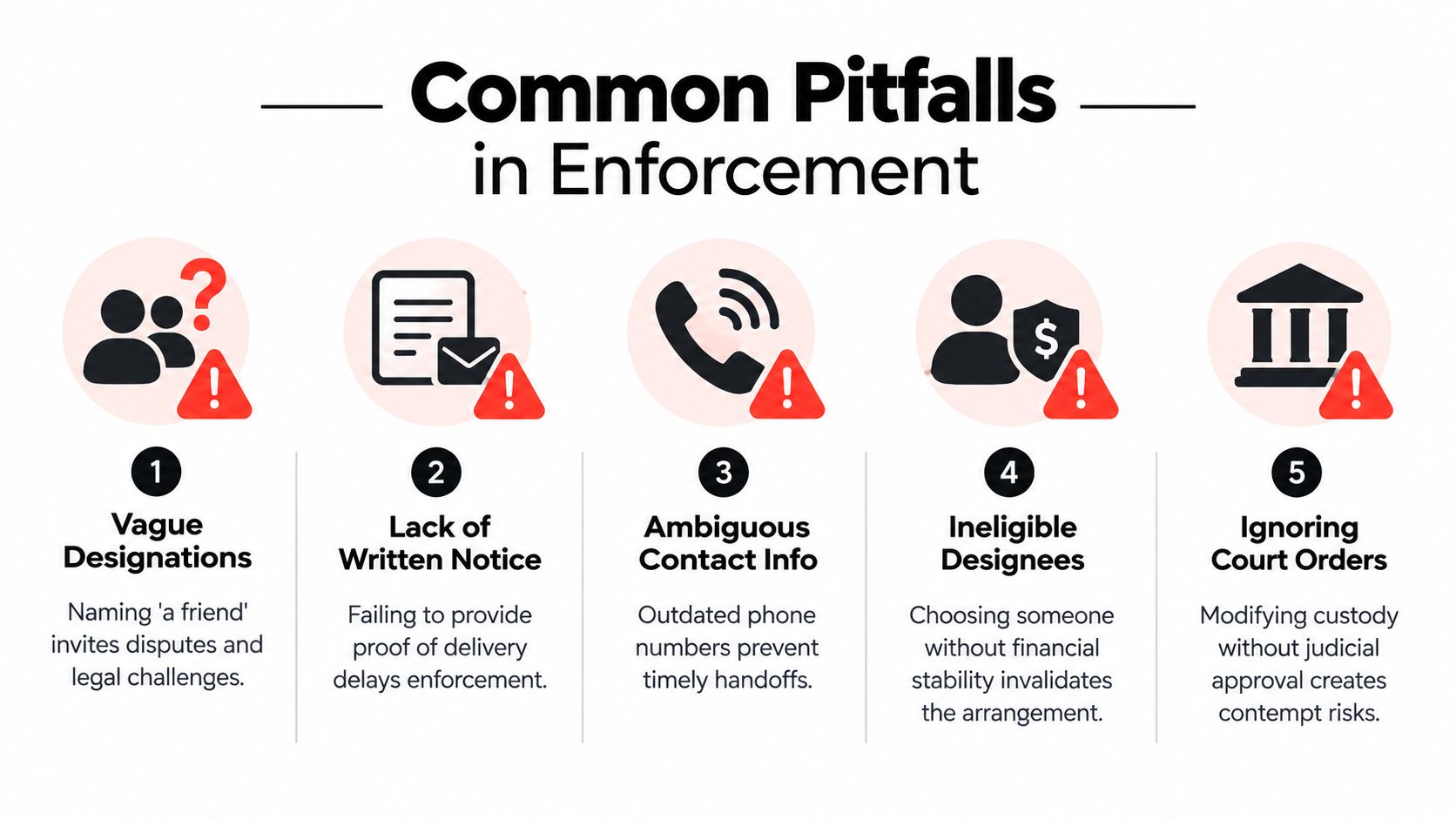
A designation can fail even when the parent has good intentions. The most common problem is a vague notice. “My brother will get her” leaves open which brother, when he will arrive, how the other parent can reach him, and whether the school knows he is authorized.
Another problem is choosing someone who cannot safely perform the task. A minor sibling, an impaired relative, or an adult who refuses to follow the order may create a serious dispute. A parent shouldn't treat the competent-adult provision as a way to send anyone who happens to be available.
Where real-world exchanges break down
- Vague designations: Identify the adult by full name and provide reliable contact information.
- School and daycare barriers: A facility may refuse release to someone absent from its authorized-pickup roster, even when the custody order permits the transfer.
- Safety objections: The other parent may raise concerns about impairment, violence, child endangerment, or a protective order. Preserve the facts instead of responding with threats.
- Unauthorized delegation: A designee may transport the child, but that doesn't automatically authorize medical, educational, or long-term custody decisions.
- Order violations: A designee can't be used to defeat a geographic limit, supervised-exchange requirement, or protective restriction.
School and daycare handoffs deserve special care because private facility policies and court orders operate differently. A judge may authorize a competent adult, while the facility still requires identification, written authorization, or a completed pickup form. Handle those requirements before the exchange date rather than waiting at dismissal.
A court order governs the parents' legal duties, but a school or daycare still needs enough information to identify the authorized adult safely.
When a parent refuses a lawful handoff, the court may consider an enforcement motion. Depending on the facts and the requested relief, possible remedies can include makeup possession, clarification of the order, contempt, or a change in conservatorship. Those outcomes depend on the wording of the order, proof of notice, and the seriousness of the conduct. A parent dealing with a supervised setting can review Texas supervised visitation information before deciding whether a neutral facility should be requested.
Document every incident with dates, times, messages, location details, witnesses, and reports from the school or daycare. Avoid argumentative messages. Calm records usually explain the problem more clearly than a long exchange of accusations.
When to Call a Texas Family Law Attorney
Self-help may be enough when both parents agree, the order is clear, and the school or daycare accepts the authorization. Legal advice becomes more important when the same issue keeps returning or when an objection affects the child's time with a parent.
Consider speaking with a Texas family law attorney if:
- Exchanges are repeatedly refused: The other parent blocks the designee even after receiving clear written notice.
- A facility rejects the arrangement: School or daycare staff say their policy conflicts with the custody order.
- Competence claims become a weapon: A parent makes general accusations without identifying a specific safety concern.
- Relocation is involved: A move may affect transportation, exchange locations, distance limits, and the existing schedule.
- A SAPCR modification is pending: A modification case may require updated language instead of an informal workaround.
- Immediate safety concerns exist: Protective-order issues or allegations involving violence or child endangerment call for prompt legal attention.
Bring your signed order, later orders, messages, exchange logs, school or daycare communications, incident reports, and witness names to the consultation. These records help counsel distinguish a simple misunderstanding from a pattern that may support enforcement or modification.
A motion to enforce generally asks the court to address a violation of an existing order. A motion to modify asks the court to change the order because the current arrangement no longer serves the child's best interests or because legally recognized circumstances support a change. Temporary orders may be appropriate when the family needs immediate structure while a larger case is pending.
Texas courts apply the best interest of the child standard. That means the focus is the child's stability, safety, and daily needs, not which parent can make the strongest accusation. Texas guidance also explains that courts may appoint both parents as managing conservators unless the evidence supports another arrangement, while a separate possession schedule determines parenting time. Texas custody guidance from the Texas State Law Library provides a plain-language overview of that framework.
A careful attorney can review whether the order needs clearer notice rules, an approved exchange center under § 153.014, or supervised exchange provisions connected to § 153.316. The purpose isn't to escalate every disagreement. It's to protect the child, preserve a workable parent-child relationship, and create an order that families can follow in ordinary life.
The Law Office of Bryan Fagan, PLLC helps Texas parents address possession exchanges, designated competent adults, enforcement concerns, modifications, and supervised visitation arrangements. Visit Law Office of Bryan Fagan, PLLC to request a confidential review of your custody order and discuss practical options for your family. If you need help with a child custody or visitation case in Texas, our experienced attorneys can guide you every step of the way. Contact The Law Office of Bryan Fagan, PLLC today for a free consultation.