
When your child's future is on the line, understanding your rights matters most. A parent may wake up to a new job offer, a military transfer, or a family move and suddenly realize that the old every-other-weekend plan no longer works. The distance can feel overwhelming, especially when you're worried that missed exchanges will slowly weaken your relationship with your child.
Texas law provides a framework for these situations. A standard possession order over 100 miles in Texas changes the rhythm of possession to account for travel while preserving meaningful time between a child and both parents. The details matter, including written notice, election deadlines, transportation terms, holiday planning, enforcement, and possible modification.
When Texas Parents Live More Than 100 Miles Apart
A divorced father in Lubbock learns that his former wife accepted a promotion in Houston. They once lived close enough for a regular weekend rotation to work, but the move has placed their homes roughly 360 miles apart. The father is proud of her opportunity, yet he's also asking a painful question: “How am I supposed to keep seeing my child when the old schedule requires that much driving?”
That concern is common. A schedule built around frequent short visits may become exhausting when one parent must manage long drives, airfare, school calendars, luggage, and missed work. Children can also feel the strain when exchanges take up much of a weekend.
Texas Family Code Chapter 153 addresses possession and access, which are the legal terms for the time a parent spends with a child. When parents live more than 100 miles apart, the law adjusts the default schedule instead of treating the family as though the homes were nearby. The distance rule affects how possession is arranged, not whether a parent remains a parent or retains conservatorship rights.
A parent in this position may need answers about several practical issues:
- Schedule changes: What happens to first, third, and fifth weekends?
- Notice and elections: When must the possessory conservator choose a long-distance option?
- Transportation: Who picks up the child, and who pays for travel?
- Holidays and school breaks: How can parents protect important family traditions?
- Modification: What filing may be appropriate after a relocation or job change?
- Enforcement: What can a parent do when the other parent ignores the order?
You may also need a plan for phone and video contact when the child is away. A long-distance virtual possession plan can help parents think through communication expectations, but it should work alongside the written possession order rather than replace it.
Practical rule: Distance should change the logistics of parenting time, not erase the child's relationship with either parent.
The law can't remove every emotional difficulty. It can, however, give parents a predictable starting point and provide legal tools when the schedule no longer reflects real life.
What the Standard Possession Order Means
A Standard Possession Order, often called an SPO, is Texas's default parenting-time schedule in many custody cases. It commonly applies when parents are appointed Joint Managing Conservators, so both share legal rights and duties concerning the child. One parent may still have the exclusive right to determine the child's primary residence.
The labels in a custody order identify different legal functions. A Managing Conservator holds the authority the court assigns for particular decisions. A Possessory Conservator has court-ordered periods of possession and access. These titles describe responsibilities and time periods, while the child's relationship with each parent depends on the order and the parents' conduct.
Texas courts apply the best interests of the child standard. In practical terms, the judge considers an arrangement that supports the child's safety, stability, development, and continuing relationship with both parents. Gender does not determine the result. A mother or father seeking meaningful possession must connect the requested schedule to the child's needs and daily life.
The distance threshold
Texas Family Code Section 153.013 is the statutory pivot for certain distance-based possession provisions. Once the parents' primary residences are more than 100 miles apart, long-distance possession rules may govern the schedule. The mileage is measured between the parents' residences. The child's school, relatives, or a parent's workplace does not determine that threshold.
The 100-mile threshold concerns possession scheduling. It does not by itself terminate joint managing conservatorship, reduce parental rights, or establish that one parent is more fit. Its practical effect is a different default pattern for parenting time, one that must account for travel between homes.
A possession order is the broader court order establishing when and how a parent may have the child. An SPO is a standardized schedule that may be included in that order. Parents can also agree to a customized schedule, or ask the court to approve one, when standard terms do not fit the child's circumstances.
A parent reviewing an order should identify the election deadline, notice method, exchange times, transportation language, and holiday provisions. For example, a written request might say, “I elect the monthly weekend schedule under the long-distance provisions, beginning on [date].” The exact wording and timing should match the signed order and applicable law.
For parents considering a broader schedule, The Expanded Standard Possession Order in Texas explains how additional possession periods may work.
The schedule is a legal baseline. It does not set every transportation, communication, or conflict-resolution detail.
Read the final decree carefully. A parent's memory of what an SPO “usually means” may differ from the judge's signed language, and enforcement depends on that wording.
How the Schedule Changes Over 100 Miles Apart
When parents live more than 100 miles apart, Texas law shifts possession from frequent short visits toward longer, more workable periods. The verified statutory framework provides that the possessory conservator may keep the default first, third, and fifth weekend pattern or elect one weekend per month with 14 days' written or telephonic notice. The election must be made within 90 days after the parents begin living more than 100 miles apart, as described by the Texas Attorney General's parenting-time guidance.
The written order may also address how a weekend begins and ends. For example, parents may need language that permits a longer weekend from the child's school dismissal through the return deadline, but the exact terms must come from the order or a later written agreement. Don't assume that a long-distance schedule automatically authorizes a different exchange time.
School breaks and summer possession
The long-distance framework increases uninterrupted time during school breaks. Texas law gives the possessory conservator spring break every year and an extended summer period of up to 42 days, as reflected in Texas Family Code Section 153.313 and Section 153.313 of the Texas Family Code.
The practical tradeoff is straightforward. The child may have fewer school-year handoffs, but each visit can last longer. That can make airfare, long drives, and multi-day travel more manageable while giving the parent enough time to settle into a normal routine instead of spending most of the visit in transit.
The law also uses notice and election procedures for certain schedule choices. Parents should review the exact order for the required delivery method and annual deadlines. The plan notes for this topic identify April 1 as the yearly written-election deadline under Section 153.313. Because a missed deadline can affect which default applies, a parent should preserve proof that notice was sent and received.
| Possession Period | Frequency or Length | Election Deadline | Governing Statute |
|---|---|---|---|
| Regular weekends | First, third, and fifth weekends, or an elected one-weekend-per-month pattern | Within 90 days after the residences become more than 100 miles apart for the initial election | Texas Family Code Chapter 153, including Section 153.013 |
| Spring break | Every year for the possessory conservator under the long-distance framework | Review the signed order for notice terms | Section 153.313 |
| Summer | Up to 42 days, with the order controlling the details | April 1 for the annual written election identified in the governing provision | Section 153.313 |
| Weekday possession | Often becomes impractical when the homes are far apart | Controlled by the order or written agreement | Texas Family Code Chapter 153 |
Weekday possession under the nearby-distance framework may no longer be workable when a child must travel across the state. That doesn't mean parents should stop communicating. It means they may need to replace a short weekday exchange with reliable calls, school-break blocks, or another arrangement that a court can clearly enforce.
Comparing the Under-100-Mile and Over-100-Mile Schedules
The easiest way to understand the difference is to compare the rhythm of the two schedules. Within the shorter-distance framework, the SPO is designed for more frequent but shorter contact. When the homes are farther apart, the structure shifts toward less frequent but longer possession.
| Possession Element | Under 100 Miles | Over 100 Miles |
|---|---|---|
| Weekday time | A recurring weekday period may fit the school-week routine | Midweek exchanges may disappear or become impractical because of travel |
| Regular weekends | First, third, and fifth weekends, often with a Thursday overnight | The possessory conservator may retain that pattern or elect one weekend per month with required notice |
| Spring break | Allocated according to the applicable holiday rotation | The possessory conservator receives spring break every year under the long-distance rule |
| Summer | A shorter summer arrangement applies | The possessory conservator may receive up to 42 days |
| Travel burden | Exchanges can often occur by car within the region | Airfare, long drives, meeting points, and travel-day contingencies become central |
Holiday provisions deserve careful attention. Thanksgiving and Christmas may rotate according to the possession order, while spring break receives a distinct long-distance treatment. A parent shouldn't rely on a general understanding of “alternating holidays” without checking the actual decree, because holiday periods may have their own start and return times.
The same Standard Possession Order can feel completely different depending on geography. A Thursday overnight may support a child's routine when both homes are nearby. The same overnight may be unreasonable when the child must travel a substantial distance before school the next morning.
For mothers, the long-distance schedule can protect school stability while preserving extended time with the other parent. For fathers, it can provide longer blocks of meaningful parenting time instead of reducing the relationship to rushed weekends. The court's focus remains the child's best interests, not which parent makes the longer trip.
Travel, Transportation, and Practical Logistics
A possession order may say when parenting time occurs without fully resolving how the child gets from one home to the other. Parents should address that gap before the first long-distance exchange, preferably through clear language in the order or a written agreement that supplements it where legally appropriate.
Decide the exchange details
Start with the basics:
- Pickup and return: Identify which parent picks up the child and which parent returns the child.
- Meeting location: Name a neutral exchange point, airport, school, or other specific location.
- Travel companion: State whether the child may travel with a parent, approved adult, or airline service.
- Delay procedure: Explain how parents will communicate about cancellations, weather, illness, or missed connections.
- Documents and belongings: Identify who keeps passports, identification, medication, school materials, and essential clothing.
Cost allocation is another important decision. Parents may agree to divide fuel, airfare, or mileage equally, or assign travel expenses to the parent who is exercising possession or making the move. There's no universal arrangement that fits every family. Work schedules, income, the reason for the relocation, and the child's needs can all affect what is practical.
Before signing: A transportation clause should answer who travels, where the exchange occurs, when notice is required, and what happens when the original plan fails.
Section 153.313's written-notice rules require attention to both timing and delivery. If the possessory conservator must make an election by April 1, send a clear notice identifying the requested periods and use a delivery method that creates a reliable record. Keep the message, attachments, and proof of delivery.
Make travel days child-centered
Long-distance parenting works better when the child's emotional needs receive as much attention as the itinerary. A short video call during a travel day can reassure the child and help the parent know whether the trip is proceeding smoothly. Sending school items and favorite belongings ahead of time may also prevent avoidable stress.
Keep a transportation log. Record departure and return times, exchange locations, missed connections, receipts, and communications about delays. If a dispute later requires enforcement, a calm, contemporaneous record is more useful than a collection of angry messages written after the conflict.
Parents dealing with difficult exchanges may also benefit from learning how a custody X-ray exchange in Texas works. The right exchange process depends on the wording of the order and the family's safety needs.
Special Situations for Military Families, Relocation, and Grandparents
A military parent may be stationed near San Antonio, assigned temporarily to another state, or deployed overseas. The ordinary long-distance schedule may not match the parent's actual availability, but deployment doesn't automatically end the parent's relationship with the child. A court may need to consider makeup possession, communication during separation, and a schedule that becomes active when the service member returns.
Military families should review both the possession order and protections that may apply under the Servicemembers Civil Relief Act. Those protections can affect court proceedings involving an absent service member. Texas law also contains family-law provisions addressing military circumstances. The specific effect depends on the case, the order, and the service member's duties, so parents should obtain advice before assuming a deployment changes possession automatically.
Relocation can change the legal picture
A parent who accepts a job in another city should provide the notice required by the existing order and evaluate whether a modification is needed. A move that increases or decreases the distance between homes may make the current schedule unworkable, even if the parent's reason for moving is legitimate.
The court's review centers on the child's best interests and the material facts surrounding the move. Relevant issues may include school continuity, travel responsibilities, the child's relationship with each parent, the reason for the relocation, and whether a revised schedule can preserve meaningful contact.
A grandparent's situation is different. Chapter 153 addresses grandparent access and possession, but a grandparent doesn't automatically receive the same possession rights as a parent. A fit parent's objection can create a higher legal barrier, and the court must apply the statutory requirements rather than deciding that grandparent contact would be pleasant or beneficial.
For families facing a high-conflict custody dispute, the discussion of Gonzalez & Waddington high stakes custody offers additional context about the seriousness of preparing evidence and responding carefully when allegations affect possession.
The long-distance rules provide a dependable starting point, but military service, relocation, and grandparent relationships may require a custom order. Parents should ask for language that reflects the actual family calendar instead of hoping a generic schedule will solve an unusual situation.
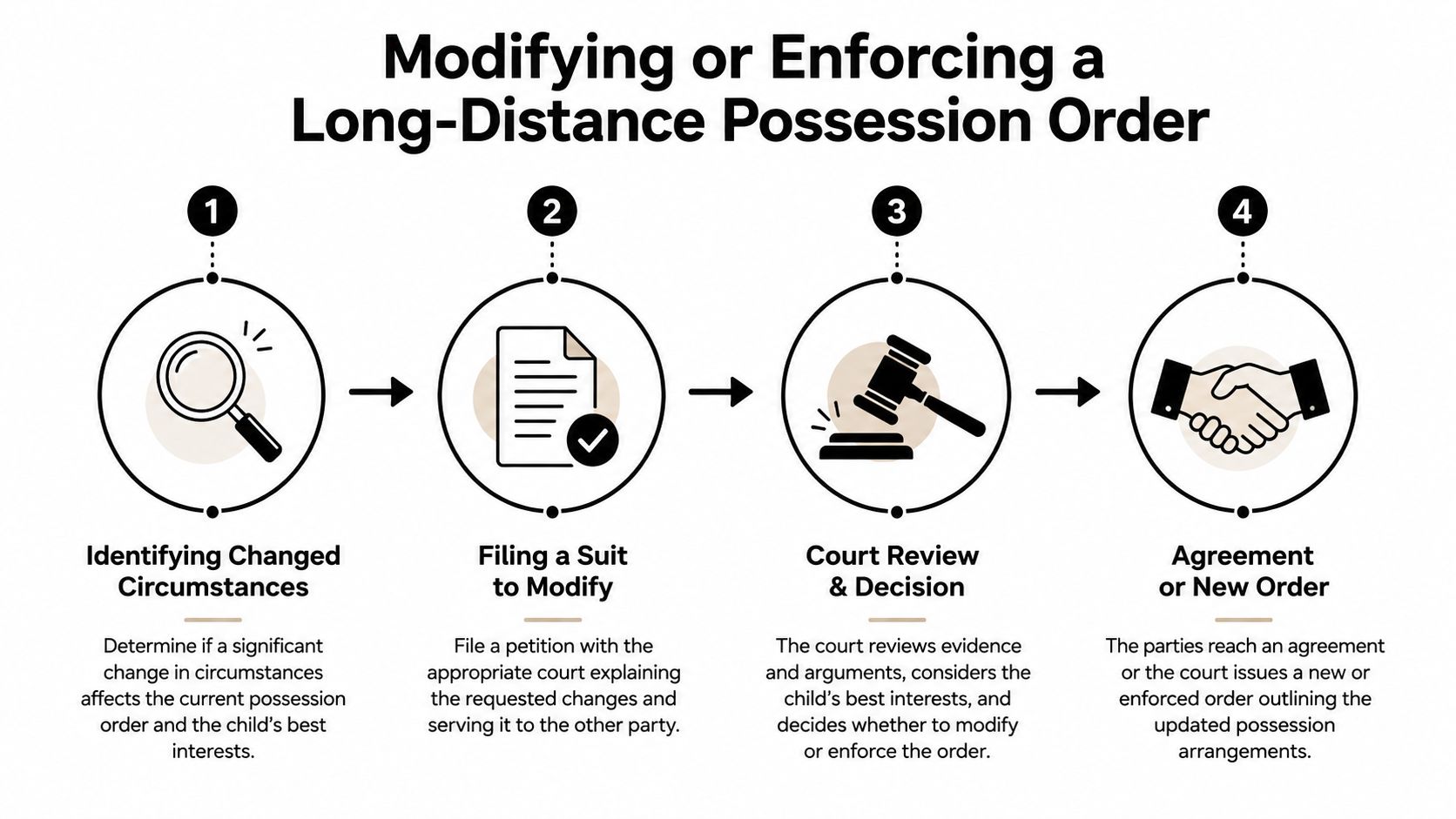
Modifying or Enforcing a Long-Distance Possession Order
Parents usually face one of two problems. The existing order no longer fits the family's circumstances, or the other parent is refusing to follow it. Texas law treats those problems differently.
A Suit to Modify the Parent-Child Relationship under Chapter 156 asks the court to change the order. The parent generally must show a material and substantial change in circumstances since the last order and show that the requested change serves the child's best interests. Examples may include a confirmed relocation, a new job that changes available possession windows, or the child's evolving educational or medical needs.
A Motion to Enforce asks the court to address a willful violation of the existing order. Examples can include refusing to return a child after summer possession, denying court-ordered communication, or ignoring a transportation duty. The motion should identify each violation separately, include dates, and attach texts, emails, travel records, or other supporting material.
Build the filing around facts
A modification filing may include a petition, an order setting a hearing, and a proposed amended possession order. A proposed order should address the new geography, exchange locations, notice procedures, school breaks, holiday periods, and transportation costs.
An enforcement motion should be specific. Sample language might read:
“Respondent violated the possession order by failing to make the child available at the ordered exchange location on the date and time stated in the order. Petitioner requests enforcement, appropriate makeup possession under the applicable Texas Family Code provision, and any other relief authorized by law.”
Don't copy that sentence blindly. The motion must match the signed order and the facts you can prove. Parents may also request makeup possession under Section 153.315 when the statute and circumstances support it, along with attorney's fees where appropriate.
The case generally returns to the district court that issued the original order. A temporary-orders hearing may be requested while the case proceeds, but timing varies by court and case conditions. Continue following the existing order until a judge signs a new one or the parents enter an enforceable written agreement.
For a focused discussion of choosing between enforcement and clarification, review enforcement versus clarification in Texas custody orders.
The most useful preparation is often quiet and consistent: keep a journal, preserve messages, save receipts, calendar deadlines, and avoid inflammatory communications. A court needs organized evidence, not just a record that both parents were angry.
Key Takeaways, Next Steps, and Common Questions
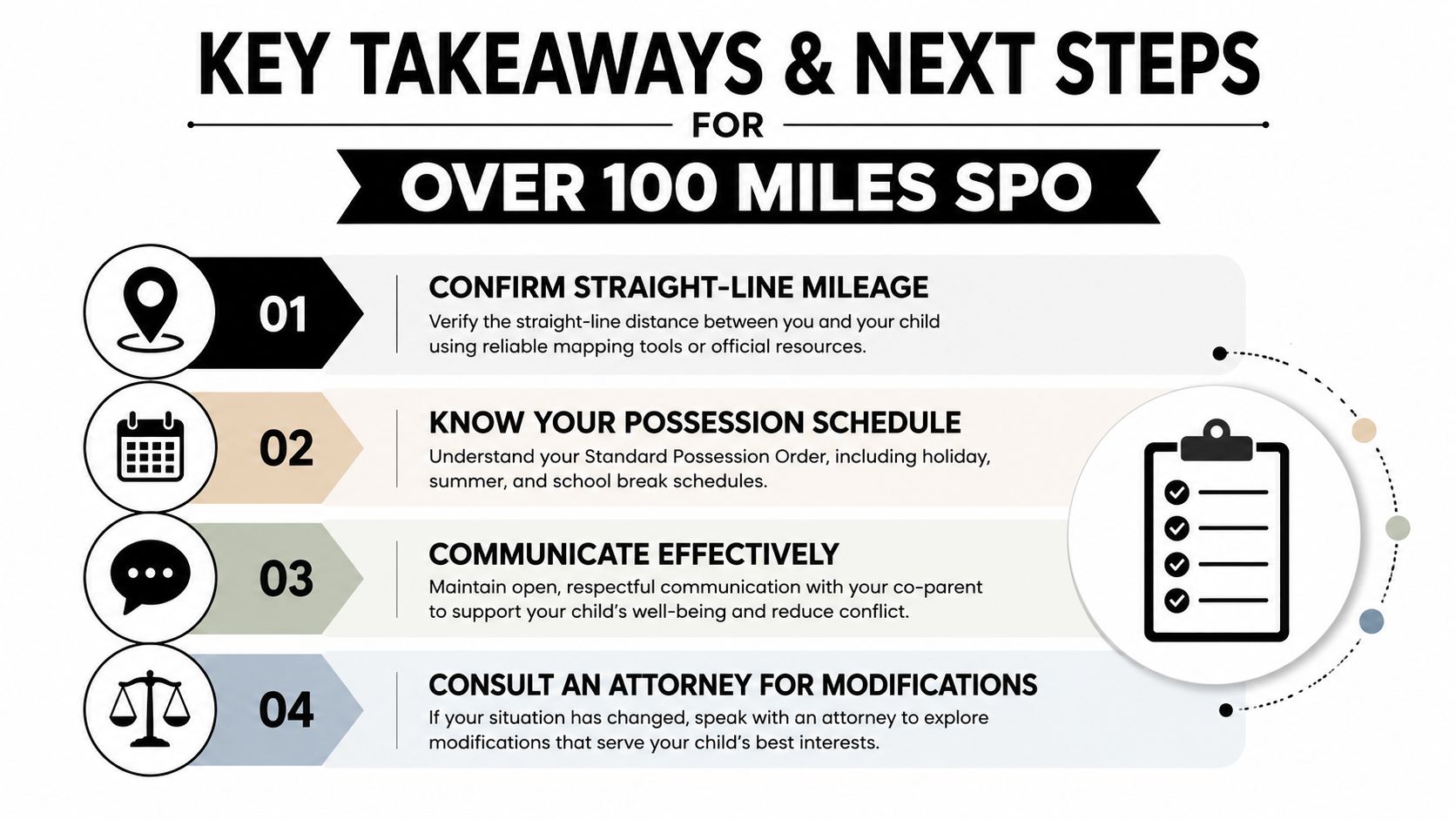
Long-distance possession becomes easier to manage when parents turn broad concerns into specific decisions. Confirm the mileage between the parents' primary residences, read the signed order, calendar every notice deadline, and put transportation terms in writing.
A practical checklist
- Confirm the distance: Determine whether the residences fall within the statutory distance category used by the order.
- Review the election language: Identify whether the possessory conservator must choose a weekend pattern or another long-distance option.
- Protect notice records: Send written notice clearly and preserve proof of delivery.
- Plan the exchange: Name the location, responsible parent, travel method, and delay procedure.
- Save evidence: Keep messages, receipts, school calendars, and a possession log if disputes arise.
- Seek modification when needed: Gather documents showing the change instead of relying only on oral testimony.
Common questions
Can a parent trade the 42-day summer period for longer holiday time?
Parents may agree to a different arrangement if the agreement is legally effective and protects the child's interests. A parent shouldn't assume that an informal text exchange permanently changes the court order. Put any important agreement in writing and obtain legal guidance when the change affects recurring possession rights.
What happens if a temporary work assignment pushes a parent beyond the distance threshold?
A temporary assignment may create practical problems without permanently changing the legal residence or order. The answer depends on the order's language, the assignment's duration, the child's schedule, and whether the parents can agree on temporary terms. If the assignment makes compliance impossible, seek a written agreement or court relief rather than missing possession.
Can a stepparent pick up or drop off the child?
A stepparent may be able to assist with transportation when the order doesn't prohibit it and the arrangement is safe and workable. The parents should clarify this in writing, especially if the order requires a particular person to conduct an exchange or if the other parent objects.
What if one parent blocks phone or video contact?
Document the missed calls, requested times, and responses. If communication is part of the order, repeated denial may support enforcement. Ask the court for a clear communication provision if the existing language is too vague to enforce.
You don't have to solve a long-distance custody problem alone. A careful review can reveal whether the current order already answers your question, whether a written election is needed, or whether modification and enforcement are better options.
If you need help with a child custody or visitation case in Texas, our experienced attorneys can guide you every step of the way. Contact The Law Office of Bryan Fagan, PLLC today for a free consultation. Visit Law Office of Bryan Fagan, PLLC to discuss a long-distance possession order, transportation dispute, modification, or enforcement concern with a Texas family law team.